Kidney disease can change how your dentist plans an implant. Some people with chronic kidney disease (CKD) can have implants after an individual assessment. If you are on dialysis, have had a transplant or have kidney-related bone problems, your dentist may need to coordinate with your renal team before offering surgery. Your current health, the condition of your mouth and your ability to keep the implant clean all matter. [1–3]
What kidney disease can change
A dental implant is placed in the jawbone. The bone needs to heal around the implant before it can reliably support a replacement tooth. Advanced CKD can affect how the body regulates calcium and phosphate and how bone remodels. The degree varies between patients. A dentist looks at the bone available at the planned site as well as relevant information from the renal team. A scan can show local anatomy and bone volume, while the medical assessment helps explain how well your body may heal. [2,3]
Bleeding, infection and medicine choices also need attention. Dialysis may involve anticoagulation, while some transplant medicines suppress the immune system. Other factors, such as diabetes, anaemia, smoking and active gum disease, may matter alongside the kidney diagnosis. Two people with the same CKD stage may reasonably receive different plans. [1–3]
Research on implant outcomes in advanced CKD, dialysis and transplant recipients is limited. Small reports of successful implants help show that treatment can be possible. Ask how directly that evidence applies to your health, the proposed surgery and the likely maintenance burden. [2]
What to bring to your consultation
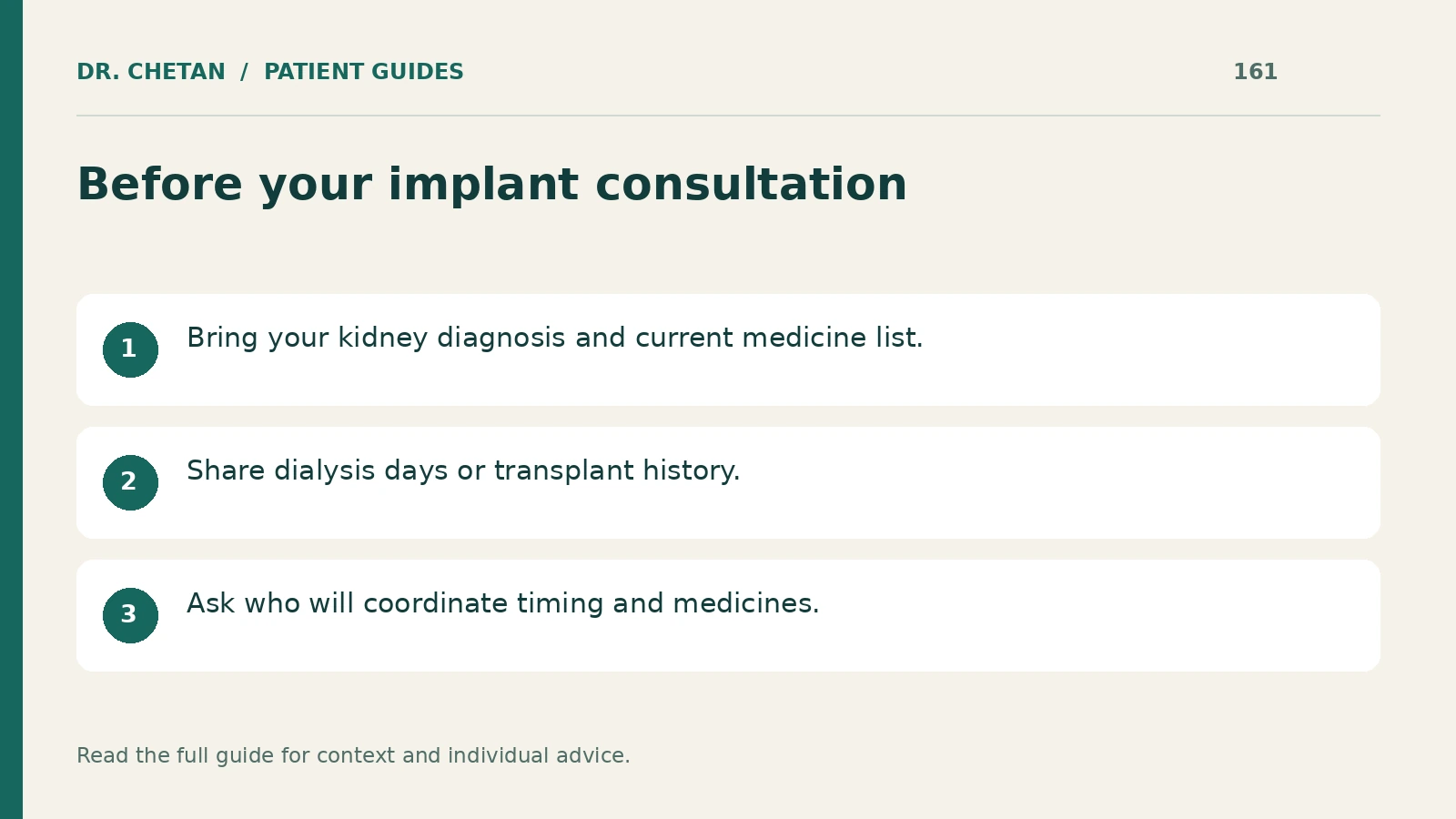
- Your kidney diagnosis and stage if known, and the contact details of your nephrologist or transplant team.
- If you have dialysis, the type, treatment days and any recent problems. Tell the team about your access site.
- If you have had a transplant, the date, any recent infections or rejection episodes, and your current immunosuppressant list.
- A current list of prescribed medicines, supplements, allergies and any history of unusual bleeding or delayed healing.
- Recent test results if your treating team has asked you to carry them.
Mention if you have recently been unwell, changed medicines or been admitted to hospital. Give your dentist permission to contact the relevant clinician if your case needs coordination. The dental team can explain which details it needs and why.
How the dental team makes a plan
The first visit usually focuses on the missing tooth, the bite, gum health and the condition of nearby teeth. The dentist assesses whether you can clean the planned restoration and whether other problems should be treated first. Selected imaging helps the team see the available bone and nearby structures. A more complex plan, such as a graft, adds surgical steps and may change the balance of benefits and risks.
The dentist and renal team may discuss dialysis scheduling, bleeding precautions, current stability and whether any recent blood tests would change the plan. Tests and appointment timing are individual decisions. Ask who will give you the final pre-operative and aftercare instructions, especially if you see clinicians at different hospitals. [1,2]
Tell the team about painkillers you already take. Medicines that are routinely used by some dental patients may be unsuitable in CKD, and certain prescriptions may need an adjusted dose. Get a written plan before surgery and check any over-the-counter medicine with your clinician or pharmacist. Keep taking prescribed blood thinners and transplant medicines as directed unless your prescribing team gives you a coordinated change. [1,2]
What if an implant is deferred?
Sometimes treating gum disease or waiting for medical stability is the sensible first step. In other cases a bridge, a removable partial denture or leaving a space may suit your goals. Each option has trade-offs. A bridge may involve adjacent teeth, a denture needs removal and cleaning, and leaving a gap can affect appearance or chewing depending on its location.
Ask for a comparison that covers the number of visits, surgery, the likely interim tooth replacement, cleaning, follow-up costs and what happens if a component fails. Those questions matter even when an implant is technically possible.
After surgery and long-term care
Follow the clinic’s bleeding, cleaning and medicine instructions. Know who to call outside opening hours. Contact the treating dentist promptly for bleeding that persists despite the instructions you were given, worsening swelling, fever, pus or increasing pain. Heavy uncontrolled bleeding, rapidly spreading swelling or difficulty breathing or swallowing needs emergency assessment.
Once the restoration is fitted, ask for a demonstration with your actual crown, bridge or denture. Report persistent bleeding when you clean, swelling, discharge or a change in how the tooth feels when biting. Keep the recall plan agreed with your dentist. [4]
Frequently asked questions
Do I need a letter from my nephrologist?
The dentist decides what information will change the plan. A recent clinic summary can help. For dialysis, transplant, unstable disease or complex surgery, a discussion between teams may be more useful than a generic clearance letter.
Do all people on dialysis need antibiotics for an implant?
Antibiotic use and dosing depend on the planned procedure and your medical history. The dentist and renal team can agree on the plan. Tell them about previous reactions and any antibiotics you are already taking.
Can I get the implant immediately after a kidney transplant?
The timing of elective surgery depends on recovery, immune suppression, infections and the transplant team’s advice. Ask about a temporary tooth replacement while your team decides when an elective procedure is appropriate.
Is a removable replacement automatically easier?
It avoids implant surgery but still needs good fit and ongoing cleaning. Dry mouth, sore tissues or difficulty handling the denture can affect comfort. Ask to compare how each option would work day to day.
References and further reading
- National Kidney Foundation on dental health and kidney disease
- Clinical review of dental implant treatment in dialysis
- Bone disease in CKD and kidney transplant
- European Federation of Periodontology clinical guideline
Sources checked 3 November 2026. This guide provides general information. Your dental or medical team can advise on your individual needs.

Leave a Reply