
Choosing a dentist in India for treatment from abroad starts with the person who will treat you, the proposed clinical plan and the arrangements after you leave. A low package price, an attractive clinic photograph or a large number of reviews cannot answer all of those questions.
You do not need to become a dental regulator or an infection-control auditor. You do need enough clear information to decide whether the team, treatment and practical arrangements suit your needs. This guide explains what to verify, which questions to ask and what should be clarified before paying for an elective treatment trip.
Sources checked: 24 November 2026. This is a patient decision guide, not a ranking or endorsement of particular dentists or clinics. No individual check guarantees a treatment outcome.
Start with the dental problem and the care you need
Describe your symptoms, previous treatment and the result you hope to achieve. Ask for an assessment of the problem before choosing a procedure from a menu. For example, someone seeking an implant still needs to understand whether a tooth can be preserved and what other replacement options are reasonable.
Make a shortlist around the proposed care and your ability to attend appointments. Consider the city, access to the clinic, time available for recovery and whether you can return for later stages. A convenient airport or hotel is useful, but it cannot establish whether a treatment plan is appropriate.
Keep urgent symptoms separate from elective comparison shopping. If you have a worsening dental problem, obtain timely assessment locally instead of delaying care while arranging an overseas package.
Verify the treating dentist’s identity and registration
Ask for the full name, registration number and registering State Dental Council of each dentist responsible for your care. Compare those details with official records. The National Dental Commission website provides dentist-register information and a State Dental Council list; contact the relevant council if a record needs clarification.
India’s National Dental Commission replaced the Dental Council of India from 19 March 2026. Older references and the official website address may still use DCI terminology. Verify the actual clinician’s details rather than treating a logo or the words “registered dentist” as sufficient evidence.
A missing search result should prompt clarification, especially where names or records differ; it is not enough by itself to conclude that someone is unregistered. Conversely, a screenshot supplied by a coordinator is not a substitute for checking the official source. Record whom you contacted and what was confirmed.
Match qualifications and experience to the procedure
Ask the clinician to explain the qualifications and relevant experience behind the proposed treatment. Clarify any specialist claim, the subject of postgraduate training and who performs each stage. A long string of initials, society memberships or attendance certificates should be explained in plain language.
For a complex case, ask when a specialist opinion or referral would be useful. If several clinicians are involved, establish who coordinates the plan and who will discuss changes with you. For implants, for example, identify both the surgical and restorative responsibilities. The treating dentist may differ from the person featured most prominently on a clinic’s social media.
The General Dental Council’s guidance on treatment abroad recommends asking about the operator, qualifications, experience, regulation and communication. Ask for explanations relevant to your case rather than relying on an unexplained success percentage.
Understand what a clinic accreditation claim means
NABH’s Dental Healthcare Service Providers programme addresses areas including assessment, continuity of care, patient rights, infection prevention and quality systems. It concerns the facility and its processes; it is a different check from verifying an individual dentist’s registration.
If a clinic advertises accreditation, ask for the issuing body, programme, certificate number, facility name, address, scope and validity dates. Check the claim with the issuing organisation or its current official records. “Applied for accreditation”, a training certificate, a manufacturer partnership and an accreditation granted to another branch are different claims.
Use accreditation as one piece of information. It does not remove the need for a suitable diagnosis, informed discussion or a workable aftercare plan. If a claim cannot be confirmed, ask the clinic to clarify it before using that claim in your decision.
Ask practical questions about infection control
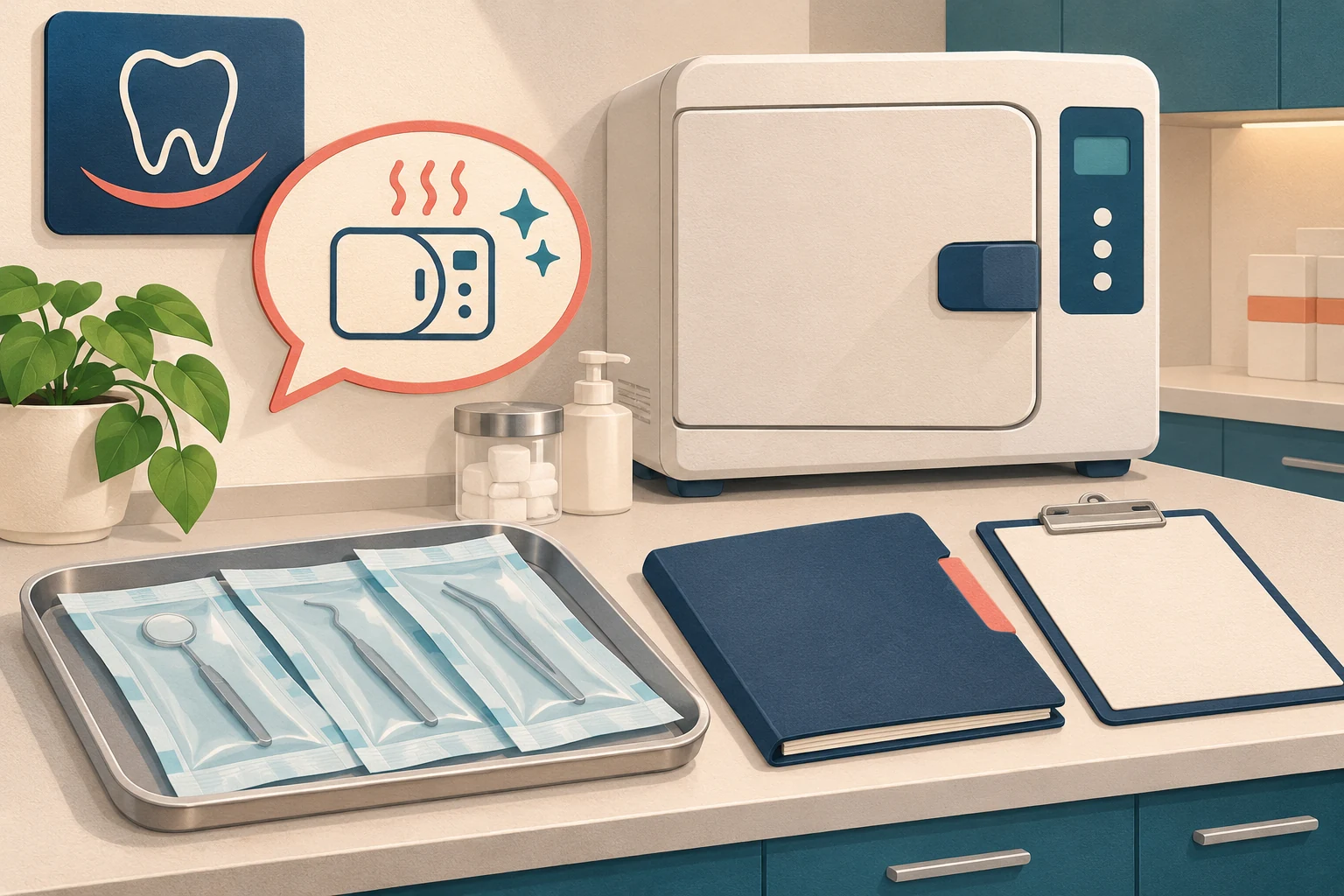
A tidy waiting room does not show how reusable instruments are processed. Ask who oversees infection prevention, how instruments are cleaned and sterilised, and how the process is checked. You are looking for an understandable explanation of a working system, rather than a promise that the clinic is “100% safe”.
The CDC’s sterilisation-monitoring guidance describes complementary mechanical, chemical and biological checks, alongside records and equipment maintenance. Mechanical checks concern the cycle conditions, chemical indicators respond to processing conditions, and biological monitoring uses resistant organisms to test the process. These are useful reference concepts for questions; CDC guidance is not a statement of Indian law.
Ask whether the clinic follows instrument manufacturers’ processing instructions and how it handles a failed monitoring result. A sealed pouch or colour-changing mark alone cannot demonstrate that every preceding step was done correctly. Patients should not need to interpret a sterilisation log themselves; the team should be able to explain its process and accountability.
Handpieces also matter. CDC guidance on dental handpieces recommends cleaning and heat sterilisation between patients for the relevant reusable devices; wiping the outside is insufficient. Ask specifically about handpieces rather than only the examination mirror and other visible instruments.
Expect a clinical assessment and a reason for each step

A remote conversation can help the team review existing records and prepare a provisional proposal. It should leave room for an examination and any necessary investigations before a final decision. Ask what is known, what remains uncertain and what would change the plan after you arrive.
A useful explanation identifies the tooth or area, the findings, the proposed procedure and the alternatives. Ask which parts are necessary for health or function and which are optional cosmetic choices. New imaging should have a clinical reason; neither routinely refusing all imaging nor purchasing every available scan is a substitute for individual assessment.
If two dentists recommend substantially different elective work, ask them to explain the difference and consider an independent opinion. Travelling a long way or paying a deposit does not settle a clinical disagreement. Leave time in the itinerary to think about a revised proposal.
Consent should involve a conversation you understand
The Indian Dental Association’s consent guidance emphasises discussion of options and costs, understanding the decision, and keeping consent valid throughout care. A signature alone is not the whole process. Ask about likely benefits, material risks, alternatives and the consequences of waiting or declining.
Tell the clinic what helps you understand information, including language or communication support. Take notes and ask the clinician to clarify unfamiliar terms. If the proposed work or estimate changes, request an explanation before agreeing to the change. You should have enough information and time to make a considered decision.
Compare the written scope of treatment and price
Request an itemised estimate with the teeth or areas, procedures, materials, temporary restorations, reviews and items that remain provisional. Clarify who provides the laboratory work and whether additional specialist or facility charges apply. For a staged treatment, identify what is included in each visit.
Ask about the deposit, payment recipient, cancellation terms and how extra work will be agreed. Count all treatment-related trips, accommodation and follow-up costs. A clinic that gives you a clear provisional estimate and explains its uncertainties is easier to compare than one giving an unexplained “all-inclusive” total.
Technology can support care, but an equipment list is not a diagnosis. Ask how a proposed scan, digital workflow or other technique helps your particular case. Do the same for material and implant-brand claims: identify the product, its intended role and the records you will receive.
Agree on aftercare before choosing the clinic
Find out who reviews you before departure and how concerns will be assessed after you return home. Ask for a named clinical contact, an out-of-hours route and the arrangements for an in-person examination when remote communication is insufficient. Clarify whether the clinic has actually arranged local support or merely suggested that you find someone.
The GDC’s overseas-care questions include guarantees, complications, complaints and responsibility for additional travel and remedial work. Read the written terms. If a part is replaced without charge, that does not necessarily cover flights, accommodation, laboratory work or treatment by another clinician.
For an implant or another long course of care, discuss compatibility of records and components with follow-up near home. The CDC’s medical tourism guidance recommends obtaining records for clinicians providing later care. Collect your treatment summary, relevant images, prescriptions, invoices and the information needed for future maintenance. Ask how records can be transferred securely to another clinician if required.
Use reviews and photographs as supporting information
Reviews may tell you about communication, waiting times and how a clinic responded to concerns. Look for details about the treatment and length of follow-up rather than relying only on a star average. A recent review written immediately after fitting cannot establish long-term performance.
Before-and-after images can help you discuss a goal, but they do not explain the original diagnosis, preparation, alternative options or maintenance. Ask what was done and whether the case is comparable to yours. Photographs and testimonials should not be treated as a promise that you will receive the same result.
Be particularly cautious about making an irreversible decision during a time-limited sales promotion. If essential clinical or financial details remain unanswered, resolve them before committing. A willingness to explain limitations and discuss alternatives is more useful than a promise that nothing can go wrong.
A checklist for comparing shortlisted clinics
| Check | Information to record | Question still to resolve |
|---|---|---|
| Treating team | Names, roles, registration details and relevant qualifications. | Who is responsible for each stage and any changes? |
| Clinical plan | Diagnosis, proposed work, alternatives and provisional items. | What needs confirmation at examination? |
| Facility claims | Exact address and any accreditation claim checked with its issuer. | Does the claim cover this facility and programme? |
| Infection control | Explanation of processing, monitoring and staff responsibility. | Can the team answer specific questions clearly? |
| Travel and costs | Visits, recovery allowance, written inclusions and payment terms. | What changes if treatment or travel is delayed? |
| Aftercare | Reviews, clinical contacts, record transfer and complaint route. | Who assesses problems at home and who pays? |
This is an organising tool, not a validated safety score. An unanswered registration or clinical question should not be cancelled out by several attractive hotel or transport benefits. Keep uncertainty visible until you have a satisfactory explanation.
A short request you can send before booking
“Please identify the dentist or team proposed for my care, their registration details and relevant qualifications. After clinical review, please explain the diagnosis, reasonable options, provisional treatment stages and required visits. Please also send the written fee inclusions, payment and cancellation terms, aftercare contacts, record-sharing arrangements and process for resolving concerns.”
Use the response to prepare questions for a direct clinical conversation. If you speak through a coordinator, ask which answers have come from the treating dentist. Keep the correspondence and arrange your final decision around the assessment, rather than around a travel package deadline.
Frequently asked questions
Does a high review score prove a clinic is right for me?
No. Use reviews alongside verified clinician details, an appropriate plan and aftercare arrangements. They cannot replace assessment.
Is NABH accreditation the same as dentist registration?
No. They address different things. Check the clinician and any facility accreditation claim separately.
Should I pick the clinic with the most advanced equipment?
Ask how the equipment contributes to your care. The diagnosis, clinician’s judgement, hygiene systems and continuity of care remain important.
What if I feel uncertain after arriving?
Ask for clarification and time before elective treatment. Consider another clinical opinion if needed, and discuss the financial consequences of a change separately from the decision about your care.
Related guides to help you plan
- Dental Tourism in India: A Complete Guide to Costs, Treatment, Travel and Aftercare
- Dental Treatment Costs in India for Overseas Patients: Prices, Savings and Comparing Quotes
- Dental Implants in India for Overseas Patients: Trips, Healing Time and Aftercare
Published guides in this dental tourism series
-
Dental Tourism in India: A Complete Guide to Costs, Treatment, Travel and Aftercare
-
Dental Treatment Costs in India for Overseas Patients: Prices, Savings and Comparing Quotes
-
Indian Visa and Travel Documents for Dental Treatment: A Patient’s Checklist
-
Dental Implants in India for Overseas Patients: Trips, Healing Time and Aftercare

Leave a Reply