Dental tourism in India means travelling to India for dental care. For someone facing a substantial treatment bill at home, it can offer a financial advantage. For an NRI visiting family, it may also be a convenient opportunity to address an existing dental problem. However, the decision needs to account for diagnosis, recovery, repeat visits and care after returning home.
The useful question is whether the complete treatment journey makes clinical and financial sense for you. This guide explains how to compare costs, choose a dentist, prepare documents and plan follow-up before committing to a trip.
Travel and visa information checked: 24 November 2026. Published fees below are examples from named providers, not a quotation for your treatment.
Is dental tourism in India right for you?
It is worth exploring when you have a clear treatment need, time for assessment and recovery, and the ability to return if treatment requires several stages. Having family or a reliable support person nearby can make practical arrangements easier. Begin with a diagnosis and discuss reasonable alternatives, including treatment near home.
Pause if your only available dates force the dentist to compress treatment, you cannot fund another visit, or nobody can provide follow-up where you live. A small saving on a single filling may disappear once flights and accommodation are included. A larger plan needs particular care because more extensive work also creates more appointments, maintenance needs and possible complications.
An online estimate is provisional. Photographs and existing records help with an initial discussion, but the final plan may change after examination and any clinically necessary investigations. Ask what happens if you arrive and the proposed treatment is unsuitable.
How much does dental treatment cost in India?
There is no single national private dental tariff. Fees vary with the tooth, complexity, materials, clinician, laboratory and what the package includes. The following published Aureva Dental prices provide one provider’s examples, checked on 24 November 2026; they are not national averages, an endorsement, or DrChetan.com treatment prices.
| Treatment | Published example in INR | What to clarify |
|---|---|---|
| Tooth-coloured filling | INR 1,500–INR 4,000 | Size, surfaces and whether additional treatment is needed |
| Root canal treatment | INR 4,000–INR 10,000, depending on tooth type | Whether the restoration, core and crown are separate |
| Porcelain-fused-to-metal crown | INR 4,000–INR 6,000 per tooth | Material, laboratory and temporary restoration |
| Monolithic zirconia crown | INR 10,000–INR 18,000 per tooth | Exact material and suitability for your bite |
| Complete single implant | INR 45,000–INR 80,000 | This listed example includes fixture, abutment and crown; check extra procedures |
| Wisdom tooth removal | INR 4,000–INR 10,000 | Imaging, surgical complexity and review charges |
| Veneer | INR 8,000–INR 24,000 per tooth | Material, preparation required and alternatives |
For an overseas reference, Bupa Dental Care advertises implants from £2,400 at selected UK practices, including a single implant, abutment and screw-retained porcelain crown under its stated terms. These are provider-specific starting prices in different markets, not matched quotations or a guaranteed saving. Compare the same clinical work and use the exchange rate available when paying.
Compare the total trip budget, not the headline fee
Ask for a written, tooth-by-tooth estimate. It should distinguish essential treatment from optional cosmetic work and identify which charges could change. For an implant, a low “implant price” may cover only the fixture: the abutment, crown, extraction, graft or temporary tooth could be additional.
- Include assessment, necessary scans, anaesthesia or sedation, laboratory work, medicines and review appointments.
- Budget for every proposed trip, accommodation, local transport, a companion if needed, and time away from work.
- Check payment stages, card or bank conversion charges, cancellation terms and the cost of changing flights.
- Set aside money for an extended stay, an unplanned return and treatment at home. Compare your actual out-of-pocket home cost after any insurance benefits.
A hypothetical example: if comparable treatment at home costs INR 6,00,000, treatment in India costs INR 2,40,000 and travel and accommodation across all visits cost INR 1,10,000, the planned total is INR 3,50,000. Allowing another INR 50,000 as a contingency reserve gives a INR 4,00,000 budget, leaving INR 2,00,000 below the home quotation. These invented figures illustrate budgeting; they do not predict your bill or final saving.
Do not add unnecessary crowns, extractions or cosmetic procedures simply to make a trip appear better value. Ask why each tooth needs treatment and whether a more conservative option is reasonable.
How long should you stay for dental treatment?
There is no safe universal “seven-day dental holiday” timetable. Ask the treating dentist to separate active appointments, laboratory time, healing and review. Build flexibility around those stages before purchasing non-refundable travel.
| Treatment | What affects the travel plan |
|---|---|
| Fillings or cleaning | The number of teeth, findings at examination and any need for further care |
| Root canal treatment and crown | Infection, tooth complexity, restoration requirements and laboratory appointments |
| Crowns or veneers | Assessment, preparation, temporary restorations, try-in, final fitting and bite review |
| Extractions or oral surgery | Surgical difficulty, recovery, review and any special travel restrictions |
| Implants or full-arch treatment | Healing, possible grafting, temporary teeth and later definitive restoration |
| Braces or aligners | Ongoing monitoring and an agreed arrangement for care between visits |
A short visit is particularly difficult to reconcile with treatment that needs continuing adjustments. Discuss who will monitor orthodontic care, deal with breakages and manage retention if you live abroad. Do not assume a dentist at home will take over someone else’s treatment without a separate assessment and fee.
Dental implants: why one trip may not be enough
Leeds Teaching Hospitals’ implant guidance describes a bone-healing period commonly lasting two to six months before implants support their restoration. Extractions or bone grafts can introduce further stages. Your own timing depends on the clinical findings and treatment protocol.
Selected patients may receive an immediate temporary tooth or bridge. That does not necessarily mean the definitive teeth are finished or that healing has been eliminated. Get the number of trips, temporary-tooth arrangements and final-restoration stage in writing. Read our dental implant procedure and timeline guide and guide to implant types and same-day treatment for more background.
How to choose a dentist and clinic in India
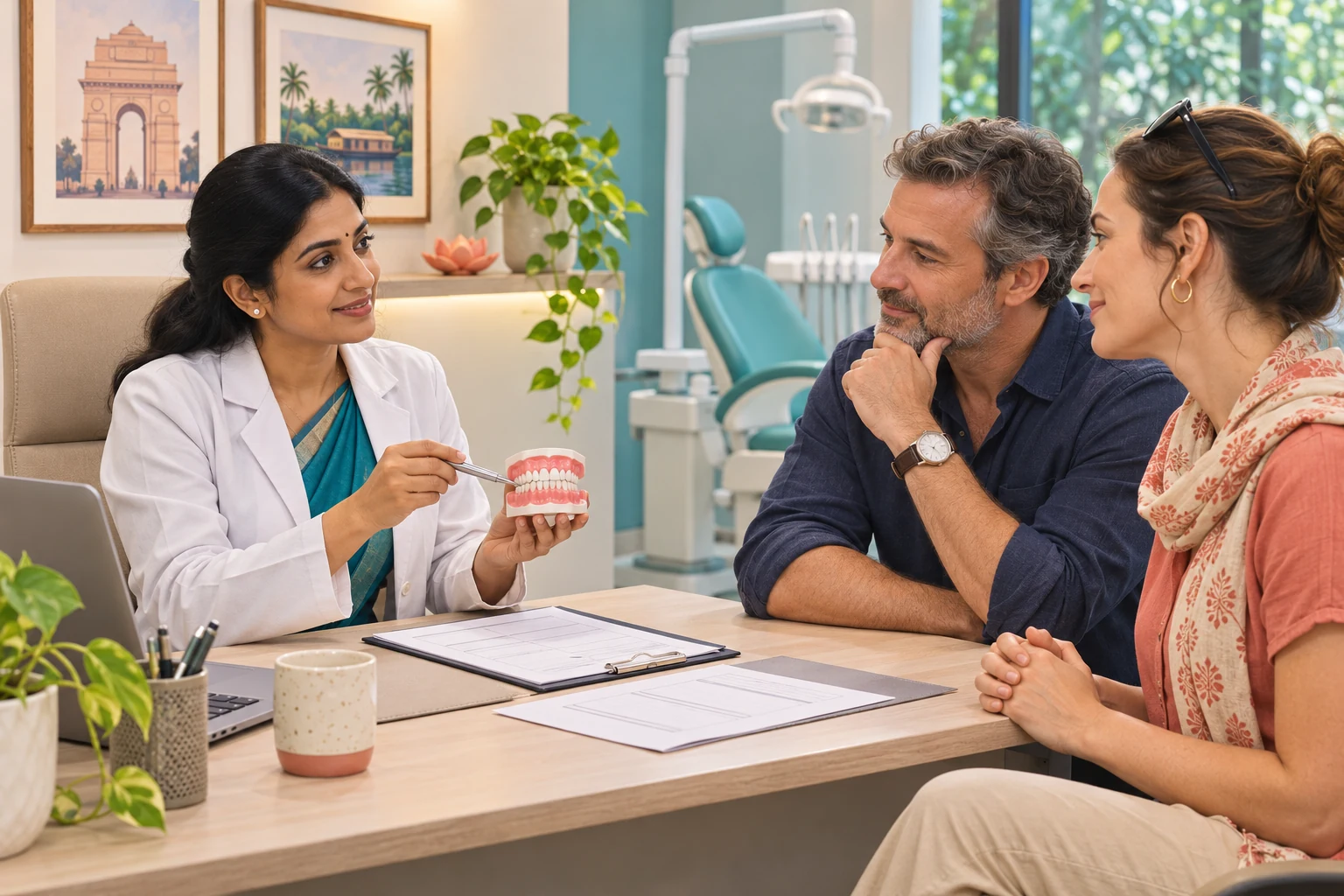
Start with the person responsible for your care. Verify the dentist’s registration through the relevant State Dental Council and available national records. India’s regulator is now the National Dental Commission; older material may still refer to the Dental Council of India. Ask about the qualifications and relevant experience of the clinician performing each procedure.
A clinic claiming NABH dental accreditation should be able to provide a current certificate whose scope covers that facility. Accreditation can help you evaluate systems and processes; it does not guarantee an individual result. A clinic’s equipment list or social media following is also insufficient to judge its suitability.
The UK General Dental Council’s advice on dental treatment abroad provides a useful starting point for questions. Ask who performs treatment, how you will communicate, what alternatives exist, and how complications, complaints and any proposed guarantee are handled. Clarify who pays for remedial work and additional travel. Read the terms before paying a deposit.
Ask how reusable instruments are processed and how sterilization is monitored. The CDC describes mechanical, chemical and biological monitoring as complementary checks. A reassuring explanation should go beyond “we have an autoclave.” These CDC recommendations are a reference for questions, not a statement of Indian legal requirements.
Choose a location around the treating team, access to reviews, suitable accommodation and reliable transport. A famous tourist destination is not automatically the best place for your particular treatment. If several appointments are likely, staying reasonably close to the clinic can be more useful than staying near sightseeing attractions.
Which Indian visa do you need for dental treatment?
Visa rules are currently in transition. A Ministry of Home Affairs announcement dated 11 November 2026 describes Visitor V-1 permissions that include short medical consultations and treatment, and an M-1 route for conventional medical treatment, with one-year multiple-entry validity as the default. It also states that IT systems are being updated for implementation by year-end.
Official pages may therefore show different versions of the rules during the rollout. Do not rely on an old blanket statement that every dental visit needs the same visa or that every medical e-Visa permits only 60 days. Ask the Indian Mission or official visa service which category fits your nationality, treatment and intended stay, and follow the conditions on the visa actually issued. A clinic cannot guarantee approval.
Apply through the official Indian visa portal or the appropriate Indian Mission. Confirm e-Visa eligibility and permitted entry points before buying tickets. Allow time for queries and approval; submitting an application is not permission to board or enter.
Travel documents and records checklist
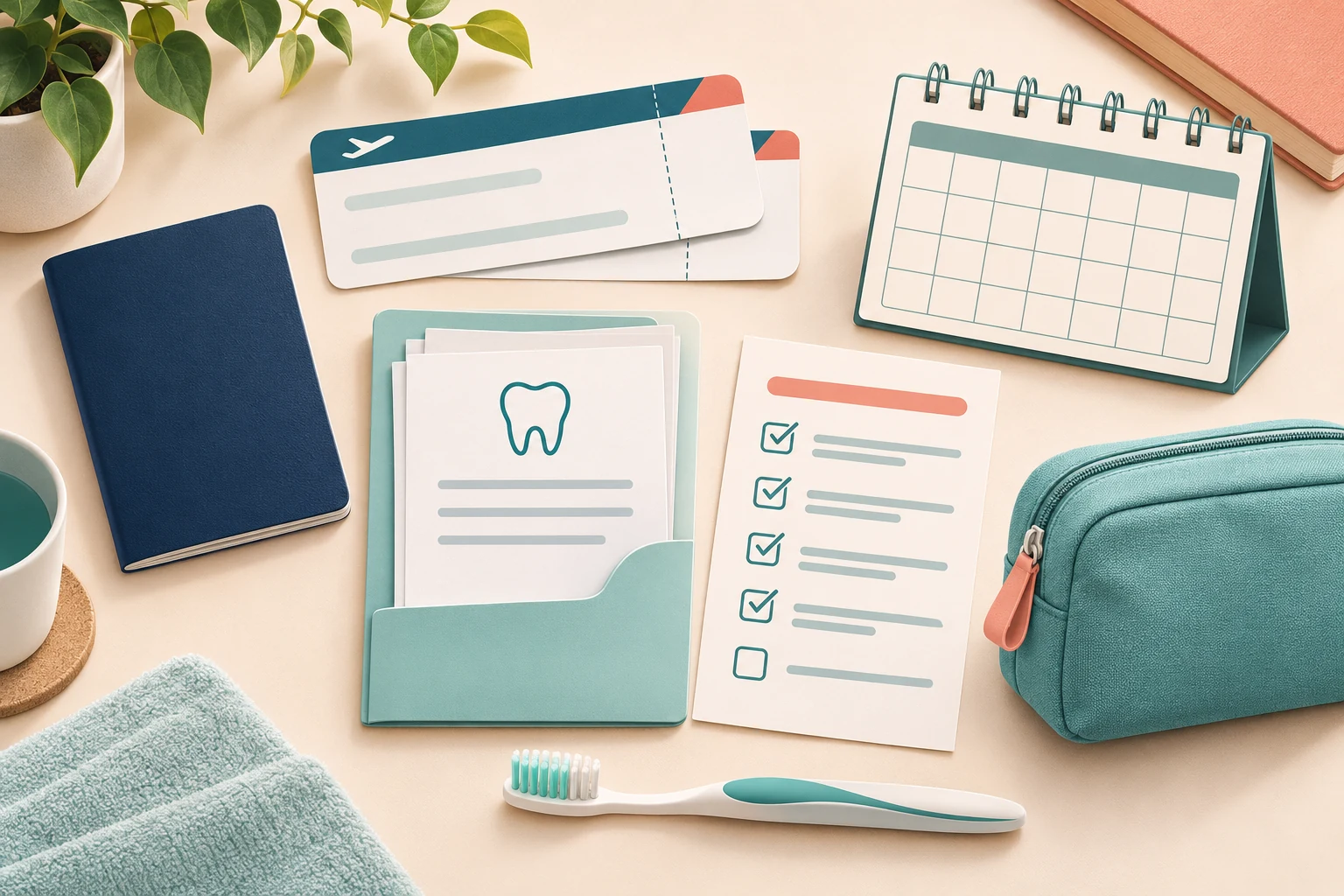
| Document or information | What to prepare |
|---|---|
| Passport and entry permission | For an e-Visa, the official portal specifies at least six months’ passport validity at application and two blank pages. Check all applicable travel conditions. |
| Application uploads | Clear passport biographical-page scan and photograph meeting the official specifications. |
| Medical documentation, if required | The medical e-Visa checklist asks for a hospital letter on letterhead with a tentative treatment/admission date, patient name, nationality and passport number. Confirm that your provider can supply an acceptable document. |
| Journey and stay details | Return/onward itinerary, accommodation, clinic contact details and evidence of sufficient funds as applicable. |
| Arrival declaration | Check the official e-Arrival Card process; it is separate from a visa. |
| Clinical records | Existing relevant X-rays, treatment history, current medicines, allergies and medical conditions; obtain new imaging only when clinically indicated. |
| Financial and insurance papers | Itemized estimate, payment receipts, policy wording and written insurer responses about planned overseas care. |
The official portal directs foreign visitors, including OCI cardholders, to complete an e-Arrival Card within the 72 hours before arrival. Check the current instructions for your journey. Indian citizens travelling on Indian passports do not need an Indian visa; NRIs with foreign passports must check their own entry status. A valid OCI card generally provides a visa exemption, but is not Indian citizenship and must be used with the required valid passport.
Before booking: agree on a practical treatment plan
Send relevant existing records through a channel confirmed directly with the clinic. Provide a complete medication and medical history, including diabetes, bleeding problems, previous reactions to anaesthesia and any medicines affecting bone health. Ask the dentist whether your medical team needs to be involved. Do not stop prescribed medicines on your own.
Request a plan with the diagnosis, alternatives, stages, likely visit count, fee inclusions and a named contact. Ask what might change after examination and how you can decline revised treatment. Keep copies of the quote and correspondence. Avoid paying a large non-refundable sum solely on the basis of promotional photographs or a coordinator’s promise.
The CDC’s medical tourism guidance recommends planning ahead, including a travel-health consultation ideally four to six weeks before departure. Discuss destination-related health needs and your planned procedure. Ask your insurer specifically about elective overseas dental treatment, complications, evacuation and cancellations; ordinary travel cover should not be assumed to include these.
Recovery, flying and sightseeing
Leave space for recovery and a review before departure. The dentist should advise when you can fly based on what was done and how you are healing; there is no single waiting period that applies to every filling, extraction, implant or sinus-related procedure. Check airline requirements where medical clearance is needed.
Plan an easy first few days rather than a tightly packed sightseeing itinerary. Ask about activity, eating, oral hygiene and any restrictions relevant to the procedure. If sedation is planned, arrange the required escort and supervision. Choose accommodation where you can rest, obtain suitable meals and return to the clinic without a long journey.
Seek urgent dental assessment for worsening pain, swelling, fever or a suspected infection. Difficulty breathing, speaking or swallowing, significant mouth swelling, or swelling affecting the eye needs immediate emergency assessment. Do not wait for a scheduled flight or a reply from an overseas clinic. The NHS dental abscess guidance identifies these as emergency warning signs.
Before leaving India: collect your aftercare pack
Agree on follow-up before treatment begins, including who can examine you at home and what they will charge. Remote messages can help communication, but some problems require an examination, imaging or hands-on treatment. A guarantee is only useful if you understand its exclusions and the practical cost of accessing it.
- Collect a treatment summary identifying the teeth treated, procedures, dates and treating clinicians.
- Obtain relevant X-rays, prescriptions, invoices, written aftercare instructions and planned review dates.
- For implants, request the implant system and component details, including brand, model and identifying information needed for future maintenance. The British Society of Periodontology highlights potential problems accessing unfamiliar implant systems after overseas treatment.
- Keep the clinic’s routine and emergency contact details, plus an agreed process for assessment if symptoms develop after returning home.
Common questions about dental tourism in India
Is it always cheaper?
No. Compare clinically equivalent plans and the complete travel and follow-up budget. A saving on treatment fees can shrink considerably when repeat visits are required.
Can an online consultation confirm my final treatment?
It can help you prepare, but an estimate based on records is provisional. Leave room for an in-person assessment and a decision about the revised plan.
Can I combine treatment with a holiday?
Possibly, provided the itinerary follows the treatment and recovery plan. Keep important appointments and reviews protected, and avoid activities your treating team has restricted.
Should I choose the cheapest package?
Ask for the diagnosis, materials, responsible clinicians, inclusions and aftercare before comparing prices. If a quote is unclear, request clarification rather than filling the gaps with assumptions.
What should I do first?
Get your dental problem assessed, gather relevant existing records and request a staged, itemized proposal. Confirm that the clinical plan, travel permission, budget and follow-up can all work together before committing to the trip.
Published guides in this dental tourism series
More guides will appear here as this series is published.

Leave a Reply