
You may notice changes that suggest tooth decay, but you cannot reliably diagnose or rule out a cavity at home. Early decay often causes no pain. A white mark, dark spot, sensitivity or food trapping deserves attention, but each can have other explanations. A dental examination establishes what is happening and whether treatment is needed.
What is the difference between decay and a cavity?
Tooth decay is a disease process involving repeated mineral loss from tooth surfaces. Bacteria in plaque use sugars and other fermentable carbohydrates and produce acids. If mineral loss outweighs repair over time, the tooth can become weakened.
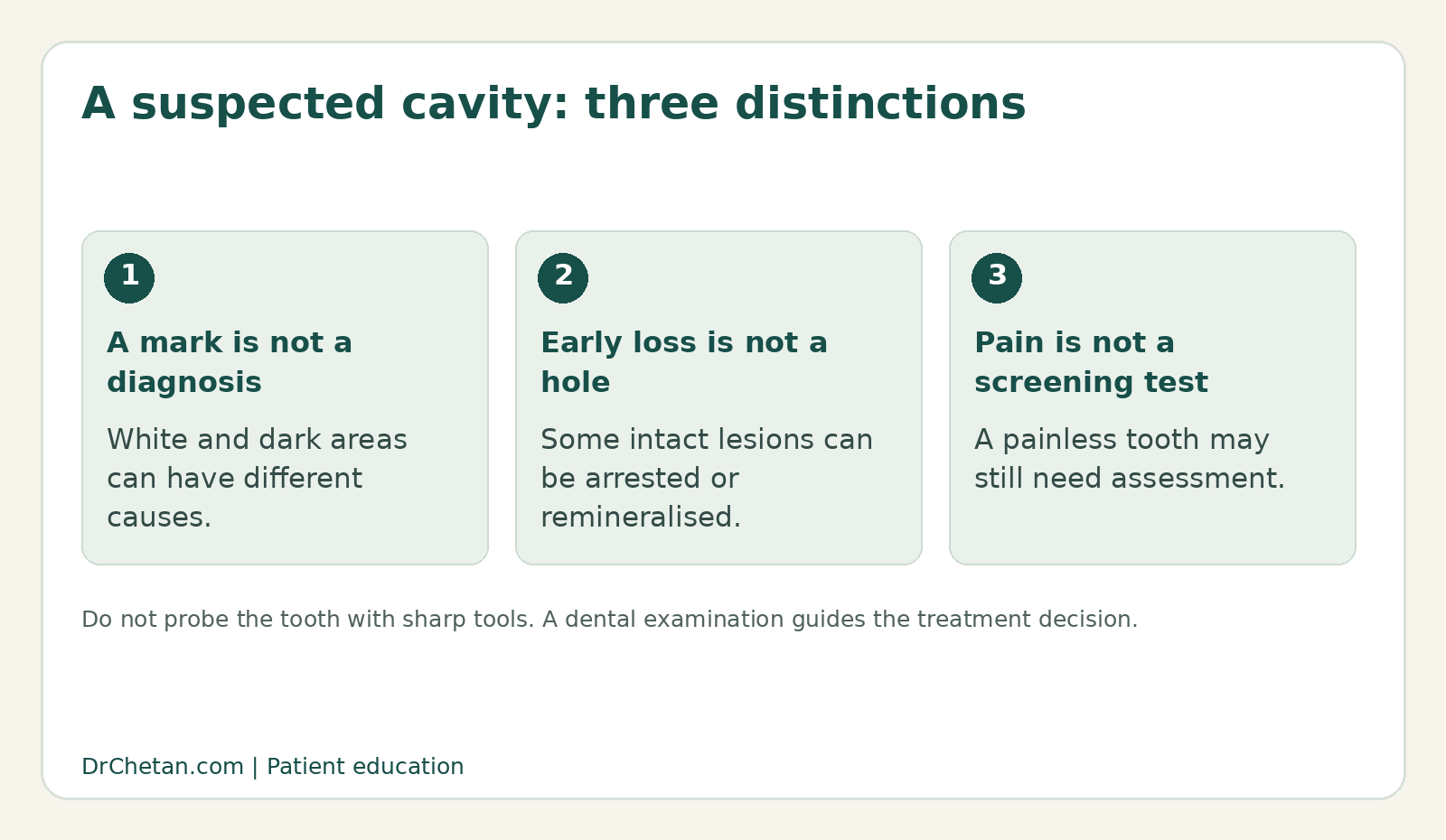
An early lesion may still have an intact surface. A cavity is a physical breakdown or hole in that surface. This distinction matters: some early lesions can be arrested or remineralised, while a hole does not simply grow closed with toothpaste.
Which changes might I notice?
- A new chalky or opaque mark, especially in a plaque-retentive area.
- A brown or dark change that appears new or is changing.
- Repeated sensitivity to sweet, cold or hot foods and drinks.
- A visible defect, rough edge or a place where food repeatedly catches.
- Toothache, biting discomfort or a broken part of the tooth.
None of these is a dependable home test. A white mark may have a developmental or other non-decay explanation; a dark fissure can be stained without needing a filling. Sensitivity can arise from exposed roots, wear, cracks or other problems.
Can a tooth have decay without a visible spot?
Yes. Decay can begin between teeth, beside an existing restoration or on an exposed root where it is difficult to see. Looking at the chewing surface in a mirror cannot show every area.
Nor does lack of pain prove that the tooth is healthy. Pain often develops later, and its severity does not accurately measure the size or depth of a lesion. Regular assessment is useful because waiting for toothache can mean losing the opportunity for simpler care.
Should I use a sharp tool or photograph to check?
Do not poke a suspected spot with a pin, metal pick or other sharp object. You can injure tissue or a weakened surface, and whether an object seems to “stick” does not provide a safe diagnosis.
A dated photograph may help communicate a change to the dentist, but lighting, shadows and limited access make photographs unreliable for deciding whether a lesion is active or deep. An online image comparison or automated image label cannot replace an examination.
How does the dentist assess it?
The dentist asks about symptoms, diet frequency, cleaning, fluoride use, dry mouth, previous decay and relevant medicines. They inspect the teeth and restorations, often after removing plaque and drying the area to see surface changes more clearly.
An indicated X-ray can help assess surfaces that cannot be seen directly, especially between teeth or beneath a restoration. Imaging is selected according to need rather than repeated automatically at every visit.
The clinician considers whether there is an intact or broken surface, lesion activity, depth, access for cleaning and your overall risk. Ask, “Is this active decay, a stained area or another kind of mark?” and “What finding determines whether I need a filling?”
Can early decay be reversed?
Some early, non-cavitated lesions can be stopped or remineralised with an appropriate prevention plan. Fluoride, effective plaque control, changes to frequent sugar exposure and management of dry mouth can help shift the balance towards repair.
That does not promise the mark will disappear or that every lesion can be managed without a restoration. The dentist may recommend fluoride varnish, a sealant or another selected treatment and arrange monitoring. A plan to watch a lesion should include what is being done to control it and how progress will be checked.
When is a filling or other treatment needed?
A cavity that cannot be kept clean, a progressing lesion or loss of tooth structure may require restorative treatment. The approach depends on the tooth, lesion and patient. Deeper disease can affect the pulp and may require more complex care; extraction is considered when a tooth cannot be retained appropriately.
The decision is not based solely on whether a spot is black. Ask for an explanation of the options, the amount of tooth affected and what may happen if treatment is delayed.
What can I do while waiting for assessment?
Brush twice daily with suitable fluoride toothpaste, spit without immediately rinsing and clean between teeth with an appropriate aid. Reduce frequent sugary snacks and drinks; repeated sipping throughout the day can matter as much as the portion in one sitting.
Do not use lemon, charcoal scraping or abrasive home remedies to remove a mark. Whitening a spot does not treat decay. For technique, see how to brush your teeth properly.
When does it need urgent attention?
Seek prompt dental advice for severe or persistent pain, swelling, fever, pus or difficulty eating. Swelling affecting breathing, swallowing, speaking or the eye requires emergency medical care. If pain suddenly settles, the cause may still need treatment.
Frequently asked questions
Is every white spot early decay?
No. Examination helps distinguish decay from other enamel changes.
Can a cavity heal if I brush harder?
Hard brushing does not close a hole and can cause damage. Early mineral loss and a physical cavity need different assessment and care.
Do baby teeth need checking for these changes?
Yes. Baby teeth can develop decay and infection. Do not wait for them to fall out or for a child to report pain.
References and further reading
- NIDCR: Tooth decay
- NIDCR: The tooth decay process
- NHS: Tooth decay
- ADA: Caries risk assessment and management
- MedlinePlus: Dental cavities
- NIDCR: Dental fillings
- ADA MouthHealthy: Cavities
Sources checked 2 November 2026. This is general patient education; an examination and an individual treatment plan may be needed.

Leave a Reply