
Routine dental treatment and local anaesthetic are generally compatible with breastfeeding. You usually do not need to interrupt feeding or discard milk after an ordinary dental X-ray or a suitable numbing injection. Medicines and sedation need a drug-specific assessment, with extra care for a premature, newborn or medically unwell baby.
What should I tell the dental team?
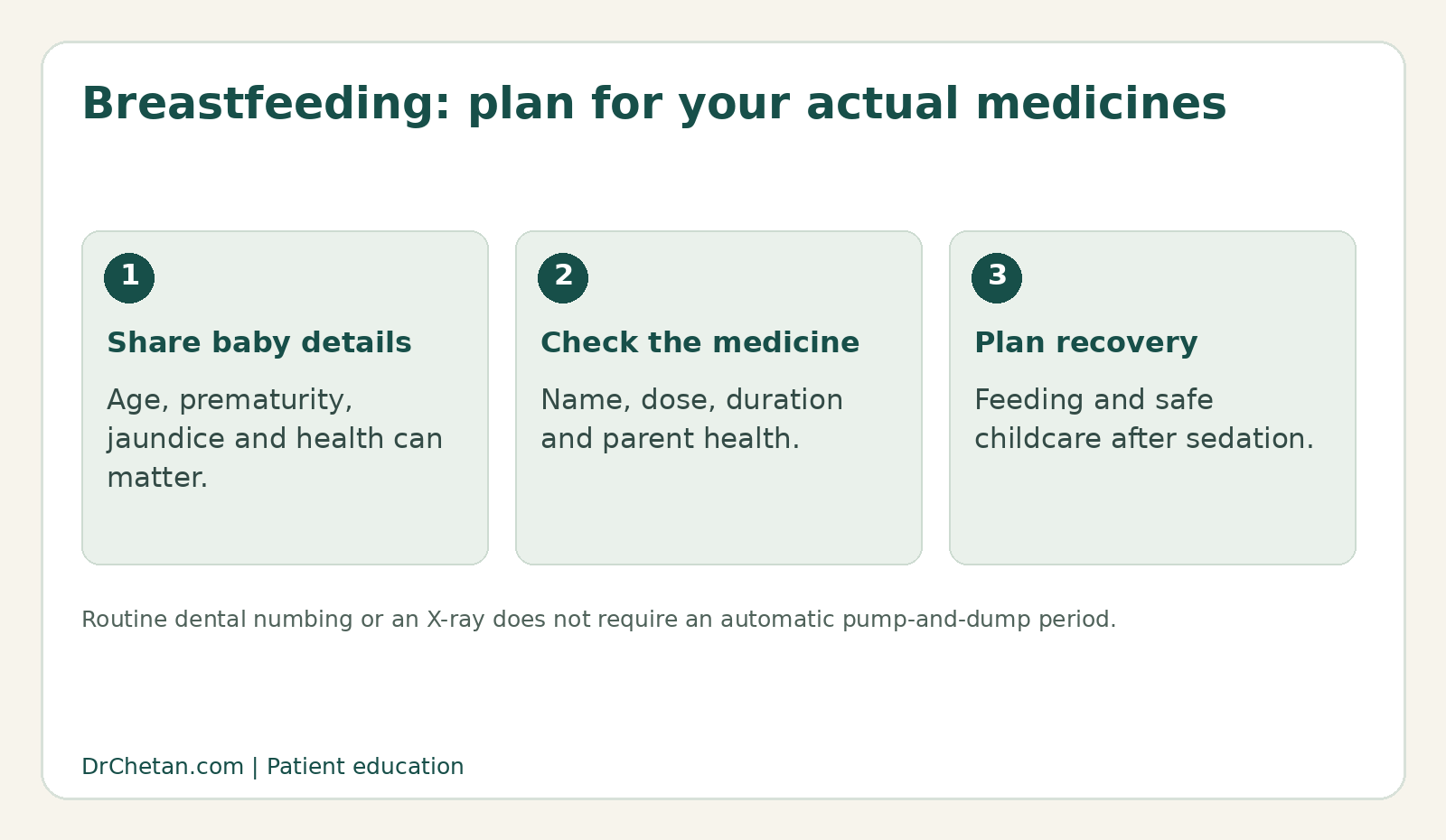
Say that you are breastfeeding when booking and again before any medicine is prescribed. Explain the baby’s age, whether they were born prematurely, any jaundice or ongoing health problems, and whether they are exclusively breastfed or also receiving other feeds.
Bring your full medicine list, allergies and medical history. Tell the dentist about any sedatives or strong painkillers you have already taken. The same medicine may require different consideration for a healthy older infant and a premature newborn.
Ask for the name, dose and expected duration of each proposed medicine. A pharmacist or your baby’s clinician can help assess a complicated situation. Do not stop regular prescribed treatment or wean your baby simply because a leaflet says “ask your doctor”.
Can I breastfeed after local anaesthetic?
Lidocaine, commonly used for dental numbing, reaches milk in low amounts and is poorly absorbed by the infant. LactMed states that no special precautions are required for lidocaine. An ordinary dental injection does not create an automatic waiting period.
The dentist still chooses an appropriate preparation and dose, taking account of your health. Local anaesthetic is different from sedation or general anaesthesia. If several medicines are used, the complete plan should be assessed rather than relying only on reassurance about one injection.
What about dental X-rays?
Ordinary diagnostic X-rays do not leave radiation in your body or breast milk. They do not make milk radioactive, and routine dental imaging does not require expressing and discarding milk. Images should still be selected according to clinical need.
Other tests involving radioactive medicines are different and need their own advice. Do not apply instructions for a nuclear-medicine test to a routine dental X-ray, or vice versa.
Do I need to pump and dump after sedation?
Current anaesthesia guidance does not support routine discarding of milk after usual anaesthesia or sedation. It generally supports resuming breastfeeding when you have recovered sufficiently to be alert, oriented and able to feed or express safely.
This is not permission to nurse while heavily drowsy or to assume every drug and baby has the same needs. Confirm the medicines used, any individual precautions and recovery instructions with the sedation or anaesthesia team, particularly for a very young, premature or unwell infant.
Arrange another responsible adult to look after you and the baby as instructed. Your judgement and coordination can remain impaired after you first feel awake. Follow the team’s advice about childcare, driving and safe sleep; do not bedshare while impaired by sedating medicines. The Breastfeeding Network advises avoiding bedsharing for 24 hours after sedation or general anaesthesia.
Can I take pain relief or antibiotics?
Paracetamol and ibuprofen are commonly compatible with breastfeeding when otherwise suitable for the parent, but that does not make them appropriate for every person or combination product. Kidney disease, stomach ulcers, allergies, liver problems and other medicines may change the choice.
Check ingredients before combining products. Codeine is generally not recommended during breastfeeding, and the FDA also recommends against tramadol. Strong pain relief needs an explicit prescribing decision rather than self-treatment with leftover tablets.
Many antibiotics can be used during breastfeeding when indicated. The exact drug, dose, duration and baby’s health matter. Do not assume every antibiotic requires a feeding break, and do not assume every antibiotic is equally suitable.
Antibiotics are not a routine requirement after every extraction or root canal. They are prescribed for a clinical indication and do not replace dental treatment of the source.
How can I make the appointment easier?
If practical, feed or express before leaving home or before the procedure. Bring what you need for your usual feeding routine and discuss expressing if a long separation is expected. These are comfort and logistics measures, not a way to clear local anaesthetic from milk.
Confirm fasting instructions if sedation or general anaesthesia is planned. Do not fast unnecessarily for an ordinary examination or local-anaesthetic appointment. Arrange help with the baby so you can rest and follow any recovery restrictions.
What should I watch for after a medicine?
Ask the prescriber what monitoring is appropriate for the actual medicine. Report poor feeding, unusual sleepiness, diarrhoea, rash or other unexpected changes. A baby who is difficult to wake, has breathing problems or appears floppy needs emergency medical assessment. Take the medicine details with you.
These signs do not mean ordinary dental local anaesthetic commonly causes harm. They explain why sedating or other higher-risk medicine decisions should include the baby’s circumstances and a clear plan.
Should I postpone a painful dental problem until weaning?
No automatic delay is needed. Seek assessment for pain, swelling or infection and tell the team you are breastfeeding. A compatible plan is often possible. Severe swelling affecting breathing, swallowing or the eye needs emergency medical help.
Frequently asked questions
Must I wait 24 hours after every dental injection?
No. That blanket rule is not appropriate for routine local anaesthetic. Ask about the actual medicines used.
Is expressed milk after a dental X-ray unsafe?
No. Ordinary diagnostic X-rays do not leave radioactivity in milk.
Who can resolve conflicting medicine advice?
Ask the prescriber and a pharmacist with breastfeeding-medicine expertise to review the exact medicine and your baby’s age and health.
References and further reading
- NHS: Breastfeeding and medicines
- LactMed: Lidocaine
- LactMed: X-rays
- Association of Anaesthetists: Breastfeeding anaesthesia and sedation guidance, 2026
- Association of Anaesthetists: Full 2026 consensus guideline
- Breastfeeding Network and SAAD: Dental sedation
- Breastfeeding Network: Dental treatment and breastfeeding
- FDA: Codeine information and breastfeeding warnings
- NHS Specialist Pharmacy Service: Codeine, dihydrocodeine and tramadol during breastfeeding
Sources checked 2 November 2026. This is general patient education; an examination and an individual treatment plan may be needed.

Leave a Reply