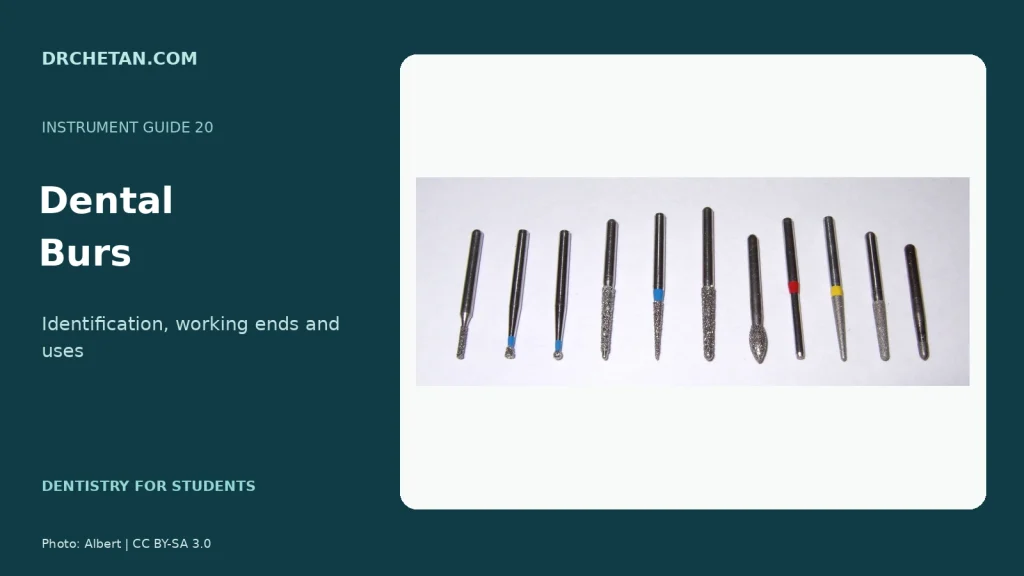
A dental bur is identified by more than its head shape. Students should describe the working head, cutting or abrasive material, size, shank and manufacturer’s marking together before deciding what the instrument is designed to do.
A learning guide for dental students. Clinical instrument use requires practical training and supervision.
Photographic reference
Parts of a rotary instrument
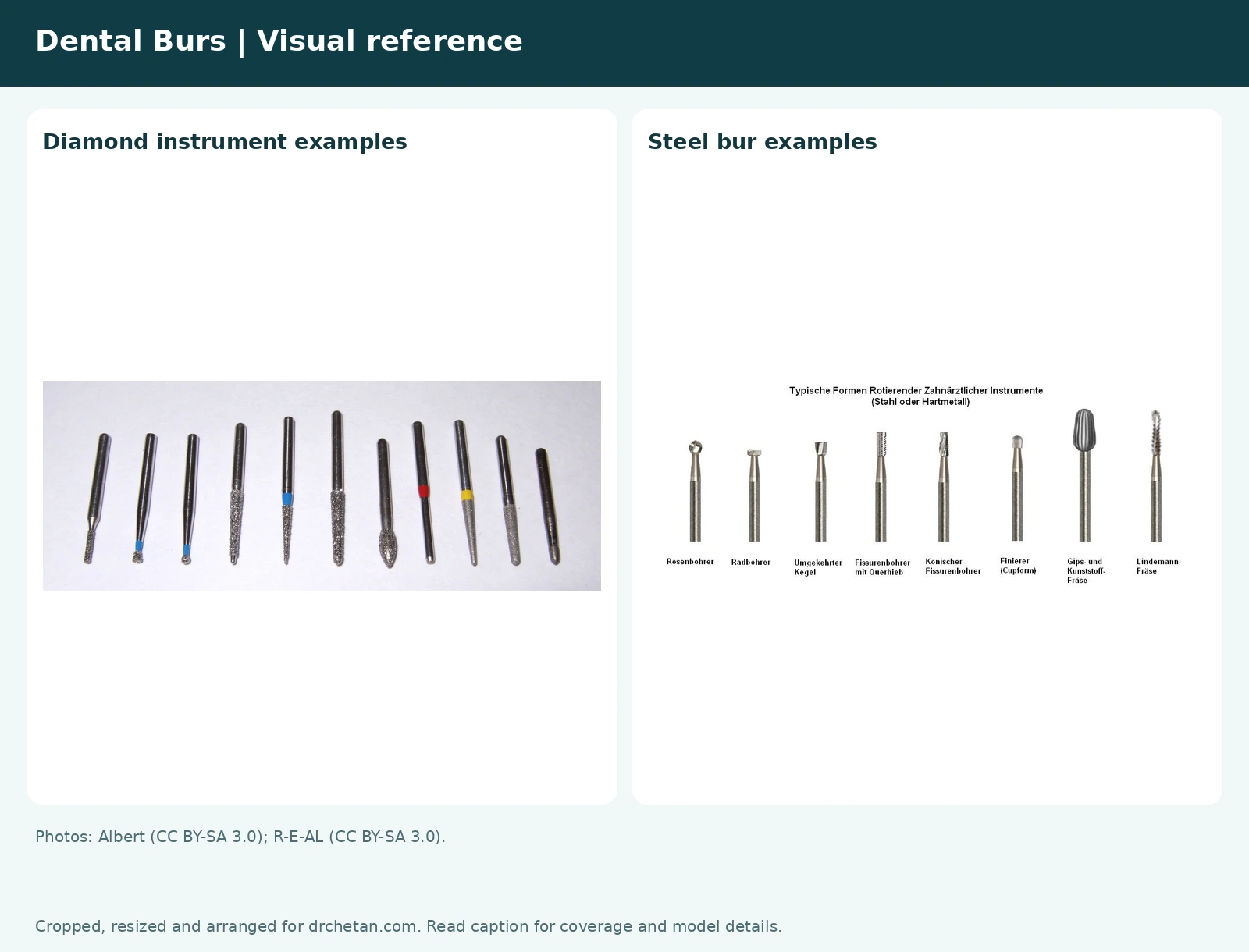
The head is the working portion, the neck links it to the shank, and the shank is retained by the handpiece. The head may have cutting blades or an abrasive surface. Its shape influences the surface it can create, while the shank determines the compatible retention system.
In everyday teaching, “bur” is often used broadly for both bladed cutters and diamond-coated rotary instruments. More precisely, a diamond instrument abrades using diamond particles, whereas a fluted steel or carbide bur cuts with blades. This distinction helps explain their different surface appearances.
Common head shapes
| Shape | Recognition point | Broad learning association |
|---|---|---|
| Round | Approximately spherical head | Selected access, excavation or shaping tasks, depending on material and size |
| Pear | Rounded pear-like profile, narrower toward the neck | Selected operative preparation forms |
| Straight fissure | Elongated, approximately parallel-sided head | Selected wall or surface preparation |
| Tapered fissure | Elongated head that narrows toward one end | Selected tapered preparation surfaces |
| Inverted cone | Head wider at the end than near the neck | Selected preparation and retentive-form tasks |
| Flame / needle | Slender, pointed or flame-like head | Fine access or finishing, depending on the specific instrument |
| Football / egg | Elongated rounded head | Selected contouring or finishing surfaces |
| Wheel / disc | Broad thin working profile | Selected reduction, finishing or laboratory tasks |
These are shape families, not one-to-one prescriptions. A round diamond and a round carbide have a similar outline but different working surfaces. A fine finishing instrument and a coarse preparation instrument can also share a head shape.
Steel, tungsten carbide and diamond
Steel burs have bladed cutting heads and are encountered in selected excavation and other applications. Tungsten carbide burs have hard cutting blades or flutes; their geometry and flute arrangement are designed for particular cutting or finishing tasks. Diamond instruments have abrasive particles bonded to the working head.
“Diamond” does not mean that the entire instrument is a solid diamond, and “carbide” does not describe the shank-retention system. A photograph of a silver-coloured instrument is not sufficient to confirm its exact material. Use the labelled packaging or manufacturer code when the specification matters.
More flutes often accompany finer carbide finishing designs, but the actual blade pattern and intended use must be checked. Do not turn a general observation into a rule that every instrument with a particular number of blades has the same clinical indication.
FG, latch-type and HP shanks
| Shank family | Typical identifying feature | Common setting |
|---|---|---|
| FG: friction grip | Slender smooth shank, commonly about 1.6 mm diameter | A compatible friction-grip handpiece or attachment |
| RA / latch-type | Commonly about 2.35 mm diameter, with a latch-retention feature at the end | A compatible latch-type contra-angle |
| HP: handpiece | Longer, smooth shank, commonly about 2.35 mm diameter | A compatible straight handpiece |
Common standard-length catalogue codes include 314 for FG, 204 for latch-type RA and 104 for HP. Other lengths and variants exist. These codes do not specify the head shape, and a manufacturer’s short product number is not necessarily a complete ISO designation.
Do not identify every contra-angle as a low-speed latch handpiece: speed-increasing contra-angles may accept FG instruments. Confirm the actual attachment, chuck and instrument compatibility. Never force a shank into an unsuitable chuck.
Sizes, grit and coloured rings
The head diameter, working length and overall length are separate dimensions. In many ISO-style designations, a diameter ending of 012 indicates a nominal 1.2 mm head diameter, but first confirm that the number is a diameter field rather than a proprietary product code.
On diamond instruments, coloured rings commonly identify grit. A conventional scheme includes black for super-coarse, green for coarse, blue for medium, red for fine, yellow for extra-fine and white for ultra-fine. Some medium-grit instruments have no ring. Check the actual manufacturer’s chart because special ranges can use additional or different markings.
A colour ring on a carbide bur or polisher can encode a different feature. Do not apply a diamond-grit chart to every rotary instrument. The ring also does not independently establish the safe operating speed.
Speed, cooling and safe identification
There is no single safe speed for every round bur, diamond instrument or shank. The permitted speed depends on the specific instrument, size, task and handpiece. Follow the manufacturer’s limits and the taught clinical technique, including the prescribed cooling and pressure.
Do not compensate for a worn or clogged instrument by pushing harder or exceeding its recommended speed. Inspect for damage, wear, corrosion and loss of integrity. Retention must be checked according to the handpiece instructions before use.
A single-use bur should not be reprocessed for reuse. Reusable instruments need the validated cleaning and sterilisation process specified for them. Appearance alone cannot determine reuse status or sterility.
A practical-exam description
Use this sequence: head shape; visible working surface; shank type; confirmed markings; intended task. State uncertainty honestly if a photograph does not show the retention end or readable code.
Example: “This has a round abrasive working head and a smooth FG shank. The packaging identifies it as a diamond instrument of the stated diameter and grit. Its application and speed must be taken from that product’s instructions.”
Avoid answers such as “blue means medium speed,” “all round burs remove caries,” or “every bur fits any handpiece.” Each confuses one independent identifying feature with another.
Frequently asked questions
Are diamond burs made entirely from diamond?
No. Their working surface uses diamond abrasive particles bonded to a supporting instrument.
Can the same shape be supplied in carbide and diamond?
Yes. Shape and working material are separate identifying features.
What is the difference between FG and RA shanks?
FG uses a slender smooth friction-grip shank. A latch-type RA instrument has a different diameter and retention-end feature for a compatible attachment.
Does a blue ring indicate medium speed?
No. On many diamond ranges it indicates medium grit. It is not a speed setting.
Does 012 always mean 1.2 millimetres?
Only when it is the diameter field in the relevant coding system. A short proprietary model number may mean something else.
Can a bur be reused if it still looks sharp?
Reuse depends on its labelling and validated reprocessing instructions, not only its apparent sharpness.
References and further reading
- Komet: instrument identification, colours and speed guidance
- Komet: shank-type catalogue example
- Komet: rotary instrument instructions
- Dentsply Sirona: carbide and diamond rotary instruments
Featured-image photograph: Albert — source photograph (CC BY-SA 3.0). Resized and arranged with title. Adapted visual: CC BY-SA 4.0.
Explore more dental instrument guides and articles for dental students.

Leave a Reply