Small differences between the two sides of a face are common. If an uneven smile or jaw concerns you, the useful question is what is contributing to it and whether treatment would improve health, function or appearance. Teeth, gums, jaw position and soft tissues can contribute in different ways, and a selfie cannot distinguish them reliably.
When is an uneven face an emergency?
A suddenly drooping or weak side of the face needs urgent medical attention. If there is arm weakness, speech difficulty or other possible stroke symptoms, seek emergency medical help immediately, even if the symptoms improve. Do not wait for a cosmetic dental appointment or assume that a tooth caused it.
New swelling, injury, rapidly changing facial shape, a growing lump or a sudden change in your bite also needs assessment. Significant facial trauma or swelling affecting breathing or swallowing needs emergency care. These situations are different from a longstanding mild asymmetry that you have noticed in photographs.
Further reading: NHS: Symptoms of a stroke.
What can make a smile or jaw look uneven?
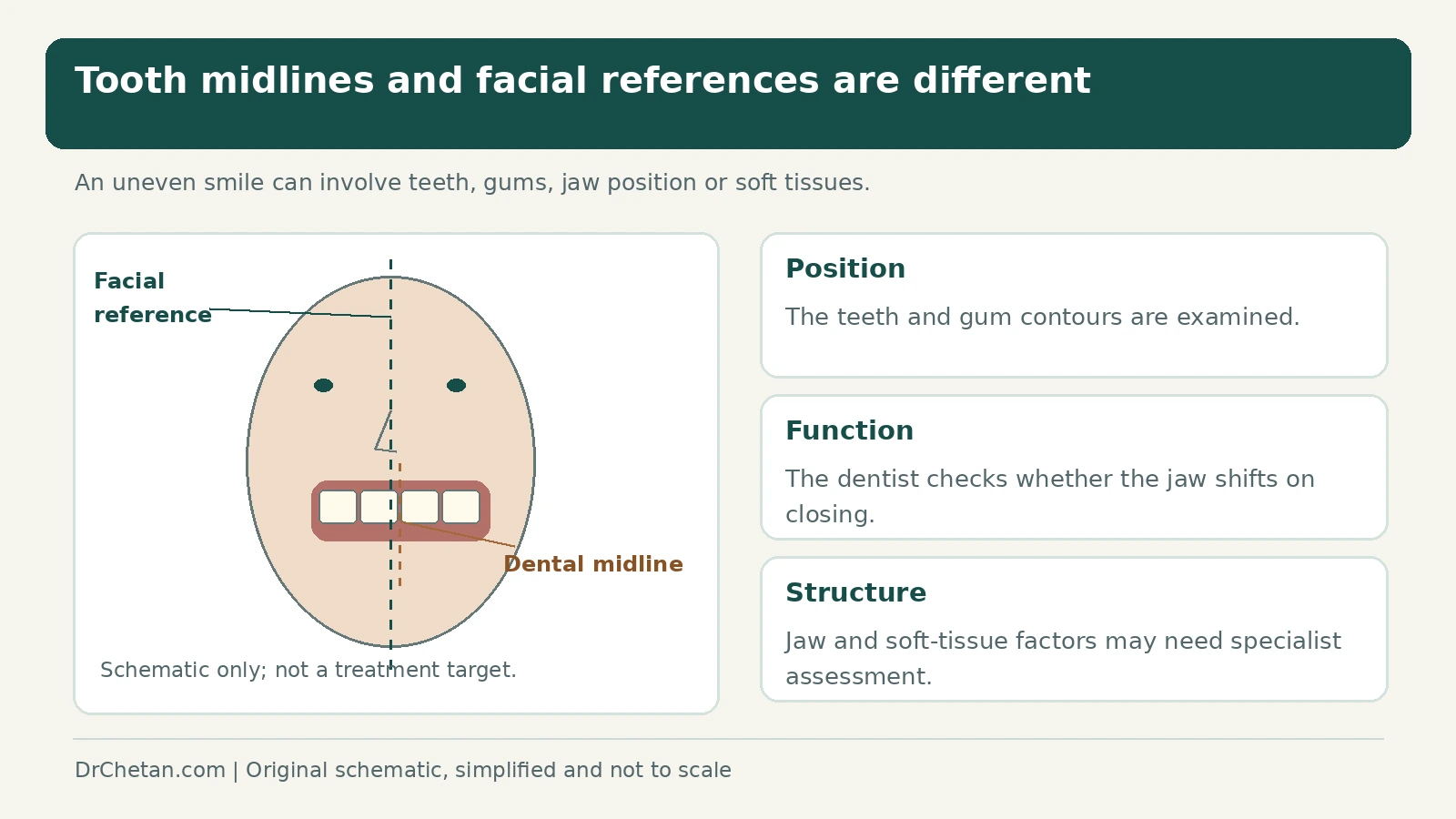
The visible effect may come from tooth positions, a dental midline that does not line up with the face, an uneven gum display or a tilted bite plane. A functional shift means the lower jaw moves to one side as the teeth close together. Differences in jaw growth or structure, previous trauma, missing teeth and soft-tissue features may also be relevant.
Camera angle, head tilt and close-range phone lenses can exaggerate differences. This does not mean a concern should be dismissed; it means the dentist needs to compare a natural head position, facial movement and the actual bite rather than diagnose from one image. Cosmetic tooth treatment cannot correct every source of facial asymmetry.
What happens at the first appointment?
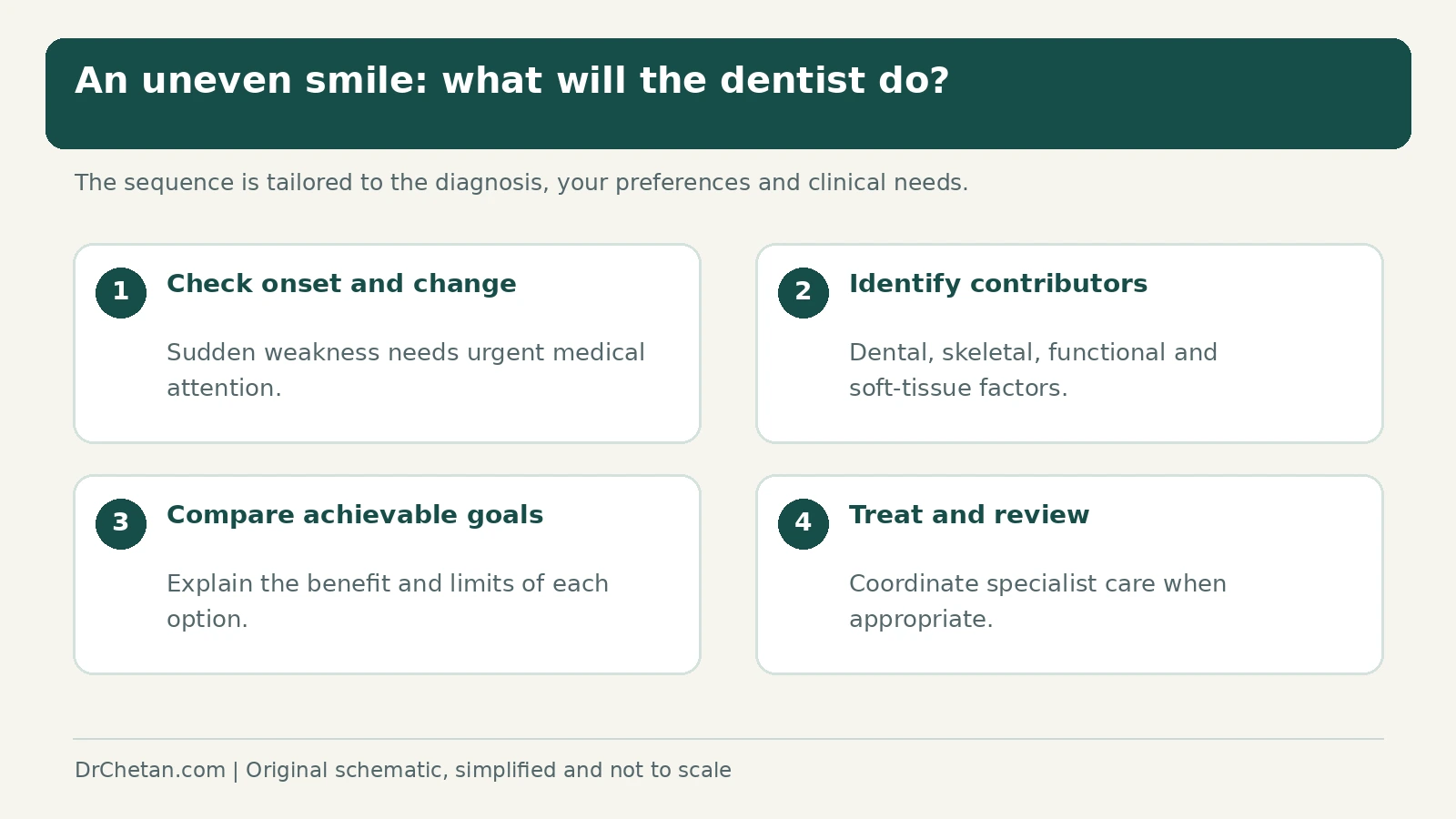
The dentist asks when you first noticed the difference, whether it is changing and what you would most like improved. Mention chewing difficulty, jaw pain or locking, previous injury, orthodontic treatment, missing teeth and changes in sensation. Older photographs or dental records may help establish whether something is longstanding.
The examination looks at the face at rest and smiling, tooth and facial midlines, gum contours, how the teeth meet and how the jaw moves on opening and closing. The clinician also checks oral health. Photographs, scans or impressions and selected radiographs may be appropriate. Three-dimensional imaging is reserved for questions where it adds useful information, not prescribed automatically for every uneven smile.
When can dental treatment alone help?
If a specific tooth-shape problem, worn edge, missing tooth or restoration is making the smile look uneven, a conservative restoration or tooth replacement may help. Gum treatment can be relevant for an uneven gumline after the cause is established. Planning should show which feature will change and which will remain.
Bonding, veneers and crowns have different preparation and maintenance needs. Covering teeth to create a straighter-looking line is not the same as moving them or repositioning a jaw. Ask how much healthy tooth structure would be removed and whether a less invasive option could meet your goal.
When is orthodontic treatment appropriate?
An orthodontist assesses tooth positions, bite relationships and whether a shift occurs when the teeth meet. Braces or aligners can move teeth and improve selected dental discrepancies. Some growing children benefit from timely management of a functional crossbite or other bite problem; assessment should not be delayed simply because the issue appears cosmetic.
In adults, orthodontics alone cannot reposition a substantially asymmetric jaw skeleton. Sometimes a tooth-based compromise is acceptable; in other cases it would not give the desired function or appearance. The clinician should explain the limits rather than promise that aligning teeth will make both sides of the face identical.
What if the jaw bones are the main contributor?
For selected significant skeletal discrepancies, an orthodontist and oral and maxillofacial surgeon assess whether orthognathic surgery is suitable. They review growth, the bite, jaw joints, photographs and imaging, and agree goals with you. A treatment plan may involve one or both jaws, sometimes with a separate chin procedure when indicated. These are individual decisions, not a standard package for everyone with an uneven smile.
Treatment commonly includes orthodontic preparation, surgery under general anaesthetic, a period of healing and orthodontic finishing. During surgery, planned sections of the jaw are repositioned and secured, usually with plates and screws. The team explains the actual operation, recovery and dietary and cleaning instructions in detail before consent.
What are the limits and risks of jaw surgery?
Possible problems include bleeding, infection, swelling, altered sensation, a bite that needs further adjustment and relapse or residual asymmetry. Numbness, particularly around the lower lip and chin after some lower-jaw procedures, may persist. The risks depend on the procedure and patient; ask your surgeon for the relevant individual discussion rather than relying on a general percentage online.
Improvement is not the same as perfect symmetry. Soft tissues and facial movement do not always follow a digital bone plan exactly. Jaw surgery is also not a guaranteed cure for temporomandibular joint pain; joint symptoms need their own assessment and can respond differently.
Can exercises, chewing on one side or fillers fix it?
Do not deliberately overload one side of the jaw or use devices that promise to reshape adult jaw bones through forceful chewing. An unexplained asymmetry needs diagnosis first. Selected soft-tissue treatments belong with a suitably qualified clinician and address different features from tooth or skeletal correction.
If no disease or meaningful functional problem is found, choosing no treatment or accepting a limited change can be reasonable. You should have room to weigh the expected benefit against cost, irreversibility, recovery and maintenance without being told that a normal variation must be fixed.
What should I ask the treating team?
- Is the main issue dental, skeletal, functional or soft tissue?
- Is it stable, or does it need investigation before cosmetic treatment?
- What improvement is realistic with the least invasive suitable approach?
- What would remain uneven after the proposed treatment?
- Would a specialist opinion help me compare the options?
The aim is a diagnosis and an achievable plan that matters to you, rather than treating a photograph as proof that the face needs correction.
Frequently asked questions
Is mild facial asymmetry always a problem?
No. Small differences are common. Assessment is useful when the feature concerns you, affects function or is new or changing.
Can braces make my jaw bones symmetrical?
Braces move teeth. They may improve a dental discrepancy or some functional shifts, but they cannot correct every adult skeletal asymmetry.
Does every uneven jaw require surgery?
No. The cause, severity, growth, symptoms and your goals determine whether monitoring, dental care, orthodontics or a surgical assessment is appropriate.
Will jaw surgery guarantee a perfectly symmetrical face?
No. Residual differences, soft-tissue responses and relapse can limit the result. Agree realistic goals with the team.
What if one side of my face suddenly droops?
Seek urgent medical attention. Possible stroke symptoms such as facial weakness, arm weakness or speech difficulty require emergency help, even if they improve.
Related reading: How to brush and clean teeth with braces.
Sources and further reading
- British Orthodontic Society: Your jaw surgery
- British Orthodontic Society: Orthodontics for adults
- Cambridge University Hospitals: Jaw and chin corrective surgery
- Cambridge University Hospitals: Lower-jaw osteotomy risks
- NHS: Symptoms of a stroke
Educational information for patients. Diagnosis and treatment depend on an examination and your individual circumstances. Consultation artwork is AI-created; explanatory visuals are original simplified educational graphics.

Leave a Reply