
Getting braces changes the way your teeth fit together—and the way you need to clean them. A quick brush across the front surfaces can leave you feeling finished while missing the edges of brackets and the spaces underneath the wire.
Fixed braces create extra places for food and plaque to collect. They make cleaning more demanding, so a clear routine matters. You still need to look after the teeth and gums throughout treatment, not just the appliance attached to them.
This guide explains a practical routine for fixed braces. Use it alongside the instructions from your own orthodontic team, who can demonstrate the tools and movements that suit your appliance.
Why clean teeth matter during orthodontic treatment
The goal is healthy teeth and gums as well as a better-aligned smile.
Plaque left around brackets can contribute to early tooth decay. One possible sign is a chalky white area on the enamel, often called a white spot lesion. These marks are different from food stuck around a bracket: they can represent mineral loss from the tooth surface.
Do not assume a new white patch will simply disappear when the brace comes off. Ask your dentist to assess changes in the appearance of your teeth.
How often should you brush with braces?
Brush at least twice daily with fluoride toothpaste, including last thing before bed. Allow at least two minutes, and give yourself enough time to clean thoroughly rather than stopping because a timer has finished.
Your orthodontist may advise extra cleaning after meals. NHS braces guidance includes brushing in the morning, at night and after meals. Follow the schedule your team gives you, including any advice about timing after acidic food or drinks.
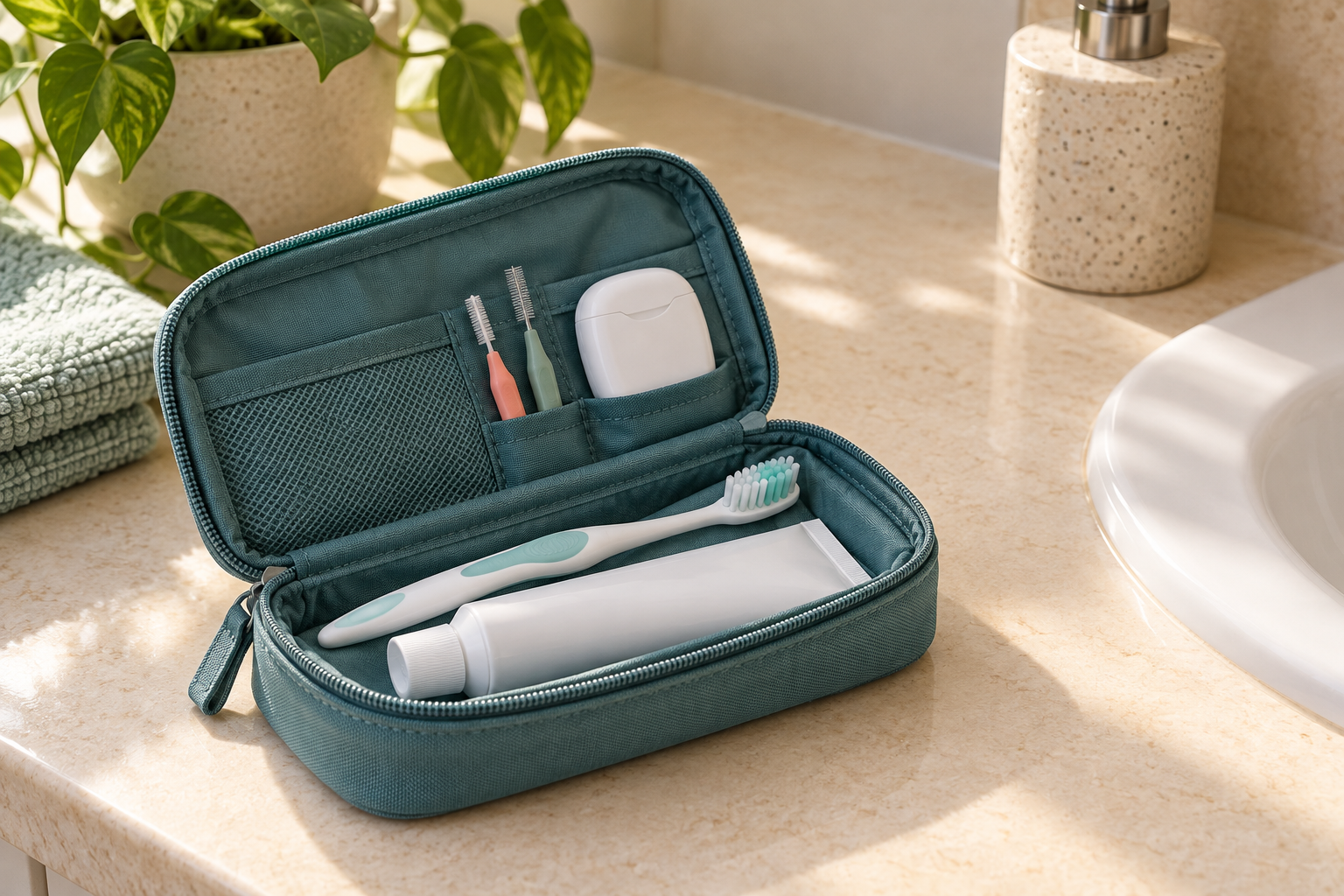
Planning is useful here. A brush at home does not help much if the cleaning session you repeatedly miss is at college or work. A small travel kit can make your prescribed routine more practical.
What do you need?
Keep the kit simple:
- A small-headed, soft-bristled toothbrush that lets you reach around the appliance comfortably.
- Fluoride toothpaste. For teenagers and adults, a standard concentration of 1,350–1,500 ppm fluoride is appropriate unless your dental team recommends otherwise. Higher-strength toothpaste should be used only as directed.
- Interdental brushes in the sizes your orthodontist or hygienist recommends.
- A floss threader or another suitable aid if your team recommends it for cleaning between teeth beneath the archwire.
An orthodontic or single-tufted brush may also be useful for particular areas. Ask someone to show you which part of the cleaning routine each tool is for.
How to brush fixed braces, step by step
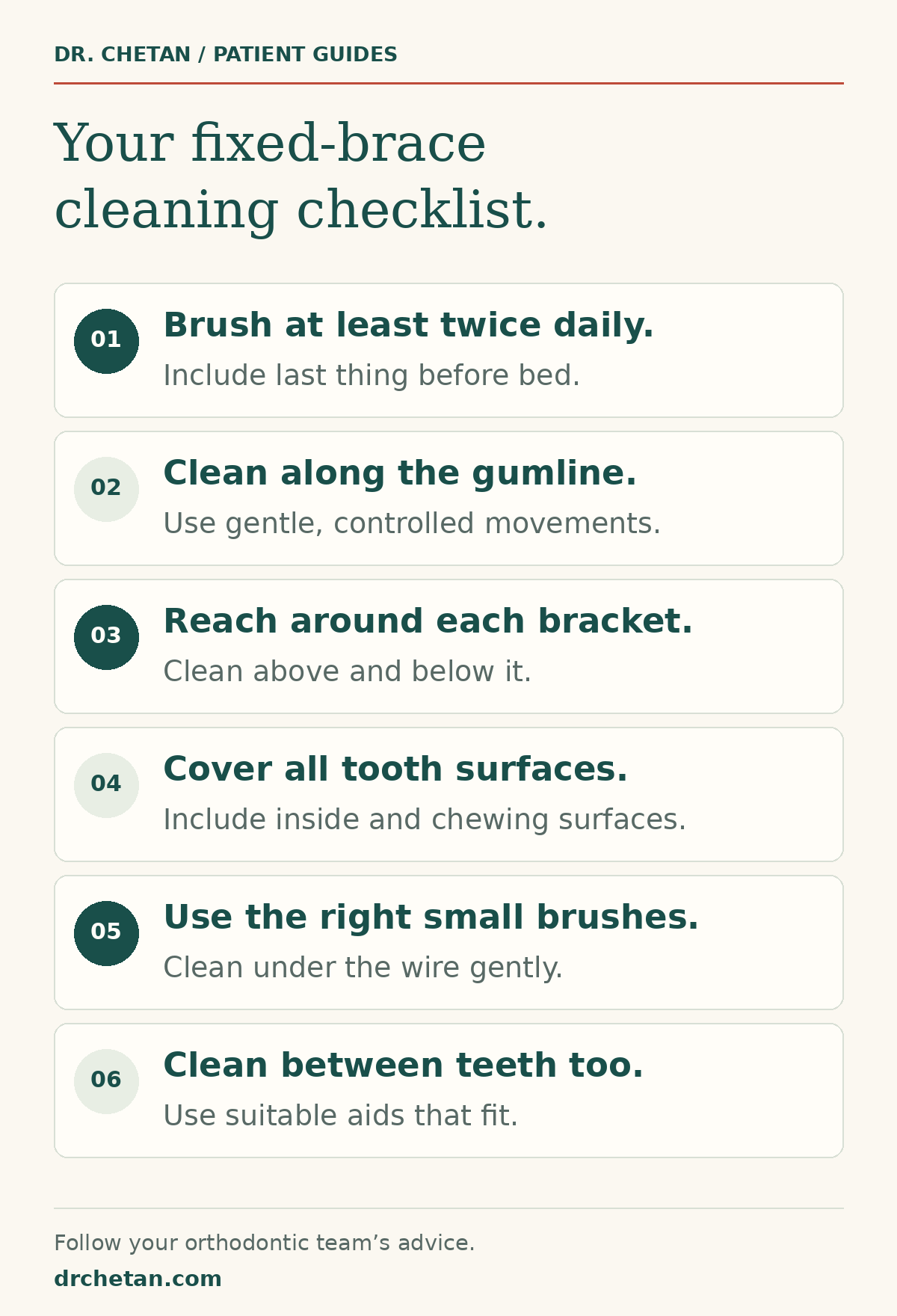
1. Look in the mirror
Start where you can see what you are doing. Notice the gumline, the brackets and the wire. These are separate landmarks; cleaning only the most visible metal parts will not cover all the tooth surfaces. Looking in a mirror can help you follow the route. [9]
2. Clean where the teeth meet the gums
With a manual brush, angle the bristles gently towards the gumline, roughly 45 degrees, and use small, controlled movements. Avoid pressing hard or scrubbing across the whole row.
Work through a short section, then move to the next. Think of this as cleaning the margin beside the gum rather than pushing the bristles into it.
3. Clean above and below each bracket
Change the direction of the brush so you can reach the tooth surfaces on both sides of the bracket: towards the gum and towards the biting edge. Clean around the bracket itself too. Use gentle movements and progress along both jaws.
Rather than waving the brush across the wire, pause at each section and ask: have I cleaned the tooth above this bracket and below it?
4. Include the inside and chewing surfaces
The brace does not remove the need to clean the surfaces facing your tongue and the roof of your mouth. Clean these, then the chewing surfaces of the back teeth. Behind the front teeth, a manual brush can be held more vertically for gentle up-and-down strokes.
5. Use the small brush around the appliance
Use the interdental or orthodontic brush your team has demonstrated to reach between brackets and underneath the wire. Guide it gently into the accessible spaces. Do not use it as a lever against the wire or force it into your gums.
The purpose is to remove plaque and trapped debris, not to move the appliance.
6. Clean between the teeth as well
Cleaning underneath the wire and cleaning between two neighbouring teeth are related tasks, but they are not identical.
An interdental brush can clean a suitable space between teeth if it fits comfortably. Tight contacts may need floss. A floss threader can help you pass floss under the wire so you can reach the tooth surfaces. Ask for a demonstration before trying to work out the route by pulling harder.
When using floss, curve it against one tooth and clean gently, then clean the neighbouring tooth. Avoid snapping it into the gum.
7. Spit out the toothpaste
Finish by spitting out excess toothpaste rather than immediately rinsing with water. This helps keep fluoride from the toothpaste on your teeth.
If you have been advised to use a fluoride mouthwash, use it at the separate time recommended by your orthodontic team. Mouthwash does not replace brushing or cleaning around the brace.
A quick check before you put the brush away
Use the same mental checklist each time:
| Area | Have you included it? |
|---|---|
| Gumline | Along both upper and lower teeth |
| Brackets | Above, below and around each one |
| Wire | Accessible spaces underneath it |
| Back teeth | Including the less visible areas |
| Inside surfaces | Facing the tongue and palate |
| Chewing surfaces | The biting surfaces of back teeth |
| Between teeth | With suitable aids that fit |
The order can be whichever you remember best. What matters is having a route rather than moving randomly around the easiest places to reach.
How can you see plaque you have missed?
Your dental team may suggest disclosing tablets. These temporarily colour plaque so that areas you have missed become easier to see. They can turn a vague instruction such as “clean more carefully” into a specific area to work on.
Use them according to their instructions and your clinician’s advice. If colour keeps appearing in the same place, show that area at your next appointment and ask for a more effective way to reach it.
What if brushing is uncomfortable after an adjustment?
Some discomfort can occur after fitting or adjusting braces. A small brush and controlled movements may make the routine easier to manage. Do not assume that all continuing pain is simply part of treatment.
If a wire rubs or a component becomes loose, contact your orthodontic team for advice. Orthodontic wax may help with rubbing when used as they have shown you. Do not leave a damaged appliance until your next routine appointment without letting them know.
What if your gums bleed?
Bleeding, swollen or sore gums need attention. They can be signs of gum disease, so do not dismiss recurring bleeding as an unavoidable effect of wearing braces.
Continue gentle oral hygiene and arrange a dental assessment. Your dentist or hygienist can check the gums, the brush sizes and the way you are cleaning. Scrubbing harder is not a substitute for finding the cause.
Food and drink still matter
A thorough cleaning routine does not cancel out frequent sugary snacks or drinks. Reduce how often you have them, especially between meals. Frequent acidic drinks can also damage teeth.
Hard, sticky or very chewy foods can damage brackets and wires. Follow your orthodontist’s advice; cutting suitable foods into smaller pieces may make eating easier without biting directly into them.
The aim is a manageable daily routine, not feeling that you have to compensate for every snack by brushing more forcefully.
Keep seeing your regular dentist
Orthodontic appointments and routine dental checks serve different purposes. Continue seeing your regular dentist during treatment so that tooth decay and gum problems can be assessed as well as the progress of tooth movement.
Take your cleaning aids to an appointment if you are unsure about them. Ask the clinician to watch you demonstrate your usual method. It is easier to correct a movement you can both see than to interpret a general instruction afterwards.
Questions patients often ask
Can I use an electric toothbrush with braces?
Yes. A suitable powered brush or manual brush can be used. With a powered brush, follow the model’s instructions and let the head work on each surface rather than adding vigorous scrubbing. Ask your team to demonstrate positioning around your brackets.
Will a water flosser clean everything?
A water flosser may help some people with braces reach awkward areas. It does not replace toothbrushing. Ask how it should fit into your plan rather than automatically dropping the interdental aids your orthodontist has recommended.
Do ceramic braces need careful cleaning too?
Yes. The aim is to clean the teeth, gumline and areas around the appliance, not just keep the visible brackets looking tidy. Ask your team for any instructions specific to your bracket type.
How do I know whether I am doing enough?
Ask for feedback at your dental and orthodontic appointments. You can say: “Which areas am I missing, and could you show me how to reach them?” A clear answer should leave you knowing what to change at home.
References
- NHS: Braces.
- Cochrane Oral Health: Fluorides for preventing early tooth decay during fixed brace treatment.
- British Orthodontic Society: The role of the orthodontist in maintaining oral health, 2024.
- University Hospitals Plymouth NHS Trust: Your fixed brace.
- American Dental Association, MouthHealthy: Brushing Your Teeth.
- Barts Health NHS Trust: How to keep your teeth and gums healthy whilst wearing braces.
- US Health Resources and Services Administration: Oral Health for Adults.
- North Cumbria Integrated Care: Advice to patients undergoing orthodontic treatment.
- Queen Victoria Hospital: Oral health advice for patients with fixed braces.
- NHS: How to keep your teeth clean.
- Dorset County Hospital: Advice for looking after your fixed brace.
- Royal Devon University Healthcare NHS Foundation Trust: Instructions for wearing your fixed orthodontic brace.
- NHS: Gum disease.
- Nottingham University Hospitals: Orthodontics — oral hygiene.
- American Dental Association, MouthHealthy: Water Flossers and Water Flossing.
- Association of Orthodontists Singapore: Taking Care of Your Braces.
Leave a Reply