
Showing gum when you smile can be a normal, healthy variation. If it bothers you, a dentist can help explain what contributes to it and whether treatment would be worthwhile. The right approach depends on the gums, teeth, lips and jaw relationship; removing gum is only one possible option.
What is a gummy smile?
A “gummy smile” is a common description for a smile showing more upper gum than a person would prefer. It is not, by itself, a diagnosis of disease. There is no single amount of visible gum that makes every smile need treatment. Your comfort, oral health and treatment goals matter more than copying someone else’s smile photograph.
Some people show extra gum because it covers more of the tooth surface. Others have a lip that lifts higher during smiling, a difference in tooth position, or a vertical jaw relationship that makes more gum visible. More than one factor can be involved. A still photograph cannot tell the dentist which is responsible.
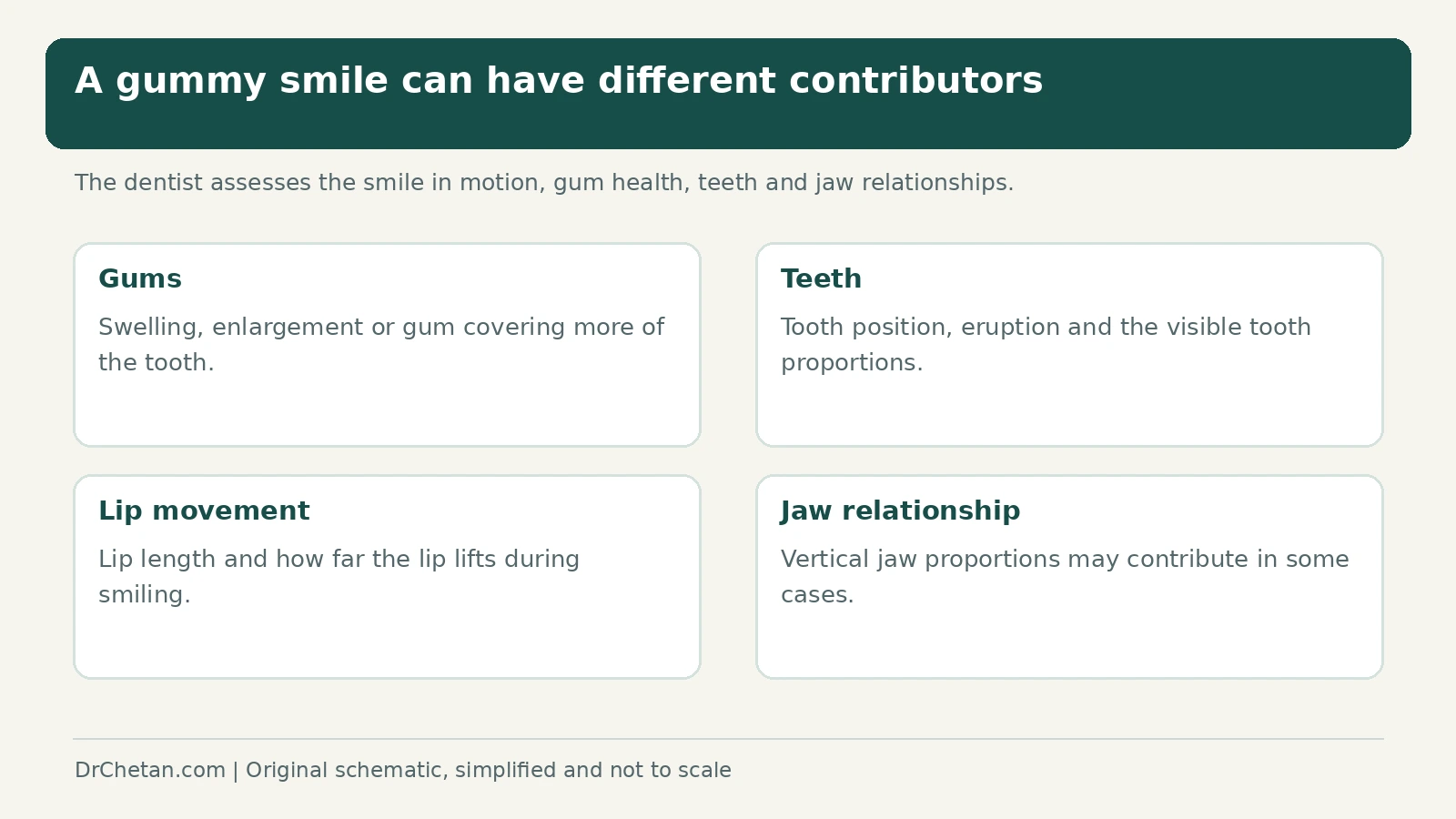
What will the dentist examine?
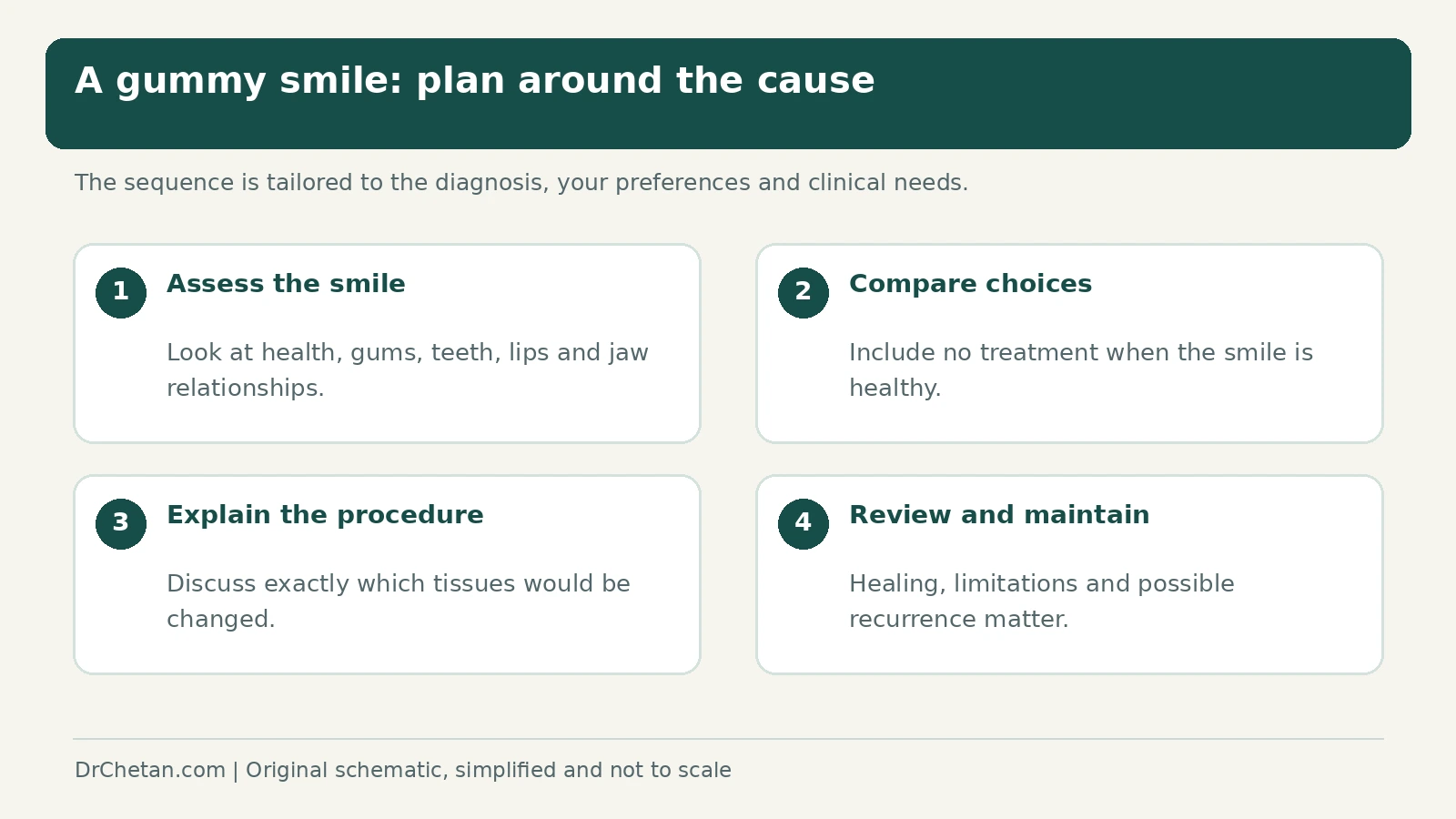
The dentist looks at your smile at rest and in motion, tooth proportions, lip movement, the gum edges and your bite. They ask what you would like changed and whether the appearance is longstanding or recent. Photographs or a short smile video may help with planning. Gum measurements and selected X-rays may be needed to understand the relationship between tooth, gum and supporting bone.
Tell the dentist about bleeding, swelling and medicines you take. Some medicines can contribute to gum enlargement. Do not stop or change a prescribed medicine yourself: the dentist and prescribing clinician can discuss appropriate options. Inflamed or enlarged gums need a health assessment before a cosmetic plan.
Ask: “Which factor is creating the gum display in my case, and what would your proposed treatment actually change?” This helps distinguish a treatment matched to the cause from a general offer of “laser smile correction”.
What if swollen or enlarged gums are contributing?
The first step may be professional cleaning, better plaque control and management of a contributing condition or medicine. After inflammation settles, the dentist reassesses the gum contour. Some persistent enlargement may need additional treatment, but the appearance should be judged after the gum-health plan has had a chance to work.
A healthy, stable smile may need no treatment. Choosing to keep it is a reasonable option, especially if the likely cosmetic benefit is small compared with the preparation, risks or maintenance involved.
How does crown lengthening work?
When gum covers an excessive portion of otherwise suitable teeth, a periodontist may recommend crown lengthening. This exposes more of the natural tooth; it does not mean every tooth will receive an artificial crown. Planning considers tooth proportions and the tissues needed to keep the gum attachment healthy.
Under local anaesthetic, the surgeon reshapes and repositions the gum. In some cases, a flap is raised and the underlying bone contour is adjusted as well. The tissues may be secured with stitches. Some situations need gum reshaping alone, but that decision depends on measurements rather than simply how short the teeth look.
You receive instructions about cleaning, food, protecting the area and follow-up. The gum contour changes as it heals, so a final appearance or any later restorative work should be assessed at an appropriate review. Ask about temporary soreness, sensitivity, recession, visible spaces and the chance that the result may not match the initial plan exactly.
Further reading: American Academy of Periodontology: Surgical procedures and crown lengthening.
Is a laser always better than conventional surgery?
A laser is a tool, not a diagnosis or a complete treatment plan. It can be suitable for selected soft-tissue procedures. It does not remove the need to assess bone levels, lip movement or jaw position. Whether a scalpel, laser or another technique is used, the important questions are what tissue is being changed, why it is needed and how healthy support will be preserved.
Avoid judging treatment by promises such as “no pain”, “permanent perfect gums” or “one solution for every gummy smile”. Ask for the expected benefit and limitations for your own anatomy.
When might orthodontics, lip treatment or jaw surgery be discussed?
Orthodontic treatment may help when tooth position is a major contributor. In selected lip-related cases, a qualified clinician may discuss temporary muscle-relaxing injections or a lip-repositioning procedure. These approaches have different risks, recovery needs and durability; they do not shorten an excessive jaw or treat gum disease. Temporary effects can wear off and surgery can relapse.
If jaw position or vertical jaw proportions are a substantial part of the problem, an orthodontist and oral and maxillofacial surgeon may assess whether combined orthodontic and jaw treatment is appropriate. This is a major decision with alternatives and possible complications. Many people showing extra gum do not need that approach.
Will I also need veneers or crowns?
Not automatically. Restorations may be appropriate if there are separate tooth-shape, wear or damage concerns. Healthy teeth should not be prepared for crowns simply because some gum shows in a smile. Ask whether gum or orthodontic treatment alone would meet your goal, and how much sound tooth structure any restoration would remove.
What should I ask before deciding?
- What is the diagnosis, and is this a health issue or an optional cosmetic change?
- What are the alternatives, including no treatment?
- Will only gum be changed, or will bone, teeth, lip movement or jaw position be involved?
- How long should healing or treatment take before judging the result?
- What could recur, and what future treatment or maintenance might be needed?
An informed choice includes understanding what will stay the same as well as what may improve. A planned reduction in gum display is a realistic goal; an exact permanent copy of a digital preview is not a guarantee.
Frequently asked questions
Is a gummy smile unhealthy?
Visible gum alone does not establish disease. Swelling, bleeding or a recent change should be assessed, while a longstanding healthy smile may need no treatment.
Does crown lengthening mean getting crowns?
No. The name describes exposing more natural tooth structure. An artificial crown is a separate restoration that is needed only when the tooth and treatment plan justify it.
Can all gummy smiles be fixed with a laser?
No. Gum, tooth position, lip movement and jaw factors need different approaches. A laser cannot correct every cause.
Are injections a permanent correction?
Muscle-relaxing injections have temporary effects and are relevant only to selected lip-related cases. Suitability and risks require an individual clinical assessment.
Can I keep my smile as it is?
Yes. If it is healthy and you do not want a cosmetic change, treatment may be unnecessary. The dentist can explain any health findings separately.
Related reading: How to brush your teeth properly.
Sources and further reading
- American Academy of Periodontology: Cosmetic procedures
- American Academy of Periodontology: Surgical procedures and crown lengthening
- Australian and New Zealand Academy of Periodontists: Gummy smile
- British Orthodontic Society: Jaw surgery explained
Educational information for patients. Diagnosis and treatment depend on an examination and your individual circumstances. Consultation artwork is AI-created; explanatory visuals are original simplified educational graphics.

Leave a Reply