
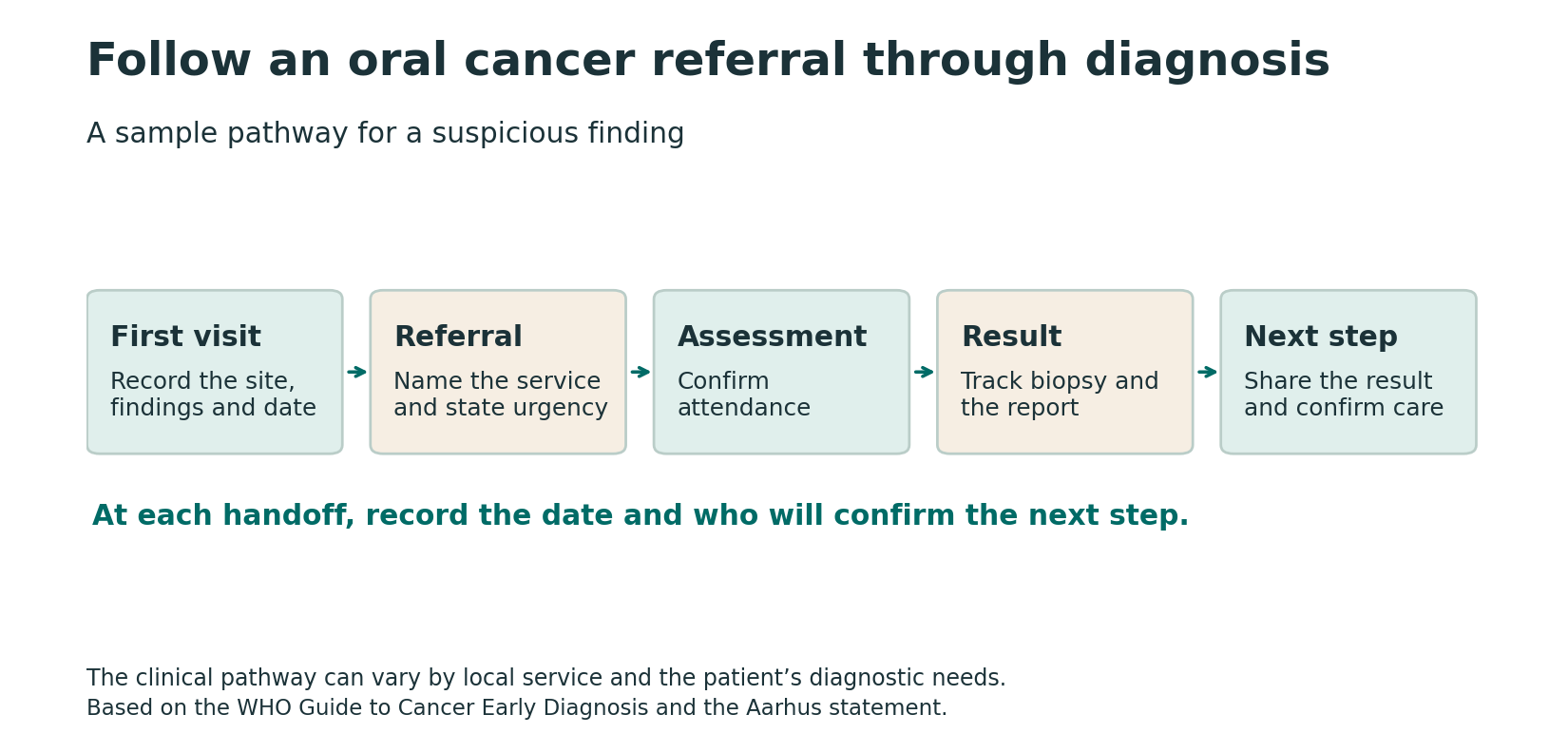
A patient notices a tongue ulcer and visits a dental clinic after several weeks. The clinician refers them, but the patient cannot take a day off to travel to the hospital. The appointment is missed. When the patient eventually attends, a biopsy is performed and the report goes to a different clinic. Each step has its own time interval and a different person or service that can help. Dental students can improve this pathway by identifying suspicious findings, communicating urgency and tracking whether referral, biopsy and communication actually happen. [1, 2, 3, 4]
Put dates on the pathway
The Aarhus statement recommends defining the beginning and end of each interval when studying early cancer diagnosis. Start with the first noticed symptom or sign for symptomatic patients, where that date can be estimated. The first clinical presentation, referral, diagnosis and treatment are separate events. A screening-detected finding may have no symptom onset date. Record the date and context in which it was detected, then follow the same diagnostic handoffs. [1, 2, 4]
| Interval | Example start and end | What can lengthen it |
|---|---|---|
| Patient interval | First noticed symptom to first presentation to a healthcare professional | Uncertain significance, intermittent symptoms, travel, cost or inability to leave work. |
| Primary care interval | First presentation to referral or transfer of responsibility | Incomplete assessment, a provisional benign explanation, lack of reassessment or uncertainty about where to refer. |
| Diagnostic interval | First presentation to an agreed date of diagnosis | Time before referral plus appointment, biopsy, pathology and communication steps. |
| Treatment interval | Diagnosis to start of definitive treatment, with both dates defined | Additional staging, multidisciplinary planning, travel, financial barriers or capacity. |
The primary care interval can be part of the diagnostic interval. Adding them can count the same days twice. In the clinical record, note whether the date came from the patient’s estimate, a referral letter or a confirmed appointment or report. Use the same endpoint definition when comparing cases. The date a specimen is taken, the date a report is signed and the date the patient is told may all differ. [1, 2]
What studies from India can tell us
A study of 261 patients with histologically confirmed oral cavity SCC recruited at a cancer centre in northern Kerala reported a median diagnostic interval of 36 days, with an interquartile range of 14 to 76.5 days. The advice received and number of healthcare providers consulted were among the factors associated with the interval in that study. This is evidence about a defined sample and its healthcare pathway. It does not establish the typical interval for every state, and the study’s chosen cutoff for analysis does not give a waiting period for an individual suspicious lesion. [2, 3, 5]
Other Indian hospital studies describe time spent before first presentation and across diagnosis and treatment. A hospital sample includes people who reached the participating centre. It can miss those who never completed referral, sought care elsewhere or died before ascertainment. Recall of symptom onset can be uncertain. The meaning of “first contact” can also differ between studies, especially when patients consulted several services. Compare definitions, sampling and the local referral context before comparing medians. [2, 6, 7]
Population-based registries describe cancer incidence within their catchment areas. Hospital-based records describe patients seen by participating facilities. Neither type alone can reconstruct the steps between symptom, first presentation and treatment without linked information. A service improvement project can start with its own referral log and define what it can reliably measure. Keep patients whose diagnosis is still pending visible in the log. [1, 2, 8]
Ask about barriers without assigning blame
An early oral cancer can cause little pain, and patients may reasonably expect a mouth sore to resolve. Other barriers include unclear referral instructions, transport costs, lost wages, difficulties finding the right clinic and competing family responsibilities. Some patients first seek help for pain or an extraction, then face several appointments for the underlying lesion. Ask what happened between visits and what would make the next step difficult. The answer is often more actionable than labelling the patient as a late presenter. [1, 5, 6, 7]
Barriers can also arise inside the clinic. An unexplained lesion may be described too broadly to convey concern, or a recommendation to “see a specialist” may lack a destination or timeframe. A biopsy report may be available without the referring clinic knowing. A referral is most useful when the next service is named, the urgency is clear and someone knows to check the outcome. [1, 3, 4, 5]
Make the first encounter count
Examine the finding and the rest of the accessible mouth and neck. Record the exact site, duration, changes, dimensions, surface, induration, fixation, relevant exposures and any limitation of view. Include the reason a common dental explanation fits poorly. An enlarging socket mass or a firm ulcer can warrant prompt biopsy by an appropriately trained clinician or referral to a specialist. Arrange assessment on the strength of the clinical findings even when the exposure history is uncertain. [3, 9, 10, 11]
A plausible benign explanation may support a short, planned review in selected cases. Document what you addressed and book the reassessment before the patient leaves. ADA’s 2026 chairside guide advises biopsy or referral when a finding managed by watchful waiting persists beyond 10 to 14 days without a definitive diagnosis and treatment plan. Suspicious findings warrant prompt action at presentation. A series of untracked trials of treatment can add time while the original question remains unresolved. [3, 9, 11]
Where possible, identify the specific service that can assess the lesion. Indian programme material describes referral to a linked service with arrangements for confirmation and biopsy where indicated. The actual site may depend on the district and referral network. Give the patient a clear explanation of why tissue assessment may be needed and a way to contact the clinic if the planned route becomes difficult. [1, 3, 4]
Close the referral loop
Record who will contact the receiving service or check attendance, and on what date. A practical referral log might include the referral sent, appointment offered, attendance confirmed, biopsy done, result received and result communicated. A case can be “referred” and still have no scheduled visit. Mark each step separately. If the patient misses the appointment, work within the clinic’s contact procedures to clarify the barrier and re-establish a path to care. [1, 2, 4]
The team should also distinguish time required for appropriate workup from avoidable gaps. Imaging and multidisciplinary planning may be needed before treatment. A missed handoff, report routed to the wrong clinic or unclear instruction can be investigated and corrected. If the clinic audits its pathway, use case dates, report missing data and review both the median and unusually long intervals. A median alone can obscure the people who waited longest. [1, 2, 7]
Make the patient’s next step easy to repeat
After explaining the finding, ask the patient to describe the plan in their own words. A patient who expects a routine cleaning appointment may not realise that the referral is for a persistent lesion and possible biopsy. Confirm which clinic they should contact, when they should attend and who will check the outcome. If transport or cost is a barrier, establish what assistance or alternative appointment routes exist through the local service. Avoid promising access that the receiving service has yet to confirm. [1, 4]
In a teaching clinic, hand over unresolved referrals when a student rotates away. The referral record should include a responsible team or clinician and the date by which the next event will be checked. A patient who has seen several clinicians should not have to reconstruct the whole history for every new appointment. Share relevant findings and dates through the authorised clinical channel, with the patient’s information handled according to local requirements. [1, 2, 4]
Apply the framework to two chairside cases
The referral is sent but the appointment is missed. An adult with a progressive lateral-tongue ulcer is referred to a district service. At follow-up the clinic learns that the patient could not attend because the only available transport required a day away from work. Document the missed step and contact the receiving service through the local pathway. Clarify the available appointment and how the clinic will confirm attendance. The lesion remains a diagnostic priority. [1, 3, 4]
A biopsy result arrives at the wrong clinic. A person has a biopsy after a suspicious socket lesion is assessed. The referring dentist has no report, and the patient assumes silence means a reassuring result. Verify where the specimen went and who is responsible for obtaining and communicating the result. Record the date the result becomes available and the date the patient is informed. If the report does not explain the clinical finding, coordinate further assessment with the treating service. [1, 2, 3]
A dental referral is complete when the next clinical action and its outcome are known. The most useful first improvements are often concrete: name the service, state why the finding is concerning, book or clarify the next contact and assign responsibility for checking the result. [1, 3, 4]
References
- WHO. Guide to cancer early diagnosis, 2017.
- Weller et al. The Aarhus statement on early cancer diagnosis research. British Journal of Cancer, 2012.
- ADA. Oral Cancer Guideline, 2026 update.
- India National Health Mission. NCD medical officer training module.
- Mappalakayil and Srinivasan. Patient and health system factors in the oral cancer diagnostic interval in Kerala. ecancer, 2024.
- Time intervals and patient-level factors in oral cancer diagnostic pathways in India.
- Delay in diagnosis and treatment of oral cancer in a public hospital in India. Cross-sectional study.
- ICMR-NCDIR. National Cancer Registry Programme Report 2020.
- ADA. Chairside Guide to the Early Detection of Oral SCC and Potentially Malignant Disorders, 2026.
- NIDCR. Oral Cancer.
- NICE NG12. Suspected cancer recognition and referral, oral cancer section.

Leave a Reply