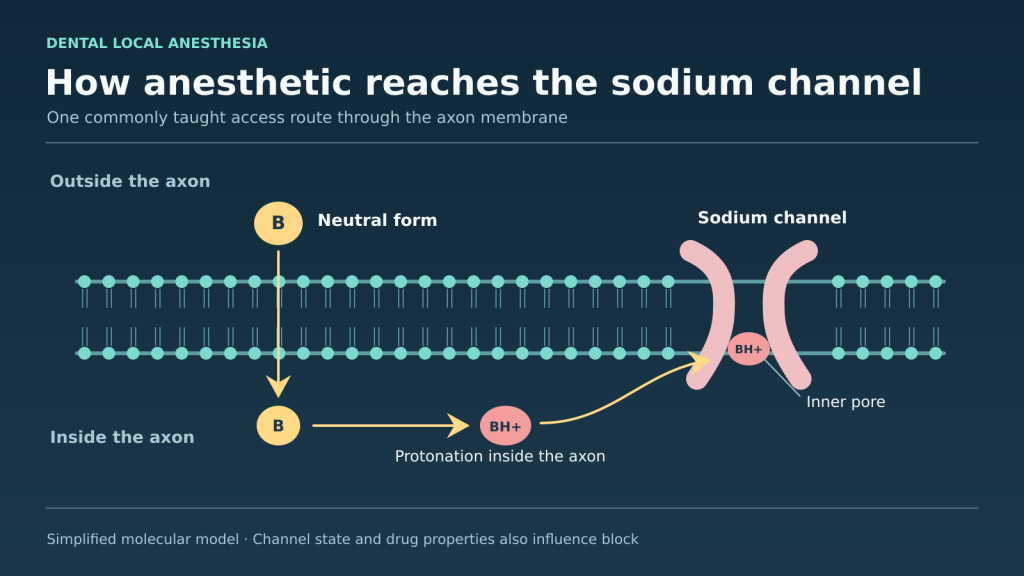
Many dental local anesthetics are weak bases. In solution, some molecules are uncharged and some are protonated. Their balance affects movement through tissue and across membranes. Once sufficient drug reaches sodium channels in an axon, it reduces the current needed for an impulse to propagate. [1, 2]
From the injection site to the axon
An injected solution creates a drug depot in tissue. The drug diffuses away from that depot, encounters connective-tissue barriers and is simultaneously subject to vascular uptake. The concentration at the nerve changes over time. Drug that remains in the region long enough can reach the axonal membrane.
In the classic teaching model, the uncharged form crosses lipid membranes more readily. Inside or near the membrane, the molecule can equilibrate with its protonated form. Protonated drug can interact with the channel’s inner pore. This is a useful starting model. Experimental work supports more than one access pathway, including interactions that depend on the drug, channel state and membrane environment. Treat the two forms as a dynamic equilibrium. [2, 3, 4]
Channel state affects inhibition
Voltage-gated sodium channels cycle through resting, open and inactivated states. Local anesthetics can show greater inhibition when channels are repeatedly activated. Use-dependent block describes inhibition that can build with repeated channel use under specified conditions. State-dependent binding describes how the channel’s conformation changes the interaction. The terms are related. They describe a mechanism in an experimental or physiological context and cannot predict the success of a particular injection by themselves. [4, 3]
As sodium conductance falls, the next segment may fail to reach threshold. Clinical anesthesia therefore depends on sufficient effect across the relevant fibers and nerve length. A full block of every channel is unnecessary, and the presence of some drug near a nerve does not guarantee enough inhibition.
Why pH enters the explanation
For a weak base, lower pH generally shifts the equilibrium toward the protonated form. That can reduce the neutral fraction available for membrane passage. The neutral fraction also depends on the drug’s pKa. This helps explain why the chemical environment can affect onset. It does not explain every anesthetic failure in inflammation. Delivery distance, vascular uptake, altered excitability and the disease context also influence the result. [3, 1, 5]
For a mandibular molar with an inflamed pulp, the conventional inferior alveolar block is placed away from the pulp. Acidity at the inflamed pulp and acidity at the injection site are different questions. When the lip becomes numb but the tooth remains sensitive, consider the endpoint, timing, anatomy and pulp diagnosis before attributing the failure to one mechanism. [5]
Local effects and systemic exposure
Sodium channels are present in excitable tissues throughout the body. If enough drug reaches the circulation, effects can occur outside the intended nerve field. The clinical implications are cumulative exposure, careful product selection and timely recognition of adverse signs. The pharmacology, dose and emergency modules cover those issues in detail. The mechanism alone cannot establish a safe dose for a person or a formulation.
Summary
Local anesthetics reach the nerve through diffusion and tissue barriers, interact with sodium channels and reduce the current required for propagation. Ionization and channel state help explain the process. Clinical success also depends on delivery, exposure and the tissue endpoint.
References
- Local anesthetics: review of pharmacological considerations
- Local anesthetics: hydrophilic and hydrophobic pathways for the drug-receptor reaction
- Local anesthetics. Effect of pH on use-dependent block of sodium channels in frog muscle
- State-Dependent Inhibition of Sodium Channels by Local Anesthetics: A 40-Year Evolution
- Successful Local Anesthesia: What Endodontists Need to Know – American Association of Endodontists

Leave a Reply