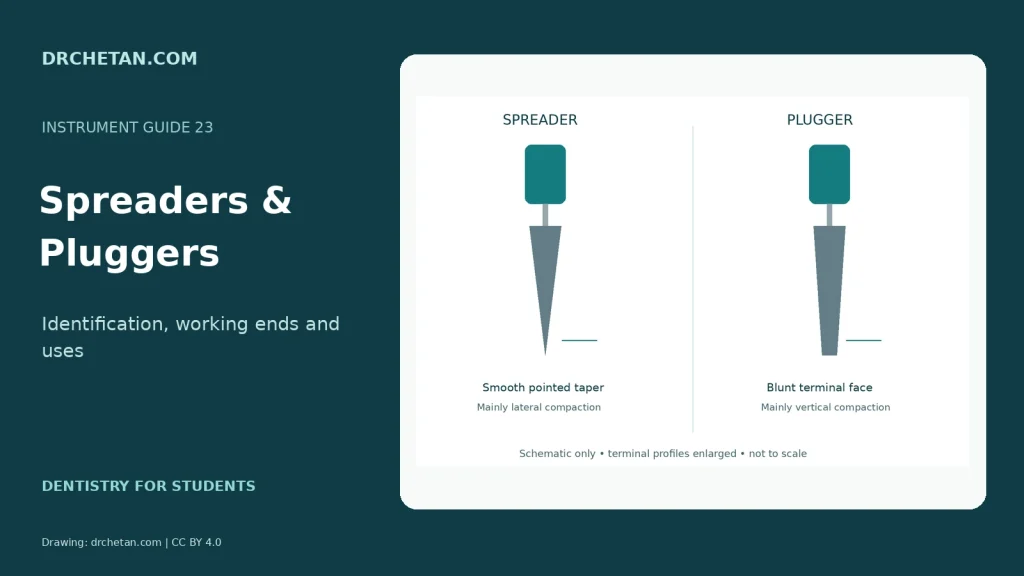
An endodontic spreader usually ends in a pointed taper; an endodontic plugger has a blunt or relatively flat terminal face. That difference helps explain their broad roles in adapting root canal filling material.
A learning guide for dental students. Clinical instrument use requires practical training and supervision.
Visual reference
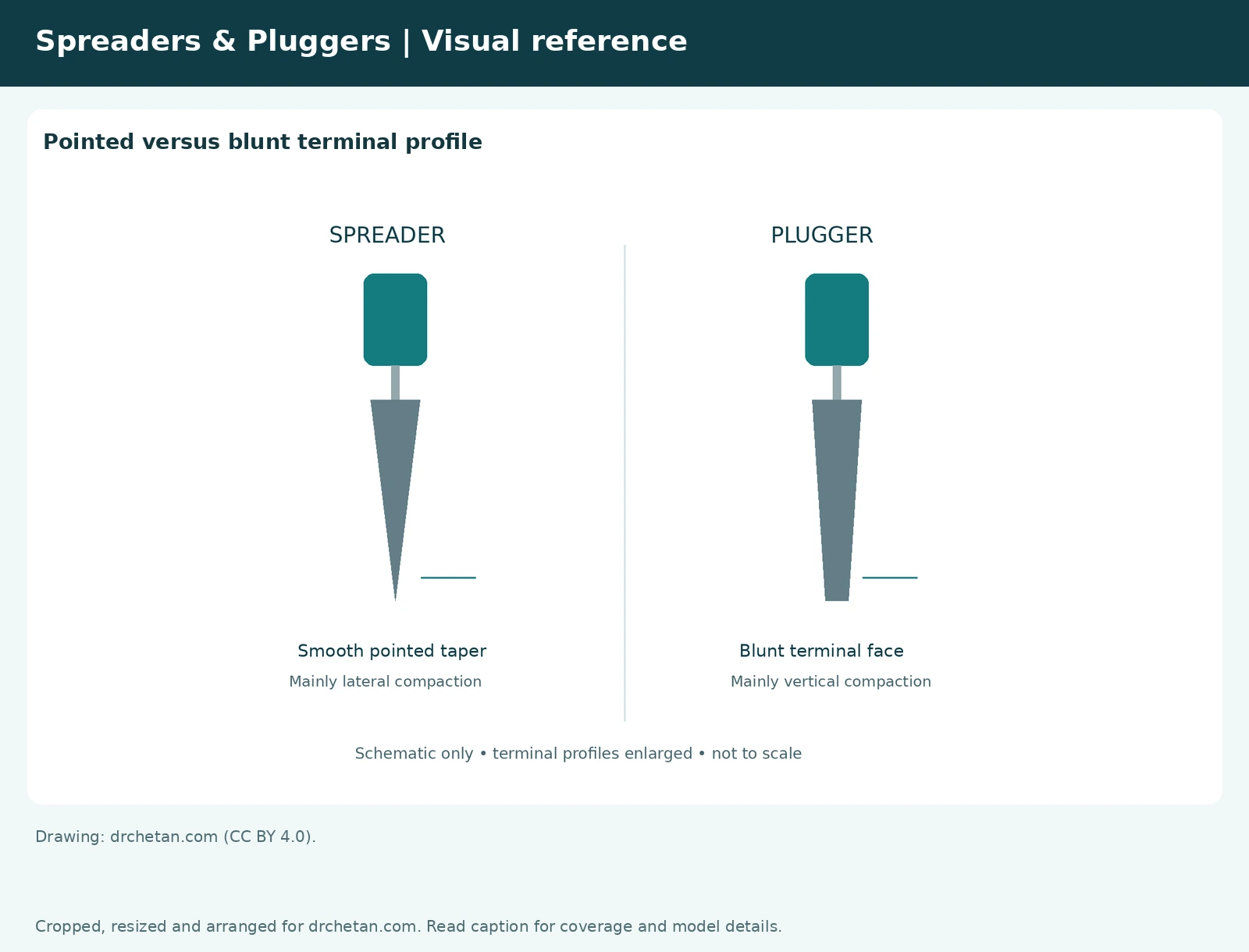
The quickest useful distinction
| Feature | Spreader | Plugger |
|---|---|---|
| Tip profile | Usually smooth and tapered towards a point | Blunt-ended, with a relatively flat or rounded terminal face |
| Broad action | Displaces and compacts filling material mainly laterally | Compacts suitable filling material mainly vertically |
| Familiar context | Creating space for an accessory gutta-percha cone in lateral compaction | Adapting gutta-percha or another suitable material with a terminal face |
| What appearance cannot tell you | Exact size, taper, flexibility or safe penetration depth | Exact diameter, taper, heat compatibility or required force |
“Lateral” and “vertical” describe the principal compaction concepts, not a promise that all forces act in only one direction. The instrument’s size, access, fit and the clinical technique determine how it contacts the material.
Why the working end matters
A spreader’s slender, tapered form can enter alongside suitable filling material and displace it laterally. On withdrawal, the space it creates can accommodate an accessory cone in a lateral-compaction technique. It is not designed to cut dentine like a fluted shaping file.
A plugger contacts material with a broader terminal face. That end transmits compaction pressure to the material rather than acting like a pointed wedge. A plugger may still have a tapered shaft; the important distinction is the terminal working face.
Not every blunt metal dental instrument is an endodontic plugger. Restorative condensers, periodontal instruments and other tools can resemble one from a distance. Confirm the marking, working-end dimensions and catalogue before giving a precise identification.
Finger and hand designs
A finger instrument has a short handle intended for controlled manipulation between the fingers. A hand instrument usually has a longer handle resembling other dental hand instruments. Both handle arrangements are available within endodontic compaction instrument ranges.
| Handle form | Recognition point | Do not assume |
|---|---|---|
| Finger spreader or plugger | Compact handle with a long slender working part | That the colour alone identifies size or family |
| Long-handled spreader or plugger | Long grip with an angled or straight shank | That every long handle applies a clinically appropriate force |
| Double-ended design | Two working ends on a shared handle | That both ends have identical size or function |
Handle length does not change a pointed end into a plugger or a flat end into a spreader. Name the working-end family first, then describe the handle design and confirmed size.
Sizes, tapers and colour markings
Spreaders and pluggers are sold in different tip diameters, tapers and lengths. Some ranges use ISO-related size designations, some use letters or proprietary numbers, and some combine systems. A manufacturer’s number is not automatically transferable to another brand.
Do not carry the conventional file colour chart into every plugger set. HuFriedyGroup’s endodontic catalogue, for example, lists colour-marked plugger products whose markings must be read within that specific range. The safe identification is the product code and stated tip diameter, supported by the colour where appropriate.
A silicone stop can help maintain a selected reference during a taught technique. It is not a safety device that determines the correct depth automatically. The permitted position is established clinically; an instrument should not be forced until the stop reaches a landmark.
Stainless steel, nickel–titanium and heat-compatible tools
Stainless steel and nickel–titanium spreaders can differ in flexibility. Material alone does not establish suitability for a particular canal or make excessive force safe. Confirm the instrument’s design and limits.
A manual plugger and the working tip of a heat-delivery system are not automatically interchangeable. Some techniques use heat to soften gutta-percha, but that does not mean an ordinary hand instrument may be heated with any available source. Use only a compatible instrument and the specified system instructions.
The terminal size and taper should suit the planned technique and available space. An instrument that binds against canal walls can transmit harmful forces. More pressure does not guarantee a better root filling.
Avoid confusion with files, paper points and gutta-percha
- File: usually has cutting flutes for its specified canal preparation task.
- Spreader: usually has a smooth pointed taper for the intended compaction role.
- Plugger: has a blunt terminal working face for compaction.
- Paper point: an absorbent disposable point used for drying or another specified purpose.
- Gutta-percha cone: a filling material component, not a metal compaction instrument.
A plain photograph can hide very fine flutes or flatten the apparent shape of a tip. Examine the instrument from more than one angle under suitable lighting. If the tip cannot be seen clearly, describe the uncertainty instead of guessing.
Practical examination and care
Suggested answer: “This is an endodontic finger spreader. It has a compact handle and a smooth taper ending in a point. Its broad role is lateral compaction of suitable root canal filling material. I would verify the size, taper and use instructions from the product marking.”
For a plugger, replace the pointed-tip description with its blunt terminal face and explain the principal vertical-compaction role. Do not prescribe insertion depth or force from a spotter image.
Inspect for distortion, roughness, corrosion, damaged tips and residual material. Follow the particular device’s cleaning, sterilisation and reuse instructions. Heat delivery tips and detachable components may have different processing requirements from ordinary hand instruments.
Frequently asked questions
What is the simplest difference between a spreader and a plugger?
A spreader is generally pointed; a plugger has a blunt terminal face. Their main compaction roles differ accordingly.
Is a spreader a canal shaping file?
No. A conventional spreader has a compaction role and does not have the same intended dentine-cutting action as a file.
Are all spreaders finger instruments?
No. Short finger handles and longer hand designs are available.
Can every plugger be heated?
No. Heat use requires an instrument and system approved for that purpose.
Do the colours always match the conventional file chart?
No. Confirm the exact manufacturer’s size and colour system.
References and further reading
- HuFriedyGroup: endodontic instrument catalogue
- FDA AccessGUDID: manual endodontic spreader definition
- NIC Dental: hand-use spreader product family
Featured-image drawing: drchetan.com — original source (CC BY 4.0). Resized and arranged with title. Adapted visual: CC BY-SA 4.0.
Explore more dental instrument guides and articles for dental students.

Leave a Reply