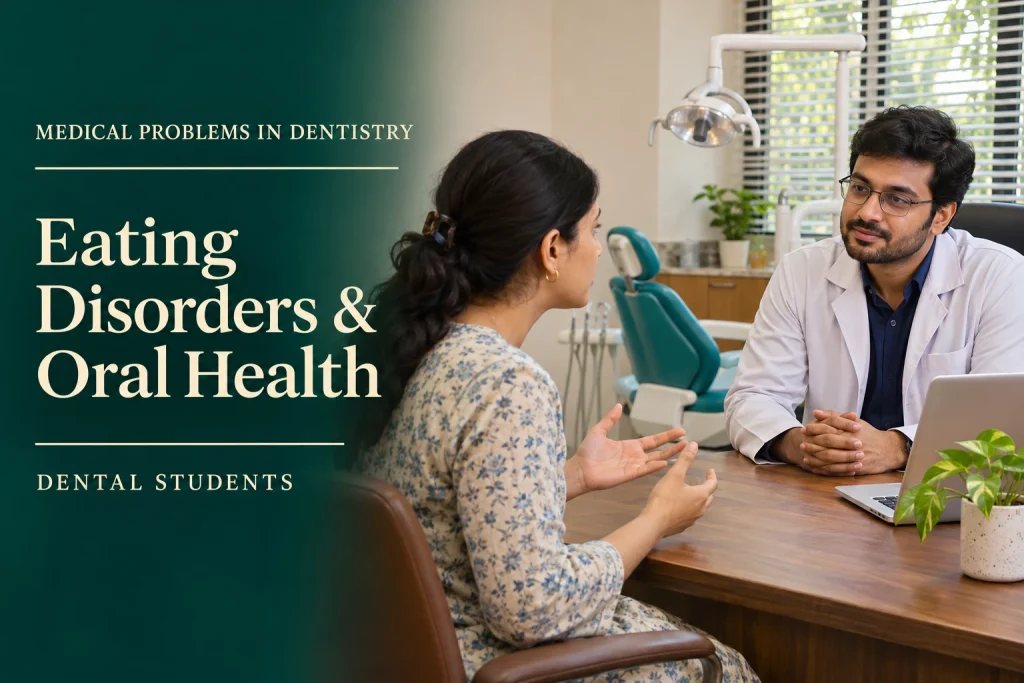
Medical Problems in Dentistry: Article 84 of 215 · Psychological and behavioural presentations · Complete student guide
Medical Problems in Dentistry · Student guide
Dental findings can open a helpful conversation about eating difficulties, but they do not reveal a person’s diagnosis by themselves. A respectful history, careful examination and appropriate referral are more useful than assumptions about appearance or behaviour.
In this guide: Learning objectives · Start with this clinical case · Recognise the range of illness · Describe the mouth findings before interpreting them · Ask privately and explain why the questions matter · Recognise medical risk without relying on appearance · Offer protective oral care alongside medical treatment · Resolve the case through assessment and support · Viva and self-check
Learning objectives
- Assess erosive wear and salivary symptoms with a broad differential.
- Ask about eating and vomiting without accusation or blame.
- Recognise medical concerns that take priority over elective dentistry.
Start with this clinical case
Fictional teaching case. A young adult presents with sensitive palatal tooth surfaces and dry mouth. They appear well and initially mention reflux. Later they describe episodes of vomiting and dizziness. The student assumes that a normal-looking body size rules out serious illness.
Recognise the range of illness
Eating disorders affect people across ages, genders and body sizes. They include different patterns of restriction, binge eating, purging and avoidant intake. Not every disorder involves vomiting, and not every person with significant illness appears underweight.
NIMH describes eating disorders as serious conditions with physical and mental-health effects. They are not a lifestyle choice or a dental diagnosis made from one finding. Students should understand the broad patterns while leaving definitive diagnosis and medical treatment to appropriate clinicians.[NIMHEAT]
Describe the mouth findings before interpreting them
Record the distribution and severity of tooth wear, sensitivity, caries, mucosal problems, salivary symptoms and gland swelling where present. Consider reflux, dietary acids, medicines, dryness and mechanical wear as well as vomiting. Multiple contributors can coexist.
A palatal wear pattern may suggest intrinsic acid exposure, but it cannot distinguish all causes or prove intentional vomiting. Ask how symptoms developed and what has changed. Use photographs, casts or scans when clinically justified and consented, and document findings in neutral language.
Ask privately and explain why the questions matter
| Finding or question | Clinical implication | Student action |
|---|---|---|
| Erosive wear with sensitivity | Acid exposure has several possible causes | Ask about reflux, drinks, vomiting and timing |
| Dry mouth or gland symptoms | Local, systemic and medicine factors may contribute | Review history and examine salivary function |
| Dizziness, fainting or poor intake | Medical stability may be uncertain | Arrange appropriate medical assessment |
| Disclosure of an eating difficulty | Support and coordinated care may be needed | Discuss referral and the patient’s current team |
Ask permission to discuss eating and stomach symptoms. A useful introduction is that several conditions can affect teeth through acid exposure or reduced saliva, so the same questions are asked to understand the cause. Avoid demanding a confession or arguing when the patient is not ready to disclose.
Recognise medical risk without relying on appearance
Ask about current intake, vomiting, fainting, palpitations, weakness and existing medical support. Severe dehydration, electrolyte disturbance or marked nutritional compromise can require urgent medical care. Do not reassure solely because the patient’s body size looks ordinary or the dental procedure seems short.
NICE recommends assessment of fluid and electrolyte concerns in relevant compensatory behaviours and acute medical care for severe complications. The dentist should recognise the concern and arrange appropriate evaluation rather than prescribing an unsupervised electrolyte-replacement or refeeding plan.[EATING]
Offer protective oral care alongside medical treatment
Manage pain and sensitivity, assess fluoride needs and agree a preventive plan. For ongoing vomiting, NICE advises regular dental and medical review, avoiding brushing immediately afterwards and rinsing with a non-acid mouthwash. Tailor advice to the person’s oral findings and treating team.[EATING]
Avoid a restrictive food list that conflicts with nutritional rehabilitation. Coordinate dietary advice with the relevant clinician or dietitian. Discuss the timing of complex restorative work in relation to active disease and the likelihood of ongoing damage; do not withhold all useful dental care until the patient has recovered.
Resolve the case through assessment and support
The vomiting and dizziness require a medical review appropriate to the current severity. Explain that the tooth wear has several possible causes and that the wider symptoms deserve attention. Ask whether the patient has a treating team and agree how relevant information will be shared.
Provide a staged dental plan for sensitivity and prevention, with a defined review. Record findings, the patient’s own account, advice, referral and escalation arrangements. Respect confidentiality while following applicable safeguarding and emergency duties. The aim is to keep a reliable route to care open, not to make the patient prove that they deserve help.
Viva and self-check
Can eating disorders be serious at an average body size? Yes. Appearance does not establish medical stability.
Does palatal erosion prove self-induced vomiting? No. Consider reflux and other sources of acid alongside the wider history.
Should dental dietary advice create further restriction? No. Coordinate it with the medical and nutritional treatment plan.
Continue through the series
- Previous: Functional Oral Symptoms and Persistent Pain: Validating Symptoms and Avoiding Harm
- Next: Body Dysmorphic Concerns and Requests for Irreversible Dental Treatment
- Browse all 215 student guides by subject
More in Psychological and behavioural presentations: Dental Anxiety and Phobia: Assessment and Stepped Behavioural Support · Functional Oral Symptoms and Persistent Pain: Validating Symptoms and Avoiding Harm · Body Dysmorphic Concerns and Requests for Irreversible Dental Treatment · Communication in Complex Consultations: Boundaries, Expectations and De-escalation
Continue learning
- Structured medical history and examination
- Medical liaison and referral for complex dental patients
- Informed consent in an Indian dental practice
References and scope
Sources checked on 26 November 2026. This is an original student teaching guide. International clinical recommendations are identified by their issuing organisation. Emergency contact information is specific to India. Use current local protocols, appropriate supervision and an individual clinical assessment.
- NIMH: Eating Disorders, What You Need to Know
- NICE NG69: Eating Disorders Recognition and Treatment
- NIDCR: Dry Mouth
Images are AI-generated educational illustrations of fictional people or equipment, not clinical records or diagnostic photographs.

Leave a Reply