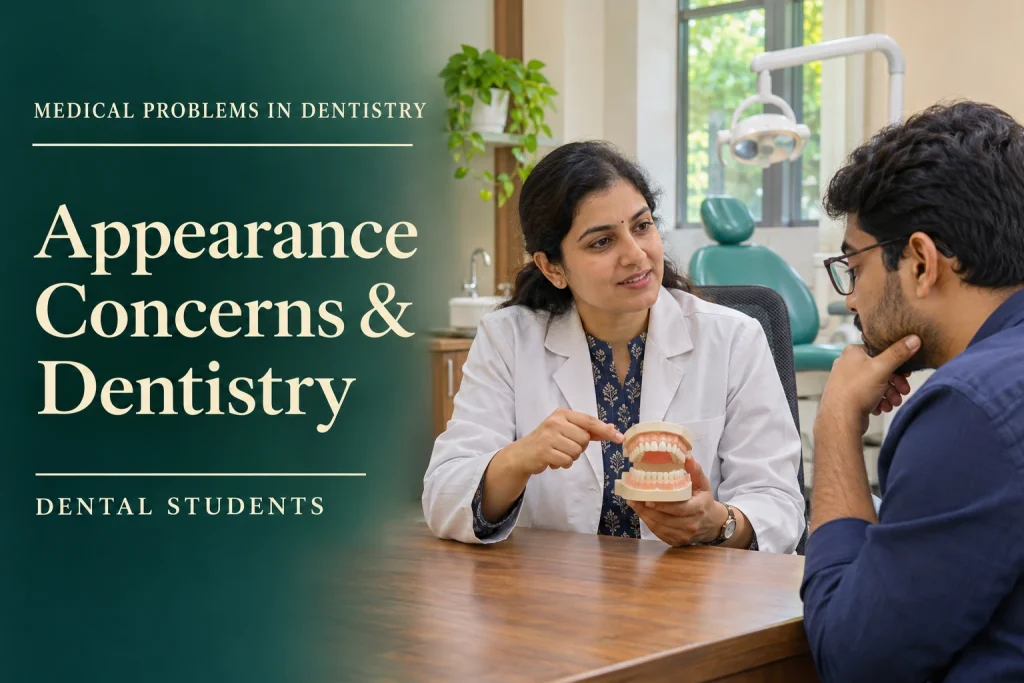
Medical Problems in Dentistry: Article 85 of 215 · Psychological and behavioural presentations · Complete student guide
Medical Problems in Dentistry · Student guide
A concern about tooth appearance is not automatically body dysmorphic disorder. Students should listen carefully, assess the dental findings and recognise when distress or expectations require more than a cosmetic treatment proposal.
In this guide: Learning objectives · Start with this clinical case · Take the concern seriously without confirming the feared defect · Examine the dental problem independently · Explore expectations before designing the procedure · Use referral as support rather than a dismissal · Maintain boundaries and respond to immediate safety concerns · Resolve the case with a safer decision process · Viva and self-check
Learning objectives
- Distinguish an aesthetic preference from possible clinically significant distress.
- Explore expectations and the limits of proposed dental treatment.
- Respond to concerning requests without diagnosing or dismissing the patient.
Start with this clinical case
Fictional teaching case. A patient requests crowns on several healthy teeth to correct a minor asymmetry. They report hours of checking photographs and avoiding social contact. Previous cosmetic work has not relieved the concern. They ask for a guarantee that new crowns will make them feel normal.
Take the concern seriously without confirming the feared defect
Ask what the patient notices, how long it has troubled them and how it affects work, relationships or daily life. Listen without agreeing that the appearance is defective or dismissing the concern as vanity. Aesthetic preferences and significant distress can coexist with genuine dental findings.
The NHS describes body dysmorphic disorder as persistent appearance-related preoccupation that can cause major distress and disruption. Repetitive checking or avoidance can prompt further assessment, but a dental clinician should not diagnose the disorder from one request or from dissatisfaction alone.[NHSBDD]
Examine the dental problem independently
Assess oral health, function, existing restorations, occlusion and the actual indication for treatment. Record the findings and what the patient hopes to change. Separate a treatable dental condition from a promise that altering teeth will resolve wider distress or social difficulties.
Ask about previous procedures, benefits, complications and remaining concerns. A repeated procedure request may have several explanations, including inadequate earlier treatment. Do not assume a psychiatric cause merely because another clinician has been involved or the patient has asked detailed questions.
Explore expectations before designing the procedure
| Finding or question | Clinical implication | Student action |
|---|---|---|
| Minor variation with major disruption to daily life | The impact may exceed the dental finding | Explore distress and offer further assessment |
| Repeated dissatisfaction after several procedures | More treatment may not resolve the concern | Review records and expectations carefully |
| Request for guaranteed confidence or relationships | The requested outcome is outside dental control | Explain what the procedure can and cannot achieve |
| Healthy teeth proposed for extensive reduction | Irreversible harm needs a clear justification | Pause and consider conservative alternatives or no treatment |
Discuss biological costs, maintenance, alternatives and the option of no treatment. Use factual explanations rather than persuasive mock-ups or language that creates a new defect. A consent form does not make an unsupported procedure clinically appropriate.
Use referral as support rather than a dismissal
NICE recommends specialist mental-health assessment for people with suspected or diagnosed BDD seeking cosmetic surgery or dermatological treatment. That recommendation concerns those settings; it provides a relevant caution when considering irreversible elective dental changes, rather than a dentistry-specific Indian legal rule.[BDD]
Explain the reason for a pause in plain language: the distress is substantial, the proposed dental change may not address it and further support could improve the decision. Ask permission to involve the appropriate clinician. Continue to offer necessary oral-health care and avoid presenting referral as punishment for an unwanted request.
Maintain boundaries and respond to immediate safety concerns
Do not promise a procedure to end a difficult conversation, refund pressure or repeated requests. If the expected benefit is unclear or risk is disproportionate, explain why you cannot recommend it. Offer a second opinion or a further assessment with a clear purpose, rather than an indefinite cycle of consultations.
If the patient describes immediate danger to themselves or severe deterioration, seek urgent senior and appropriate emergency support. Do not treat an imminent safety concern as a routine cosmetic referral. This article does not provide a crisis assessment or a mental-health treatment regimen.
Resolve the case with a safer decision process
The reported checking, avoidance and lack of relief after previous work justify a broader assessment. Explain that crowns cannot be guaranteed to resolve those difficulties and that reducing healthy teeth has lasting costs. Pause the elective irreversible plan while exploring appropriate support.
Document the dental findings, the patient’s own goals, information discussed, alternatives, reason for the recommendation and agreed follow-up. Avoid pejorative labels or a diagnosis beyond the evidence. The patient should leave knowing which oral-health problems will be treated and how the appearance-related distress can receive proper attention.
Viva and self-check
Does wanting cosmetic dentistry diagnose BDD? No. Assess the nature, impact and context of the concern.
Can a signed form justify treatment with disproportionate harm? No. Clinical justification and a valid decision process are still required.
What should a referral explanation emphasise? The patient’s distress, the uncertainty of benefit and the purpose of further assessment.
Continue through the series
- Previous: Eating Disorders: Dental Erosion, Salivary Changes and Sensitive History-Taking
- Next: Communication in Complex Consultations: Boundaries, Expectations and De-escalation
- Browse all 215 student guides by subject
More in Psychological and behavioural presentations: Dental Anxiety and Phobia: Assessment and Stepped Behavioural Support · Functional Oral Symptoms and Persistent Pain: Validating Symptoms and Avoiding Harm · Eating Disorders: Dental Erosion, Salivary Changes and Sensitive History-Taking · Communication in Complex Consultations: Boundaries, Expectations and De-escalation
Continue learning
- Informed consent in an Indian dental practice
- Structured medical history and examination
- Medical liaison and referral for complex dental patients
References and scope
Sources checked on 26 November 2026. This is an original student teaching guide. International clinical recommendations are identified by their issuing organisation. Emergency contact information is specific to India. Use current local protocols, appropriate supervision and an individual clinical assessment.
- NHS: Body Dysmorphic Disorder
- NICE CG31: OCD and Body Dysmorphic Disorder
- Supreme Court of India: Court News, January–March 2008, Samira Kohli
Images are AI-generated educational illustrations of fictional people or equipment, not clinical records or diagnostic photographs.

Leave a Reply