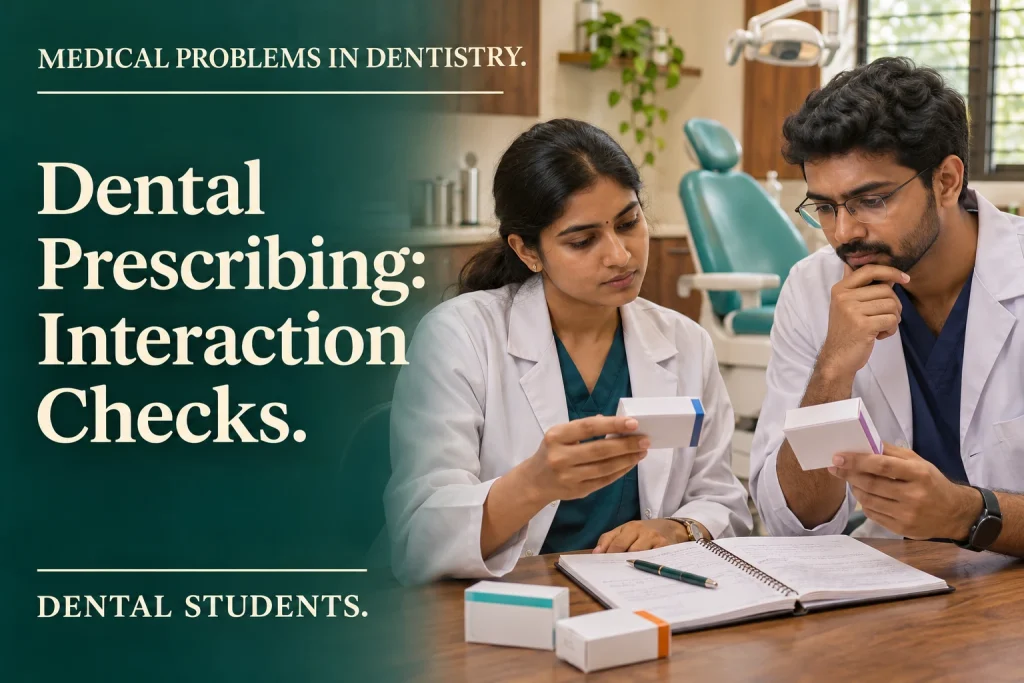
Medical Problems in Dentistry: Article 189 of 215 · Drug and dental material use · Complete student guide
Medical Problems in Dentistry · Student guide
A routine dental prescription can change the effect of a medicine prescribed for a completely different condition. The useful skill is recognising when the exact combination needs checking, then finding a practical treatment plan. Memorising a short list of interacting drugs cannot replace medication reconciliation or current prescribing information.
In this guide: Learning objectives · Start with this clinical case · Reconcile medicines before opening an interaction checker · Anticoagulants require exact-drug decisions · Psychotropics, macrolides and azoles · Translate the alert into an action · Explain and safety-net the plan · Viva and self-check
Learning objectives
- Recognise common high-consequence dental prescribing interactions.
- Separate an interaction alert from a decision to withhold essential treatment.
- Document a checked, supervised prescribing plan and appropriate liaison.
Start with this clinical case
Fictional teaching case. A patient taking warfarin and an antidepressant attends with dental pain. They request the antibiotic and painkiller supplied by a relative. Before discussing a prescription, establish the dental diagnosis, the exact regular medicines and what the patient has already taken. Neither an assumed antibiotic indication nor an incomplete medication list is a safe starting point.
Reconcile medicines before opening an interaction checker
Ask for generic and brand names, strength, formulation, route, frequency, indication and recent changes. Include medicines taken occasionally, non-prescription analgesics, oral gels, supplements and treatment obtained elsewhere. A photograph of packaging may clarify an uncertain name, but confirm what is actually being used. Record previous adverse reactions separately from the current interaction assessment.
Next establish whether a medicine is indicated at all. Definitive dental treatment, drainage or another intervention may address the cause of pain or infection. An interaction should not become a reason to postpone necessary care without an alternative plan. Consider renal and hepatic function, current illness, age and other medicines alongside the proposed dental drug.
Anticoagulants require exact-drug decisions
SDCEP identifies important interactions between anticoagulants and medicines used in dentistry. Metronidazole should not be prescribed with warfarin under its drug-interaction guidance; miconazole should also be avoided with warfarin or acenocoumarol. A product applied inside the mouth is not automatically free of systemic interactions. These examples are prompts to check the actual product, not reasons to stop anticoagulation.[INTERACT][ANTICOAG]
Warfarin and direct oral anticoagulants are not interchangeable in this assessment. INR is relevant to vitamin K antagonist management and does not provide routine monitoring of a DOAC effect. Infection itself can affect anticoagulation control. Where an antibiotic is necessary, discuss an appropriate alternative and any monitoring with the relevant clinician or anticoagulation service. Do not independently adjust the patient’s regular anticoagulant.
Psychotropics, macrolides and azoles
NSAIDs can interact with lithium and increase harm; SDCEP says not to prescribe this combination. Its guidance also advises avoiding NSAIDs with SSRIs because of bleeding risk. The word “antidepressant” is too broad for a complete check: obtain the exact agent and assess the whole prescription, including sedating drugs.[INTERACT]
Macrolide antibiotics and azole antifungals can interact with several medicines, including some statins and anticoagulants. The risk depends on the specific pair, route, duration and patient. Do not extrapolate a warning about one macrolide to every antibiotic or assume all members of a medicine class have identical effects. Consult a current interaction resource and product information with your supervisor or pharmacist.
Translate the alert into an action
| Finding or question | Clinical implication | Student action |
|---|---|---|
| Warfarin plus proposed metronidazole | SDCEP advises against prescribing the combination | Confirm indication; agree a suitable alternative with supervision |
| Lithium plus proposed NSAID | Potentially serious interaction | Avoid this combination under SDCEP guidance; seek an alternative plan |
| SSRI plus proposed NSAID | Bleeding risk can increase | Review other risks and select an appropriate supervised approach |
| Macrolide or azole plus multiple regular medicines | Several exact-drug interactions may coexist | Check every relevant pair and whether medical liaison is needed |
Write down the resource, date, exact drug pair, relevant patient factors and decision. “Interactions checked” alone does not show why an alternative was selected. When advice is requested, state the dental problem, urgency and intended treatment. A focused question is more useful than a general request for medical clearance.
Explain and safety-net the plan
Tell the patient which medicines to take, which additional non-prescription products to avoid, and whom to contact if there is a problem. Check understanding by asking them to describe the plan back. Where monitoring or medical advice is required, assign responsibility and confirm how the result will reach the dental team. A referral letter without a follow-up arrangement is an unfinished plan.
Unexpected bleeding, marked deterioration, severe allergic features or other acute concerns need prompt assessment appropriate to the presentation. Do not ask patients to manage a suspected interaction by skipping an essential medicine themselves. For Indian students, SDCEP is a Scottish clinical resource; verify local availability, current Indian product information and institutional prescribing rules. This guide does not supply a dosing regimen.
Viva and self-check
Does a potential interaction mean an antibiotic can never be used? No. Establish the indication, check the exact combination and choose an appropriate treatment or monitoring plan with qualified advice.
Can you tell a patient to stop warfarin to make a dental prescription easier? No. Changes require an individual plan involving the responsible clinician.
Why ask about oral gels? Route and formulation affect exposure, but locally applied products can still have clinically important interactions.
Continue through the series
- Previous: Drug-Induced Oral Disease: A Dental Student's Diagnostic Framework
- Next: Dental Material Hypersensitivity: Contact Reactions, Differential Diagnosis and Referral
- Browse all 215 student guides by subject
More in Drug and dental material use: Drug-Induced Oral Disease: A Dental Student's Diagnostic Framework · Dental Material Hypersensitivity: Contact Reactions, Differential Diagnosis and Referral · Analgesic Selection in Medically Complex Patients: Contraindications, Interactions and Limits
Continue learning
- Structured medical history and examination
- Medical liaison and referral for complex dental patients
- Dental clinic medical emergency readiness
References and scope
Sources checked on 26 November 2026. This is an original student teaching guide. International clinical recommendations are identified by their issuing organisation. Use current local protocols, appropriate supervision and an individual clinical assessment.
Images are AI-generated educational illustrations of fictional people or equipment, not clinical records or diagnostic photographs.

Leave a Reply