
Medical Problems in Dentistry: Article 51 of 215 · Disorders of haemostasis · Complete student guide
Medical Problems in Dentistry · Student guide
Warfarin creates two linked planning problems: bleeding if haemostasis is difficult and thrombosis if anticoagulation is unnecessarily interrupted. Good dentistry addresses the local wound and the patient’s medical context together.
In this guide: Learning objectives · What warfarin changes · Before looking at the number · The SDCEP INR framework · Why different INR numbers appear in textbooks · Plan the wound before making it · Local haemostasis supplies · Prescription review and communication · Original cases · Aftercare and rebleeding · Viva and MCQ
Learning objectives
- Read an INR in the context of vitamin K antagonist treatment.
- Use a named dental guideline without mixing thresholds from different documents.
- Prepare a procedure, haemostasis and follow-up plan before starting.
What warfarin changes
Warfarin reduces production of functional vitamin K-dependent clotting factors. Its effect develops and resolves over time; interactions, illness and dietary changes can alter the response. INR is used to monitor this effect. The intended range depends on the medical indication and is managed by the prescribing or anticoagulation team.
Patients may take warfarin for conditions such as atrial fibrillation, venous thromboembolism or certain prosthetic valves. The dental history needs the actual indication and relevant recent events. INR is not a platelet count, and the patient’s INR target is not automatically 1.0.
Before looking at the number
Ask about previous prolonged bleeding, spontaneous bruising, recent hospitalisation, medicine changes, antibiotics, non-prescribed analgesics, alcohol use and liver or kidney disease. Inspect the planned surgical field and consider wound size and accessibility. A brief examination and several surgical extractions are different interventions.
Explain the balance of risks in understandable terms. “Blood thinner” is a useful patient phrase but not a sufficient prescribing record. Record the generic name, dose schedule, indication, prescriber and current monitoring information.
The SDCEP INR framework
SDCEP advises dental treatment without interrupting a vitamin K antagonist when INR is below 4, with assessment and local haemostasis. For procedures likely to bleed, check INR ideally within 24 hours; up to 72 hours is acceptable only when it is stable and still representative. INR 4 or above requires liaison and delay of invasive care; urgent needs require an appropriate secondary-care pathway.
Its stability description includes no weekly monitoring and no INR above 4 in the preceding two months. If illness or a medicine change may have altered the result, an older test may not represent the day of treatment. This is a named UK clinical framework, not a rule to extrapolate to every patient or operation.[1]
Why different INR numbers appear in textbooks
The ADA review discusses evidence and professional statements using different INR limits for uncomplicated extraction. Those discussions address specific procedures and populations; they should not be merged into an invented universal number. Identify the source, setting and procedure, then follow the responsible clinician’s current protocol.
Neither a normal-looking wound nor a result within one framework removes the need to assess coexisting bleeding problems. Conversely, seeking a normal INR by stopping prescribed treatment may expose the patient to serious harm.[2]
Plan the wound before making it
| Planning stage | Practical question | Reason |
|---|---|---|
| Before booking | Will the patient have a relevant recent INR and a clear plan? | Avoid an unresolved risk assessment on the treatment day |
| Extent of treatment | Can the initial surgical area be limited or staged? | Allows assessment of haemostasis before a larger wound |
| Technique | Are visibility, atraumatic technique and local supplies adequate? | A medication decision does not control the socket mechanically |
| Discharge | Has active bleeding stopped and is the patient stable? | Instructions alone do not correct failed haemostasis |
| Aftercare | Can the patient understand instructions and reach help? | Delayed bleeding needs an accessible response |
Local haemostasis supplies
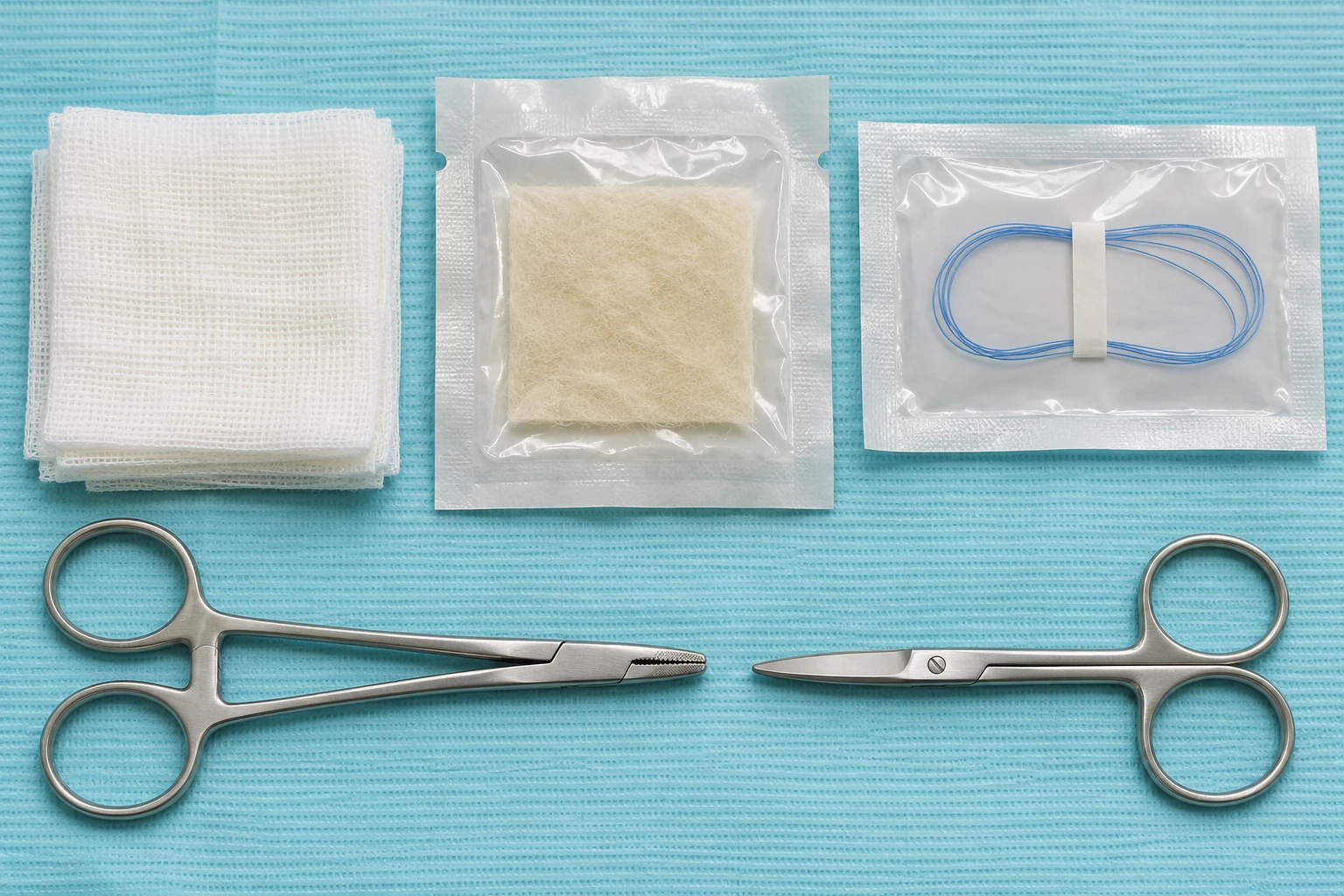
Prepare absorbent gauze, an appropriate haemostatic packing material and a suture kit when indicated. Apply pressure and inspect the actual source of bleeding; choose packing and suturing for the wound and patient. Check whether animal-derived materials are acceptable to the patient and have suitable alternatives.
Confirm haemostasis before discharge. An antifibrinolytic, where prescribed under an appropriate local protocol, is an adjunct rather than a substitute for local wound control. Hospital reversal strategies are not a routine dental workaround.[3]
Prescription review and communication
Check a current interaction resource before prescribing. An antibiotic course or analgesic choice can change the overall risk. Do not assume every antibiotic is interchangeable or give antibiotics merely because the patient takes warfarin.
A useful consultation states: planned procedure, urgency, INR with date and trend, bleeding history, relevant medicines and the specific concern. Changing warfarin dose or arranging bridging belongs to a coordinated medical plan; a student should not issue an independent “stop for three days” instruction.
Original cases
Case 1: A stable patient has an INR of 2.7 from yesterday and needs one uncomplicated extraction. Under an applicable SDCEP pathway, continuing treatment can be considered with the responsible clinician’s assessment and local haemostasis. The number alone is not the entire consent and procedure plan.
Case 2: INR was 2.8 three days ago, but the patient became unwell and started another medicine yesterday. Do not treat that result as automatically current. Reassess and obtain the relevant information before invasive care.
Case 3: INR is 4.3 and a tooth is painful. Do not advise self-reduction of the warfarin dose. Contact the relevant service, manage the dental urgency within a safe plan and use secondary care where needed.
Aftercare and rebleeding
Give clear written instructions with a contact route and explain what persistent bleeding looks like. Record the local measures used and the discharge check. Persistent bleeding despite appropriate local care, major blood loss, airway concern, collapse or systemic instability requires urgent escalation. Do not repeatedly discharge a patient with active bleeding and the same advice.
Viva and MCQ
Why is INR not the whole bleeding history? It measures one relevant coagulation effect; local pathology, platelets, systemic illness and other medicines still matter.
MCQ: The safest response to an unexpectedly high INR is A, halve the dose yourself; B, coordinate with the treating service and defer or refer invasive care as appropriate; C, ignore it if the tooth is small. Answer: B.
Continue through the series
- Previous: Dental Bleeding History and Coagulation Tests: Platelets, PT/INR and aPTT
- Next: Direct Oral Anticoagulants and Antiplatelet Drugs: A Dental Planning Framework
- Browse all 215 student guides by subject
More in Disorders of haemostasis: Dental Bleeding History and Coagulation Tests: Platelets, PT/INR and aPTT · Direct Oral Anticoagulants and Antiplatelet Drugs: A Dental Planning Framework · Haemophilia and von Willebrand Disease: Haematology Liaison Before Dental Care · Post-Extraction Bleeding: Local Measures, Reassessment and Escalation
Continue learning
- taking a structured medical history
- assessment and medical liaison for complex patients
- medical emergency readiness in a dental clinic
References and scope
Sources checked on 25 November 2026. This is an original student teaching guide. International clinical guidance is identified by its issuing organisation; it is not presented as an Indian statutory rule. Apply the treating team’s current protocol and supervision to individual patients.
- SDCEP 2022: Warfarin or Another Vitamin K Antagonist
- American Dental Association: Anticoagulants, Antiplatelets and Dental Procedures
- SDCEP: Local Haemostatic Measures
Images are AI-generated educational illustrations of fictional people or equipment, not clinical records or diagnostic photographs.

Leave a Reply