
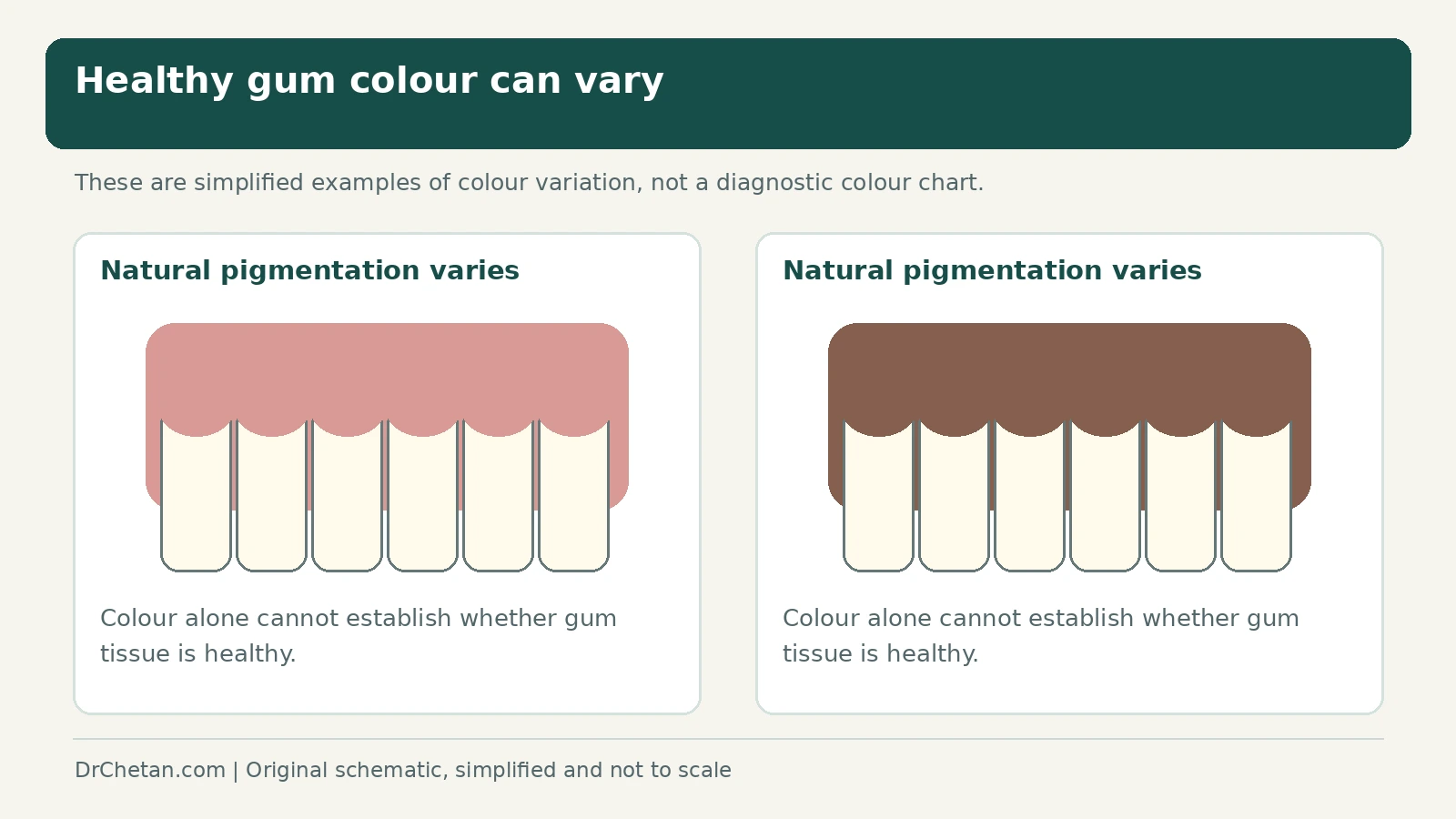
Healthy gums are not always pink. Natural melanin can give gums brown or darker colouring, including in many people with darker skin. A dentist can distinguish familiar, healthy pigmentation from a new or unexplained change that needs investigation. Cosmetic lightening is optional and should follow a diagnosis.
Does having dark gums mean poor oral hygiene?
No. Natural pigmentation is not dirt, a stain that you failed to brush away or proof of gum disease. Gum health is assessed using findings such as inflammation, bleeding, gum measurements and supporting tissues, rather than a pink-versus-brown colour rule.
Cleaning remains important, but scrubbing harder will not safely remove natural melanin. A person can have healthy pigmented gums, and another can have gum disease without striking pigmentation. Treating a cosmetic concern and treating active disease are different goals.
Why can gum colour change?
Pigmentation may be a longstanding personal characteristic. Tobacco exposure, certain medicines, previous inflammation and material introduced into tissues during dental treatment can also affect colour. Some medical conditions and less common oral lesions cause pigmentation too. These possibilities are reasons for taking a history, rather than a list for diagnosing yourself from photographs.
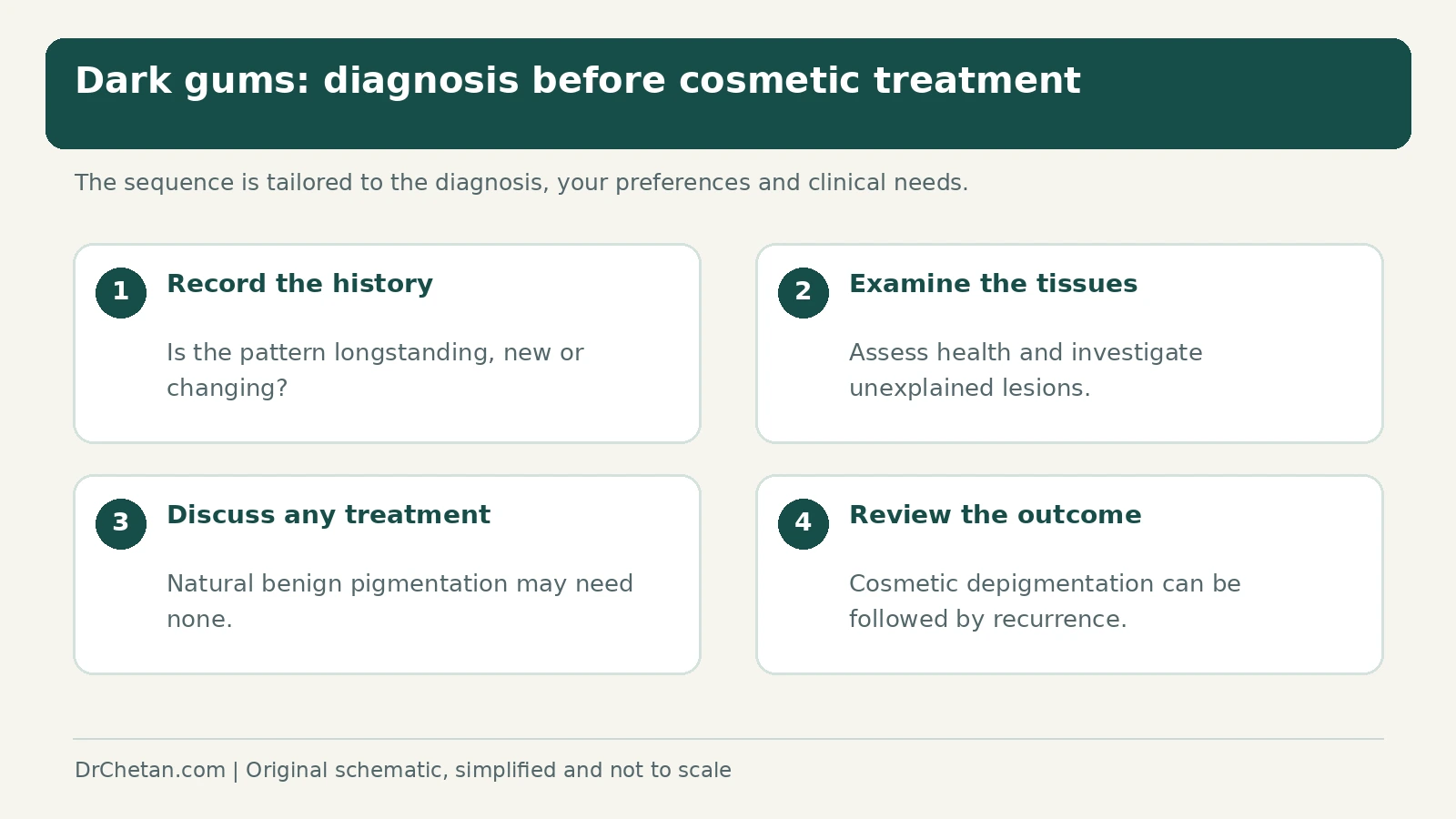
Tell the dentist whether the colour has always been present, whether it affects both sides and whether a particular spot is new or growing. Mention medicines, tobacco or areca-nut use, previous dental treatment and symptoms elsewhere in the mouth or body. Do not stop prescribed medication without discussing it with the prescribing clinician.
Which changes should I get checked?
Book a dental assessment for a new, enlarging or unexplained dark patch, especially if it is uneven in colour or outline, raised, ulcerated, bleeding or painful. A persistent lump or a change in sensation also deserves attention. Many pigmented areas are benign, but appearance alone cannot safely identify every cause.
Do not wait for a patch to hurt or for a cosmetic appointment if it is changing. Sudden dark, damaged-looking gum with substantial pain, swelling, fever or feeling unwell needs urgent dental assessment. Spreading swelling affecting breathing or swallowing needs emergency medical care.
What does the dentist do at the appointment?
The dentist records the colour, site, size and pattern, examines the rest of your mouth and reviews the history. Clinical photographs can help with follow-up. They also assess gum health and any nearby restorations. A stable pattern with a confident benign diagnosis may need reassurance and routine monitoring.
If the explanation is uncertain, the dentist may refer you to oral medicine, an oral surgeon or another appropriate specialist. A biopsy means taking a small sample for laboratory examination when it is needed to establish the diagnosis. Not every dark gum requires a biopsy, but an unexplained lesion should not simply be burned away for appearance.
The first question is “What is this pigmentation?” The question “Can we lighten it?” comes afterwards.
Further reading: Prevalence and clinical features of pigmented oral lesions — clinical research.
What if tobacco or a medicine is involved?
The plan addresses the contributing factor where possible. Stopping tobacco benefits oral health, although a change in pigmentation can take time and is not the only measure of improvement. Medicine-related changes need coordination with the prescribing clinician; a different prescription is not automatically necessary or safe.
If gum disease is present as well, cleaning and periodontal treatment are planned on their own merits. Cosmetic depigmentation is not a substitute for stopping tobacco, examining lesions or controlling inflammation.
What is cosmetic gum depigmentation?
For established benign melanin pigmentation, a patient who wants a cosmetic change may discuss depigmentation with a periodontist or suitably experienced dentist. The procedure targets superficial pigmented gum tissue. It changes appearance rather than curing a disease in otherwise healthy pigmented gums.
Common methods include careful surgical removal of the pigmented surface or use of a suitable laser. The clinician assesses tissue thickness, the area involved, medical factors and expectations before recommending a method. The goal is controlled treatment while protecting the underlying tissues and adjacent teeth; it is not something to attempt with home chemicals or abrasive tools.
What happens during and after the procedure?
After consent and an anaesthetic plan, the dentist treats the agreed areas. A surgical dressing may be used with some techniques. You receive advice on gentle cleaning, food, pain control if needed and follow-up. The healing surface changes colour and texture before its final appearance can be judged.
Ask about soreness, bleeding, infection, damage to surrounding tissue, recession, uneven colour and repeat treatment. Lasers require appropriate equipment, eye protection and training. The word “laser” does not make a procedure risk-free, and one method is not automatically best for every patient.
Will the colour stay lighter permanently?
Pigment can return after depigmentation, and the timing and extent vary. Research compares different techniques, but it does not justify promising that a particular laser will prevent recurrence for everyone. Ask how the practice discusses relapse, how long it will monitor healing and what repeat treatment might involve.
Before committing, consider whether the likely appearance change is worth the recovery, cost, uncertainty and possibility of future procedures. Keeping healthy naturally pigmented gums is a valid choice. You should not feel that a normal gum colour needs correction to count as a healthy smile.
What should I avoid at home?
Do not use tooth bleach, acids, lemon, concentrated peroxide or scraping to lighten gums. Products intended for teeth or skin are not automatically safe on oral tissues. Keep brushing gently with fluoride toothpaste and clean between teeth as advised. If a patch changes, arrange a review rather than applying a lightening product over it.
Frequently asked questions
Do healthy gums have to be pink?
No. Healthy gum colour varies with natural pigmentation. The dentist assesses tissue health and changes, not colour alone.
Will scaling remove natural dark pigmentation?
Scaling removes deposits such as calculus. It does not generally remove the natural melanin responsible for healthy pigmented gum tissue.
Is every dark patch harmless?
No. A new, growing or unexplained patch needs assessment. A dentist decides whether monitoring, referral or a biopsy is appropriate.
Is laser depigmentation permanent?
Pigment can recur. Outcomes depend on the individual and method, and permanent uniform lightening cannot be guaranteed.
Should I stop a medicine if my gums darken?
Do not stop it yourself. Tell your dentist and prescribing clinician so they can assess whether the medicine is relevant and what action is appropriate.
Do I need cosmetic treatment?
If the pigmentation is benign and the gums are healthy, lightening is an optional appearance decision rather than a medical requirement.
Related reading: How to brush your teeth properly.
Sources and further reading
- American Academy of Oral Medicine: Oral changes associated with tobacco use
- Prevalence and clinical features of pigmented oral lesions — clinical research
- Clinical comparison of scalpel and diode laser depigmentation — randomized trial
- Laser depigmentation and repigmentation during two-year follow-up — clinical trial
- Comparison of CO2 and diode lasers for gingival depigmentation — randomized trial
Educational information for patients. Diagnosis and treatment depend on an examination and your individual circumstances. Consultation artwork is AI-created; explanatory visuals are original simplified educational graphics.

Leave a Reply