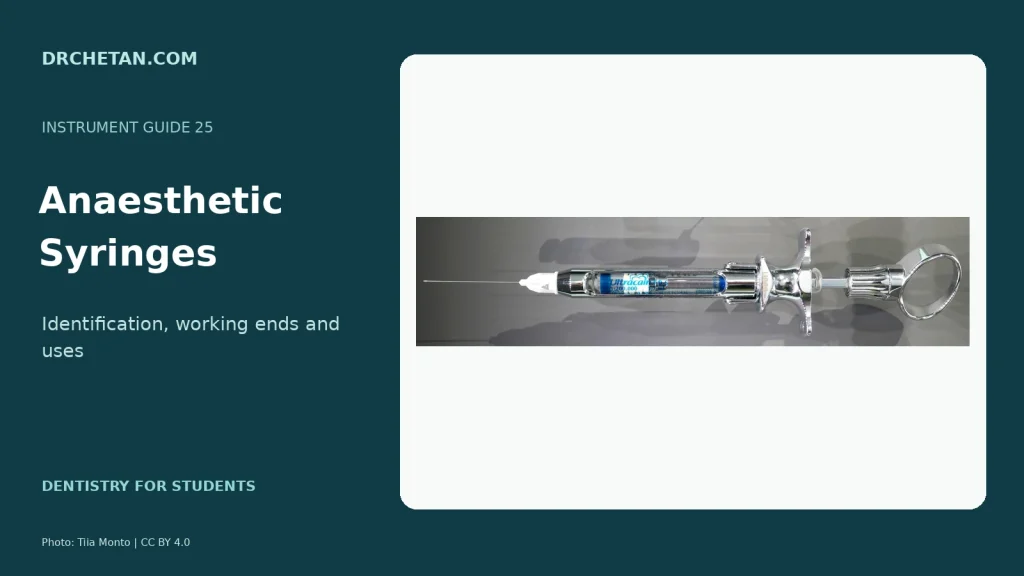
A dental local anaesthetic cartridge syringe holds a compatible anaesthetic cartridge and delivers its contents through a dental needle. Learn the reusable holder, the cartridge and the needle as three separate components.
A learning guide for dental students. Clinical instrument use requires practical training and supervision.
Visual reference
What this syringe is—and what it is not
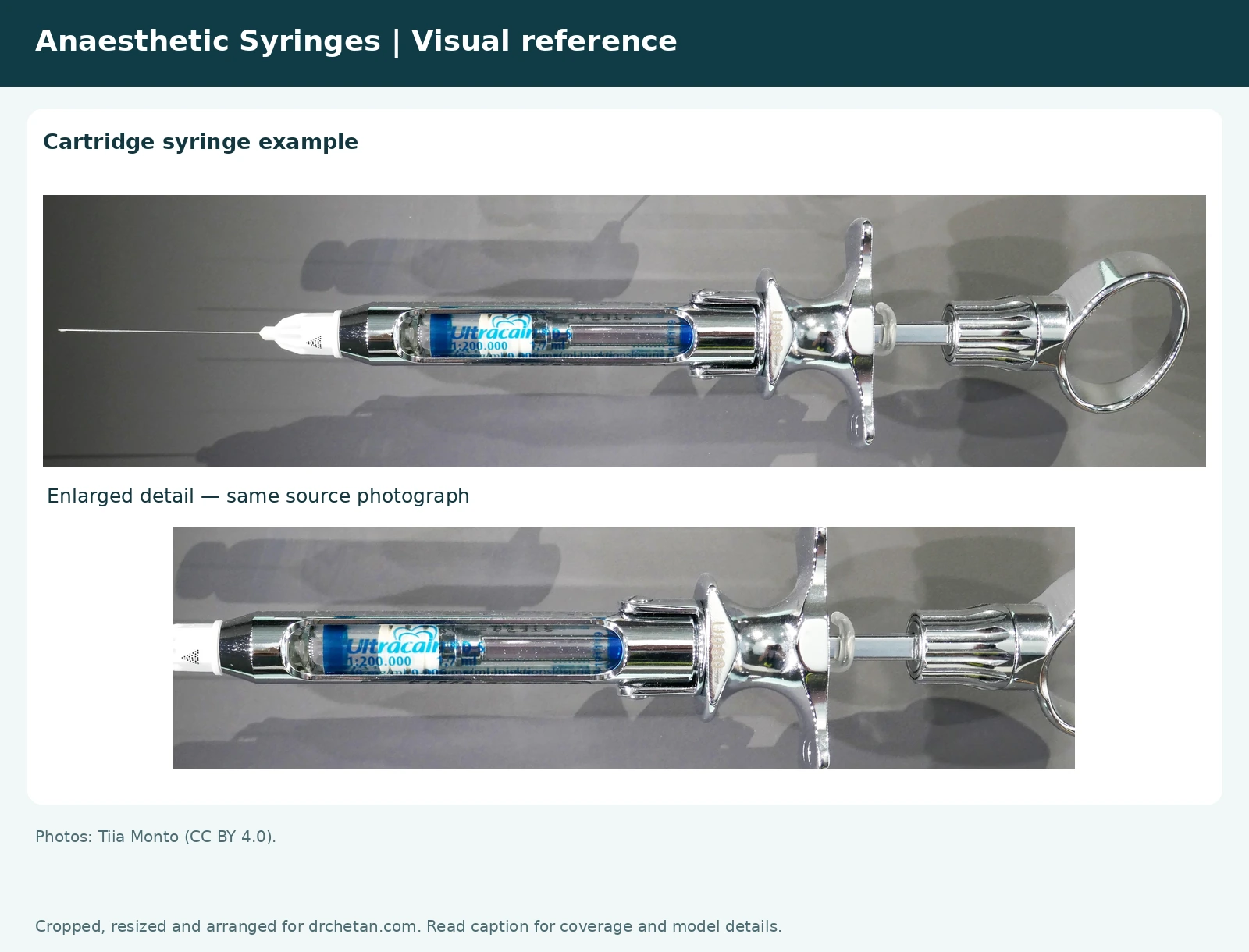
The familiar metal dental cartridge syringe is a holder and delivery mechanism for a prefilled cartridge. Its barrel is not normally filled directly from a vial in the same way as an ordinary disposable hypodermic syringe. Designs and loading arrangements vary.
Do not confuse it with the three-way air–water syringe attached to a dental unit. That instrument supplies air, water or spray for clinical tasks; it is not the syringe used to inject local anaesthetic. The shared word “syringe” does not establish a shared purpose.
This guide covers instrument recognition. Choice of anaesthetic, dose, injection technique and patient monitoring require appropriate clinical teaching and assessment.
Parts of a conventional cartridge syringe
| Part | Recognition and role |
|---|---|
| Thumb ring or other thumb control | Allows controlled movement of the plunger assembly; form varies |
| Finger rests / finger grip | Supports the operator’s fingers during handling |
| Plunger rod / piston | Transmits movement to the cartridge’s rubber stopper |
| Harpoon in a harpoon-type aspirating design | Engages the rubber plunger stopper at the rear of the cartridge |
| Barrel and viewing window | Holds the cartridge and permits inspection of its contents |
| Needle adaptor | Receives the compatible dental needle hub |
The harpoon engages the rear rubber stopper, not the diaphragm at the needle end. That distinction is useful in both a practical examination and a labelled drawing. Not every aspirating design uses a harpoon, and not every syringe has a thumb ring.
The cartridge has its own parts
A familiar dental cartridge has a labelled container, a rubber plunger stopper at one end and a diaphragm secured beneath a cap at the needle end. The plunger pushes the stopper to expel solution. The cartridge-facing end of a compatible dental needle pierces the diaphragm.
The label identifies the actual drug, concentration and other essential information. Some formulations include a vasoconstrictor and others do not. Similar cartridge appearance does not prove identical contents. Always read the label rather than relying on the cap colour.
Capacity and compatibility vary. For example, a Septodont aspirating syringe is specified for particular 1.7 and 1.8 mL cartridges. This is not evidence that every cartridge fits every syringe. Do not force a mismatched cartridge into a holder.
Inspect the cartridge according to the product instructions. A damaged, leaking, expired or otherwise unsuitable cartridge must not be used. The reusable metal holder does not make the cartridge reusable between patients.
Aspirating and self-aspirating designs
| Type | Broad distinction |
|---|---|
| Harpoon-type aspirating syringe | The harpoon engages the cartridge stopper and supports deliberate aspiration through the prescribed movement |
| Self-aspirating syringe | A different mechanism produces aspiration through its designed pressure-and-release action; learn the exact model |
| Non-aspirating design | Does not provide the same intended aspiration mechanism |
| Special-purpose or computer-controlled system | Uses its own delivery controls, accessories and instructions |
Aspiration helps the clinician assess whether blood is drawn into the cartridge at that moment. It is one safety step, not a guarantee that an injection is safe. A negative result does not establish correct anatomy, dose or absence of every risk.
Septodont’s Aspiject is an example of a self-aspirating product available with different grip options. Its operation should be learned from its own instructions rather than assumed from the appearance of a conventional harpoon syringe.
Dental needles: identify both ends
A dental cartridge needle has a patient-facing end, a hub connecting to the syringe, and a cartridge-facing end that pierces the diaphragm. Protective covers are part of the supplied assembly. Needle length, gauge and connection must match the product and intended use.
Gauge describes diameter, not length. Within the usual gauge convention, a higher gauge number corresponds to a thinner needle. A short needle is not automatically a fine-gauge needle, and a long needle is not automatically a large-gauge needle.
The hub colour or cap colour should not replace reading the packaging. Needle product ranges, connection details and labels vary. Do not estimate the selected gauge from the photograph in this article, which is an external example rather than a calibrated size comparison.
Other designs students may encounter
Breech-loading, side-loading, disposable and safety-engineered cartridge systems differ in how the components are assembled and handled. Intraligamentary or other specialised delivery devices may have a substantially different grip or pressure mechanism.
Computer-controlled local anaesthetic delivery systems add a control unit and a dedicated handpiece or disposable assembly. Their external appearance may differ from the familiar metal syringe, but the same identification questions remain useful: what holds the drug, what drives delivery, which needle or disposable set is compatible, and what aspiration mechanism is provided?
Do not attach an unfamiliar needle or cartridge simply because it appears to fit. Compatibility and operation come from the specific manufacturer’s instructions.
Sharps safety, reprocessing and an examination answer
Needles and anaesthetic cartridges are single-patient items. Discard used needles into an appropriate sharps container and follow local rules for cartridge disposal. A reusable syringe holder requires the validated cleaning and sterilisation process specified for that model.
Avoid two-handed needle recapping. Where recapping is necessary for a clinical task, follow the approved one-handed or mechanical-device approach and local policy. Do not bend, break or manually manipulate a used needle as an improvised disposal method.
Viva example: “This is a dental cartridge syringe. The viewing barrel holds the cartridge, the piston acts on its rear stopper, and this harpoon-type mechanism allows the prescribed aspiration action. It is different from a dental-unit air–water syringe.”
In a spotter, identify the syringe type only as far as the visible mechanism permits. A thumb ring alone does not prove that all internal components are present or functioning.
Frequently asked questions
Is the air–water syringe the same as an anaesthetic syringe?
No. The dental-unit air–water syringe supplies air and water; a local anaesthetic syringe delivers the drug through a needle.
Where does a harpoon engage?
In the rear rubber plunger stopper of a compatible cartridge, not in the needle-end diaphragm.
Does negative aspiration guarantee safety?
No. It is one assessment at that moment and does not replace correct clinical technique and patient assessment.
Can all dental cartridges fit one syringe?
No. Capacity, dimensions and design compatibility must match the holder instructions.
Can the cartridge be reused because the metal syringe is reusable?
No. The cartridge and needle are single-patient items; the reusable holder is processed separately.
References and further reading
- Septodont India: aspirating cartridge syringe
- Septodont: Aspiject self-aspirating design and instructions
- MSF: self-aspirating dental cartridge syringe specification
- CDC: dental infection prevention and sharps safety
Featured-image photograph: Tiia Monto — original source (CC BY 4.0). Resized and arranged with title. Adapted visual: CC BY-SA 4.0.
Explore more dental instrument guides and articles for dental students.

Leave a Reply