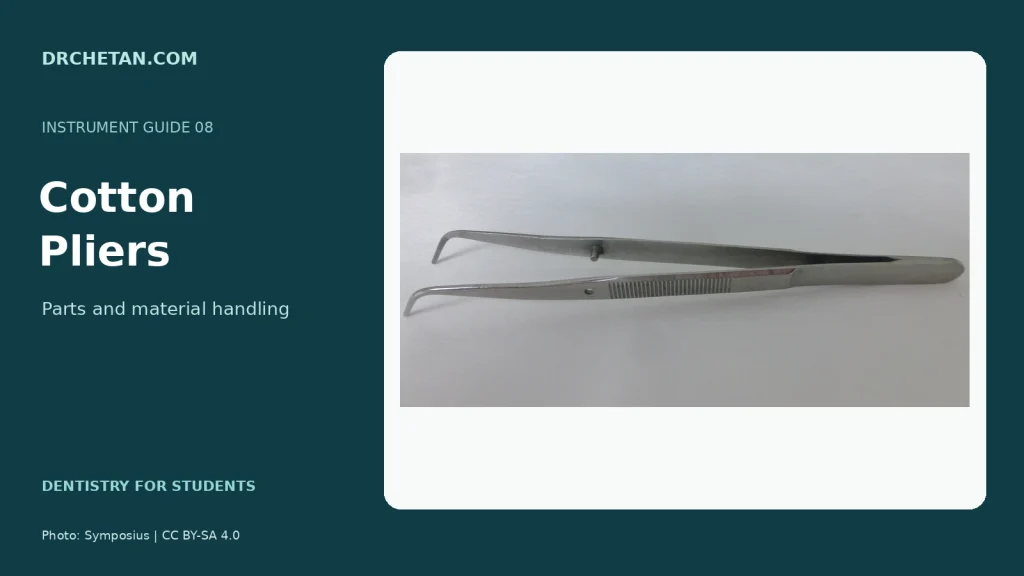
Dental cotton pliers, also called dressing pliers or dental tweezers, transfer small materials into and out of the mouth. They are simple instruments, but their tips and locking features affect how reliably they hold an item.
A learning guide for dental students. Clinical instrument use requires practical training and supervision.
Parts to identify first
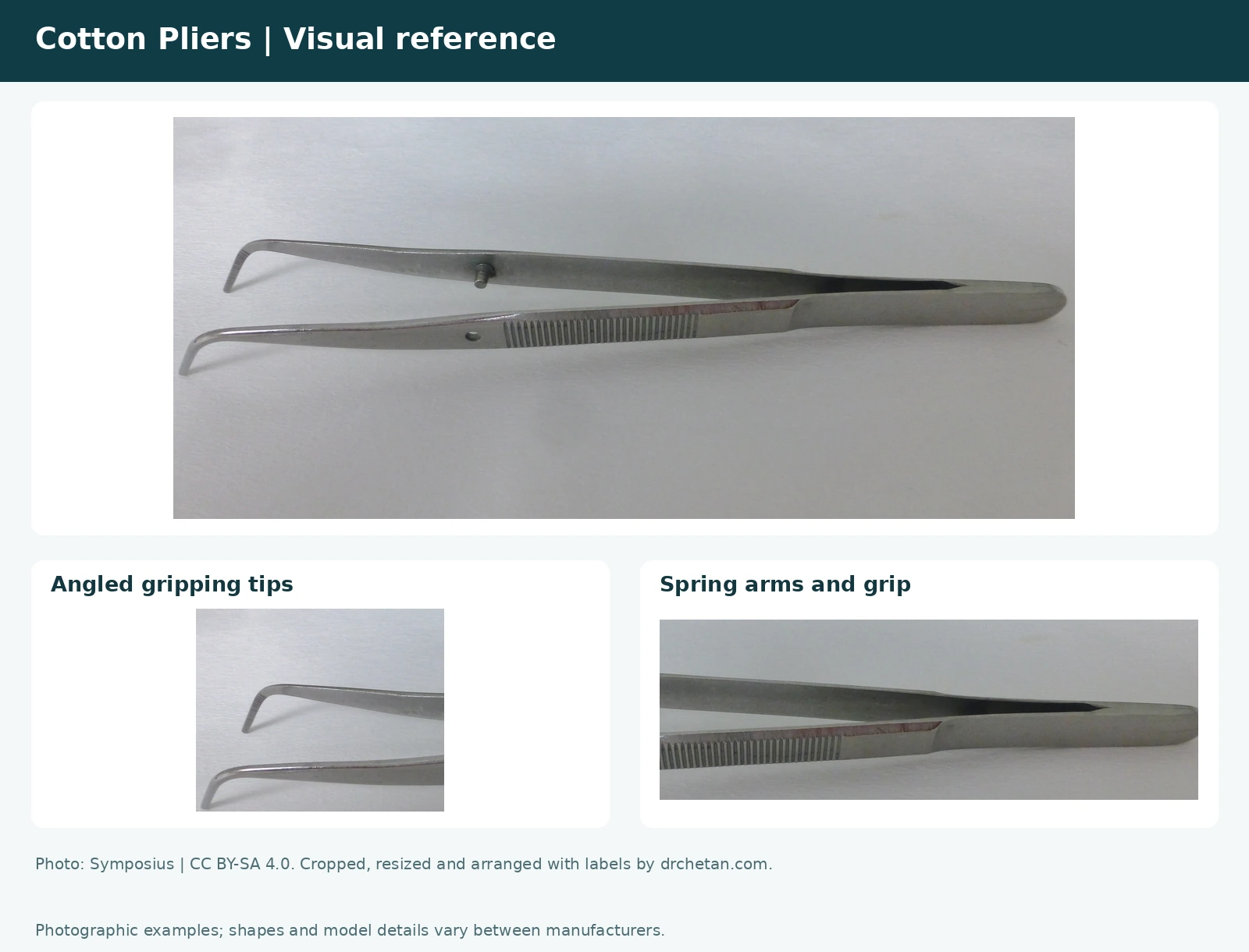
Typical cotton pliers have two spring arms joined at one end, a grip area and opposed working tips. Many dental designs have an angled tip to improve access. Pressure closes the tips; releasing pressure allows a non-locking pair to open.
Inspect the two tips together. They should meet as designed without an unintended gap or crossing. Smooth tips and serrated tips are different options; a product name does not guarantee a particular tip texture.
Photographic reference
Common types and what changes
| Design feature | Practical effect | What to check |
|---|---|---|
| Non-locking | Grip depends on continuing finger pressure | Controlled opening and closing; secure tip alignment. |
| Locking | A mechanism can maintain closure | Know how that specific lock engages and releases. |
| Serrated tips | Texture can improve purchase on suitable materials | Serrations may mark or damage delicate items. |
| Smooth tips | Less textured contact surface | Suitability and retention depend on the item being held. |
| Different tip angles | Changes the route of access | Choose for the intended task rather than appearance alone. |
College is a familiar dressing-plier pattern name. Locking and tip details vary between products. Avoid the rule that every College plier is non-locking: manufacturer catalogues include locking College designs.
Uses in a dental tray
Cotton pliers commonly transfer cotton pellets or rolls and other suitable small items. Depending on the instrument and procedure, they may also handle wedges or similar materials. Articulating paper can be handled with an appropriate instrument, but dedicated paper holders may provide better control.
Think of their role as material handling. They improve access where fingers would be bulky, but small items still require secure control. A lock does not eliminate the possibility of an item slipping or being dropped.
For an identification answer: “These are cotton or dressing pliers. The opposed tips grip and transfer small materials; this example has angled, serrated tips and a locking mechanism.” Mention only features actually present.
What they should not be confused with
Tissue forceps are selected for tissue handling; their design may include teeth or other specialised gripping surfaces. Needle holders have jaws designed to control a suture needle. Haemostats have a different clamping function. Superficial resemblance does not make these instruments interchangeable.
Do not describe cotton pliers as a routine substitute for a needle holder or as an instrument for prolonged tissue clamping. A locking mechanism indicates that the arms can stay closed; it does not establish a surgical indication.
Handling, care and common errors
Check movement, tip alignment and any lock before the instrument reaches the tray. Bent tips can lose their grip even when the arms feel normal. Remove a damaged instrument from service rather than attempting an improvised chairside bend.
Follow the manufacturer’s instructions for cleaning, inspection and sterilization of reusable pliers, including how a lock should be positioned during processing. Do not reuse a device labelled single-use.
Student errors usually come from identifying only the handle, assuming all tweezers are identical, or choosing excessive squeezing force instead of the correct tip design. Describe the material to be held and the visible features before selecting an instrument.
Frequently asked questions
Are dental tweezers and cotton pliers the same?
These names commonly refer to dental dressing pliers. Confirm the particular design rather than relying on the name alone.
Are all College pliers non-locking?
No. College designs include products with locking mechanisms; check the actual instrument.
Why do some cotton pliers have serrated tips?
Serrations improve purchase on suitable materials, but may mark delicate items.
Can cotton pliers replace a needle holder?
No. Suture needles require an appropriate needle-holding instrument with suitable jaws and control.
Does the locking mechanism make an item completely secure?
No. Retention still depends on tip alignment, the item and appropriate handling.
References and further reading
- HuFriedyGroup: cotton and dressing plier designs
- HuFriedyGroup: No. 2 College dressing pliers
- CDC: best practices for sterilization in dental settings
Explore more dental instrument guides and articles for dental students.
Featured-image photograph: Symposius — source photograph (CC BY-SA 4.0). Resized and arranged with title; adapted visual: CC BY-SA 4.0.

Leave a Reply