Endodontic hand instruments may share a small coloured handle and a slender working part, but their cutting surfaces and purposes differ. Begin with the working end, then check the handle markings and manufacturer’s description.
A learning guide for dental students. Clinical instrument use requires practical training and supervision.
Visual reference
Four instrument families at a glance
| Instrument | Working-part clue | Broad purpose |
|---|---|---|
| K-file | Closely spaced helical cutting features in conventional designs | Canal exploration and shaping within its stated indication |
| K-reamer | Generally fewer, more widely spaced flutes than a comparable conventional K-file | Canal enlargement using the prescribed reaming action |
| H-file / Hedstroem file | Prominent successive cutting flutes, conventionally machined from a round blank | Cuts chiefly during withdrawal in its approved hand-filing action |
| Barbed broach | Discrete raised barbs rather than continuous file flutes | Engages and removes suitable pulp tissue; not a canal-enlargement file |
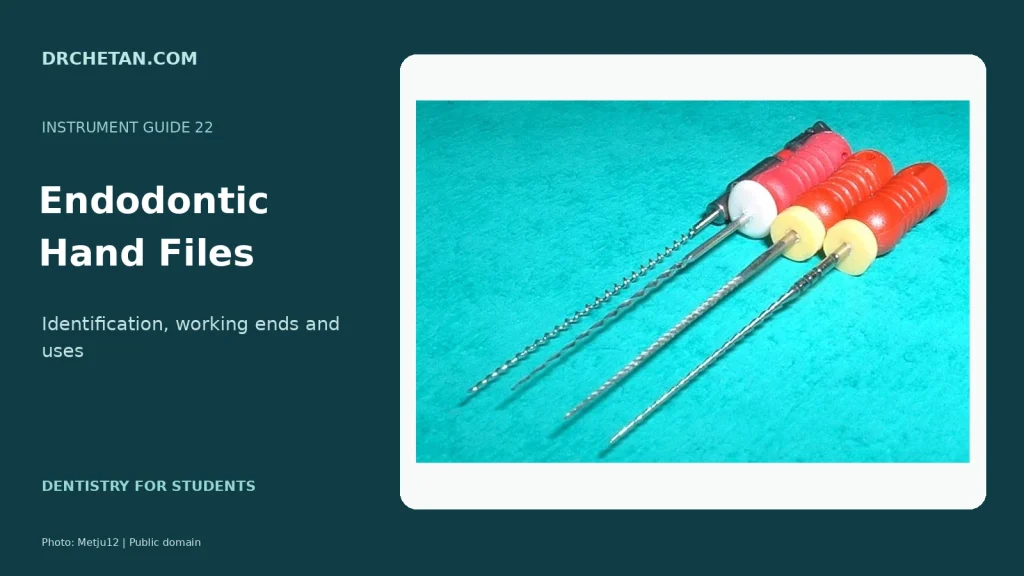
The photograph shows a Lentulo spiral, reamer, K-file and H-file, in that order from left to right. A Lentulo is a paste-carrying instrument and is included only because it appears in the source comparison. It is not a barbed broach.
K-files and reamers: compare the flutes
Traditional K-type instruments are often described as twisted instruments, while Hedstroem instruments are commonly described as machined. Modern manufacturing and design variations mean that this is a useful starting description rather than a universal rule for every product.
For comparable conventional K-type instruments, the reamer generally has fewer spirals per unit length than the file. This makes the spacing a helpful recognition clue. Do not assume that a low-resolution photograph can reveal the exact cross-section, material or tip design.
Avoid the absolute statement “all K-files are square and all reamers are triangular.” Cross-sections vary by product and size. For example, Dentsply’s Lexicon literature specifies different K-file cross-sections across its size range, and a square reamer cross-section in that particular range. Use the relevant catalogue when an examination asks for construction details.
H-files: why their design matters
A conventional H-file has a distinctive series of sharp cutting flutes. Its main cutting action occurs on withdrawal. It should not be treated as a continuously rotating reamer or placed in a motor unless the product is specifically designed and approved for that use.
The important student distinction is between recognising a cutting design and prescribing a clinical motion. A file may fracture if it binds and is stressed beyond its design. The clinical action, selection and sequence must follow practical teaching and the particular instrument instructions.
An instrument that appears unwound, distorted, corroded or damaged is not suitable for continued routine use. Absence of visible damage does not guarantee that a file has no fatigue or other defect.
Barbed broaches are not shaping files
The small projecting barbs help engage suitable soft pulp tissue. They do not form the same continuous cutting pattern as a K-file or H-file. A broach should therefore be identified by the discrete barbs and intended tissue-removal role, rather than simply called another canal file.
Broaches are relatively delicate and must not be forced into a narrow canal or used as enlargement instruments. Products may be described by fineness grades, and their handle colours need not mean the same thing as an ISO file size. Learn the particular range instead of transferring the file colour chart to every small endodontic handle.
ISO size, colour and taper
In a conventional ISO-sized file, the size number refers to nominal tip diameter in hundredths of a millimetre: size 25 corresponds to 0.25 mm. It does not mean a 25 mm instrument length. Length and tip size are separate markings.
| Conventional file size | Common colour |
|---|---|
| 06 / 08 / 10 | Pink / grey / purple |
| 15 / 20 / 25 | White / yellow / red |
| 30 / 35 / 40 | Blue / green / black |
| 45 onward | The six-colour sequence repeats over the conventional size series |
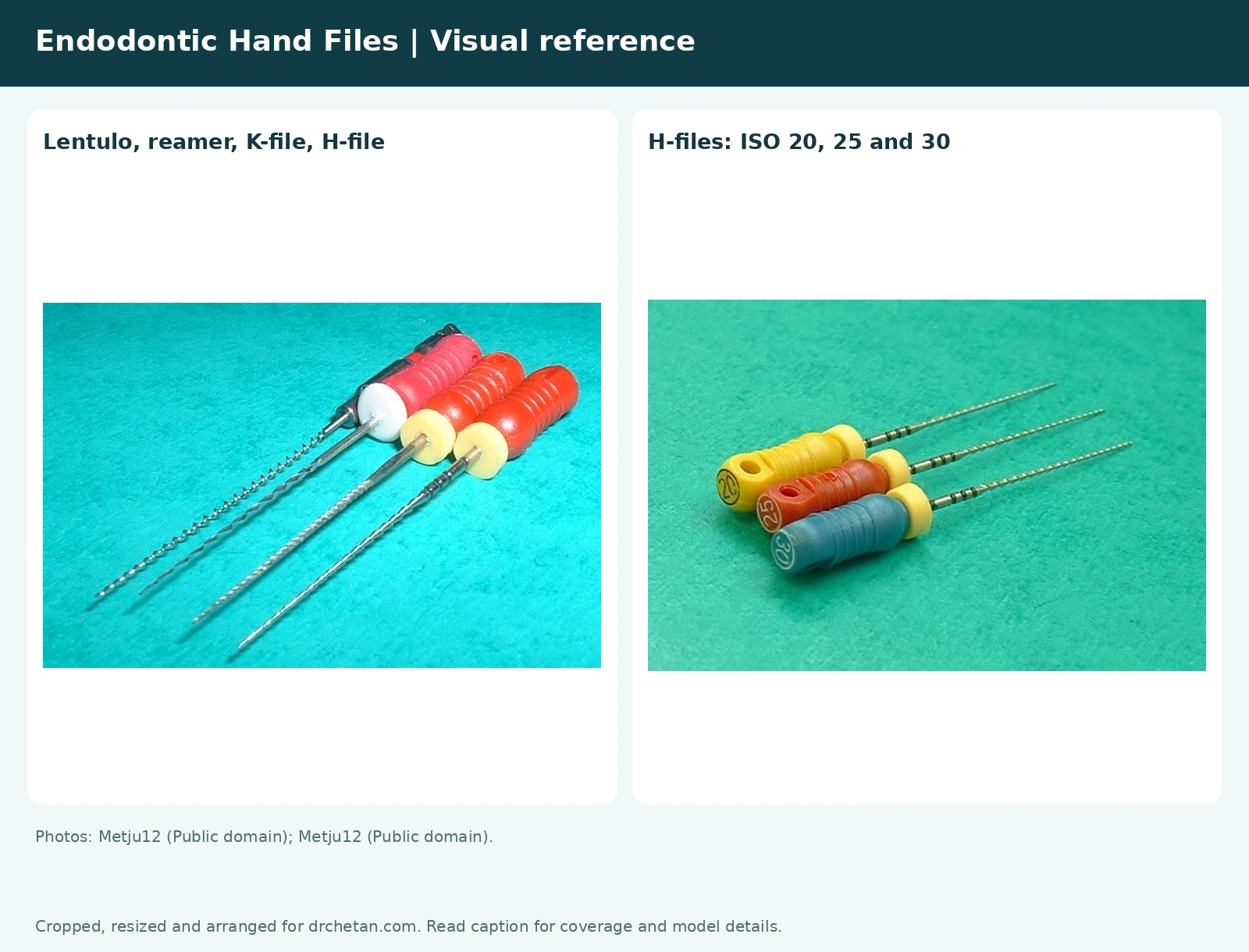
Colour alone cannot identify an instrument family, taper or length. Special systems and intermediate sizes require their own identification information. The three H-files in the second photograph are identified by the source as sizes 20, 25 and 30.
A 0.02 taper means the diameter increases nominally by 0.02 mm for each millimetre along the specified tapered working portion. It does not mean every hand instrument has this taper. Greater-taper, variable-taper and specialised designs exist.
Stops, length and handle markings
A silicone stop is a movable reference aid. It does not establish the correct working length by itself. Working length is a clinical determination using the appropriate assessment methods, not something inferred from the colour of a stop or the file’s full manufactured length.
Check the instrument name, nominal size, taper where stated, and manufactured length. Familiar file ranges include lengths such as 21, 25 and 31 mm, but availability varies. The active cutting length is not necessarily the same as the full instrument length.
A very stiff small instrument intended for negotiating a difficult canal should not automatically be described as an ordinary flexible K-file. Product names such as C+ or other specialist labels carry design differences that matter.
An examination sequence and safe handling
- Name the family from the working end.
- Describe continuous flutes, widely spaced spirals or discrete barbs.
- Read size and length separately.
- State the broad role without inventing a model-specific motion.
- Check whether the instrument is supplied sterile, single-use, single-patient-use or reusable.
Do not assume that all metal hand files can be sterilised and reused indefinitely. Reuse status differs between products. Cleaning, inspection, sterilisation and disposal must follow the instrument instructions and local policy.
Viva example: “This is an H-file. Its characteristic cutting flutes distinguish it from a conventional K-file. It is used with its prescribed hand-filing action and cuts chiefly during withdrawal.”
Frequently asked questions
Does a red handle always mean an H-file?
No. In conventional ISO file coding, red commonly indicates size 25; it does not identify the instrument family.
Is size 25 the same as a 25 mm file?
No. Size 25 refers to nominal tip diameter; manufactured length is a separate specification.
Can a barbed broach enlarge a canal?
That is not its intended shaping role. It is designed to engage suitable pulp tissue.
Are all K-files made with a square cross-section?
No. Cross-section varies by size and product range.
Can every hand file be reused?
No. Follow the stated single-use, single-patient-use or reusable designation and processing instructions.
References and further reading
- Dentsply Sirona: Lexicon instrument family brochure
- Dentsply Sirona: reamers
- Dentsply Sirona: ReadySteel hand instruments
- Dentsply Sirona: Lexicon K-files and use status
Featured-image photograph: Metju12 — original source (Public domain). Resized and arranged with title. Adapted visual: CC BY-SA 4.0.
Explore more dental instrument guides and articles for dental students.

Leave a Reply