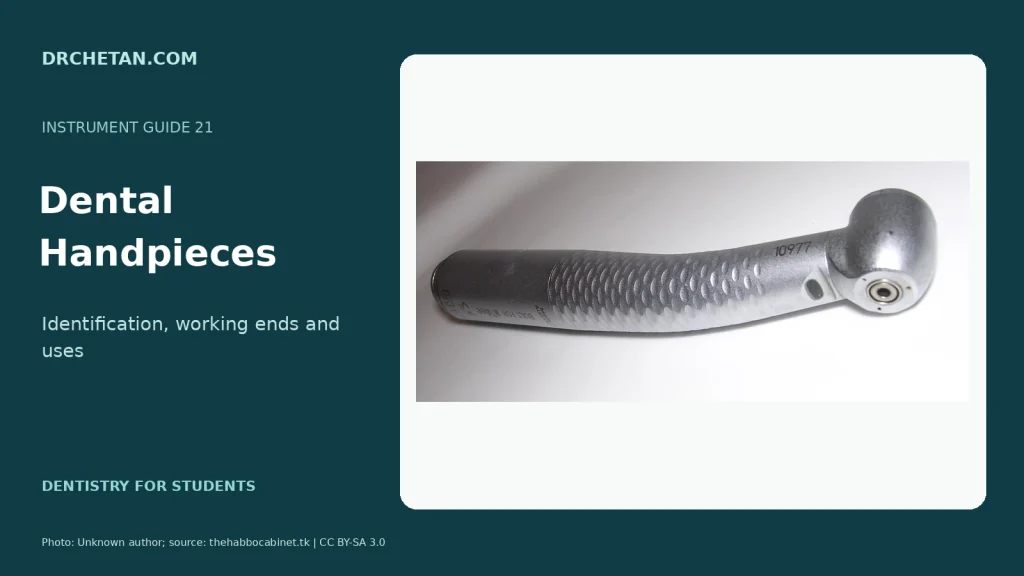
Dental handpieces hold and drive rotary instruments such as burs. To identify one correctly, separate three questions: what shape is the attachment, what powers it, and which rotary instrument can it safely accept?
A learning guide for dental students. Clinical instrument use requires practical training and supervision.
Visual reference
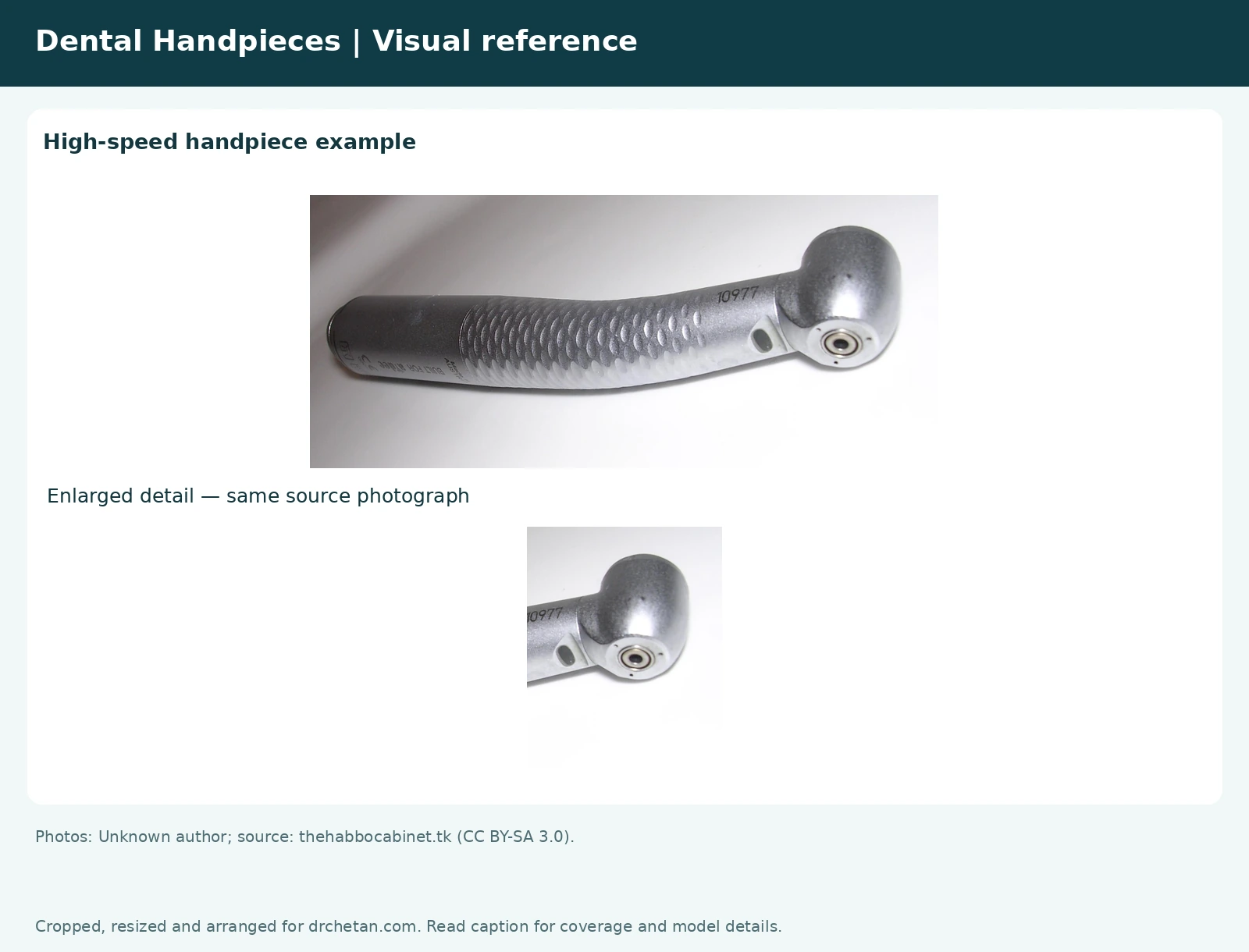
Start with shape, drive and intended use
“High-speed,” “contra-angle” and “straight” do not describe the same feature. High-speed describes an operating category. Contra-angle and straight describe the arrangement of the attachment. An air turbine and an electric motor with a speed-increasing contra-angle can both provide high-speed cutting, but their drive systems differ.
This explains a common examination error: calling every contra-angle a slow-speed handpiece. Many are used at lower speeds, but speed-increasing contra-angles also exist. Read the model and ratio markings before deciding. A curved outline alone cannot tell you the permitted speed or bur shank.
The main groups
| Group | Recognition clues | Broad role |
|---|---|---|
| Air-turbine handpiece | Small head containing an air-driven turbine; connected through its specified coupling | High-speed cutting with an approved rotary instrument |
| Motor-driven contra-angle | Angled head and neck on a motor attachment; often marked with a gear ratio | Cutting, finishing or another specified task depending on the attachment |
| Straight handpiece | Working axis broadly aligned with the body; connects to a compatible motor | Selected laboratory, extraoral or surgical tasks according to the model |
| Specialised attachment | Endodontic, implant, surgical or prophylaxis-specific design | Only the intended procedure and compatible accessories |
Some systems use an air motor and others an electric motor. Do not confuse an air motor driving an attachment with an air turbine situated in the head. The word “air” alone does not establish the operating category.
Parts students should recognise
- Head: houses the mechanism supporting and driving the bur.
- Chuck or bur-retention mechanism: secures the compatible shank; push-button, latch and other arrangements exist.
- Neck and body: position the head and provide the operator’s grip.
- Motor connection or coupling: joins the attachment to its specified drive or supply. Couplings are not universally interchangeable.
- Spray outlets and light: may be integrated, supplied separately or absent, depending on the model.
A visible push button identifies a release mechanism, not the complete specification. Never operate a release mechanism while the instrument is running or test retention by running an improperly secured bur. Learn the approved insertion and checking method on the actual model.
Understanding gear ratios
A direct-drive attachment transfers motor rotation without a designed increase or reduction. A speed-increasing attachment raises output speed relative to the motor, while a reduction attachment lowers it and changes the available torque relationship. The motor setting alone therefore does not tell you the bur speed.
For a concrete manufacturer example, NSK lists Z95L as a 1:5 increasing contra-angle. Its surgical range also includes 1:1 direct-drive attachments. These examples show why geometry and speed must be considered separately. They do not establish the limits of every similar-looking instrument.
Colour rings can be useful recognition aids within a range. Confirm the engraved ratio, product code, maximum permissible speed and instructions rather than relying on colour alone. Never calculate an output speed and assume it is acceptable without checking both the attachment and rotary instrument limits.
Bur shanks: FG, RA and HP
| Shank family | Common recognition point | What to verify |
|---|---|---|
| FG: friction grip | Usually a smooth 1.6 mm shank in familiar dental FG burs | Approved head, shank length, insertion and speed limits |
| RA: right-angle / latch type | Usually a 2.35 mm shank with a latch-retention feature | The attachment’s accepted shank and retention design |
| HP: handpiece / straight type | Usually a longer 2.35 mm shank without the RA latch feature | Length, diameter and the straight attachment’s specifications |
These are common conventions, not permission to substitute one shank for another. Equal shaft diameter does not prove equal compatibility: the retention feature and permitted length matter too. A bur must be approved for the handpiece and intended procedure.
Straight and surgical handpieces: do not infer an indication
A straight body is easy to recognise, but it does not establish whether the instrument is designed for intraoral surgery or laboratory work. Surgical attachments may have specified irrigation arrangements and other features suited to their intended use. A laboratory handpiece should not be assumed suitable for a surgical procedure.
Similarly, a routine air-turbine handpiece should not be treated as a universal substitute for a surgical handpiece. Selection depends on the procedure and the manufacturer’s indication. Photographs are useful for learning external form; they cannot certify an instrument’s clinical suitability.
Care and a practical-exam answer
Check the attachment, connection and retention mechanism for damage, unusual noise or poor running. Remove damaged equipment from use and follow the servicing instructions. Lubrication requirements differ between models; do not assume every handpiece needs the same oil or cleaning process.
CDC guidance calls for cleaning and heat sterilisation of dental handpieces and appropriate removable attachments between patients, following validated manufacturer instructions. Surface wiping alone does not address contamination within the device. Confirm the processing instructions for the motor and each component separately.
Viva example: “This is a motor-driven contra-angle attachment. I would confirm its ratio, accepted shank, maximum speed and intended use from the model marking. Its angled shape does not by itself mean that it is slow-speed.”
Frequently asked questions
Is every contra-angle slow-speed?
No. A contra-angle can be direct-drive, reducing or speed-increasing. Check its marked ratio and instructions.
Are an air motor and an air turbine the same?
No. An air motor drives an attachment; a turbine mechanism is located in the turbine handpiece head.
Can RA and HP burs be exchanged because both may be 2.35 mm?
No. Retention features, shank length and the attachment specification must also match.
Does a straight handpiece always mean a surgical handpiece?
No. Shape does not establish its intended clinical indication.
Is wiping the outside enough between patients?
No. Follow validated cleaning and heat-sterilisation instructions for the handpiece and relevant attachments.
References and further reading
- NSK: speed-increasing contra-angle example
- NSK: surgical handpiece specifications
- CDC: best practices for dental handpieces
Featured-image photograph: Unknown author; source: thehabbocabinet.tk — original source (CC BY-SA 3.0). Resized and arranged with title. Adapted visual: CC BY-SA 4.0.
Explore more dental instrument guides and articles for dental students.

Leave a Reply