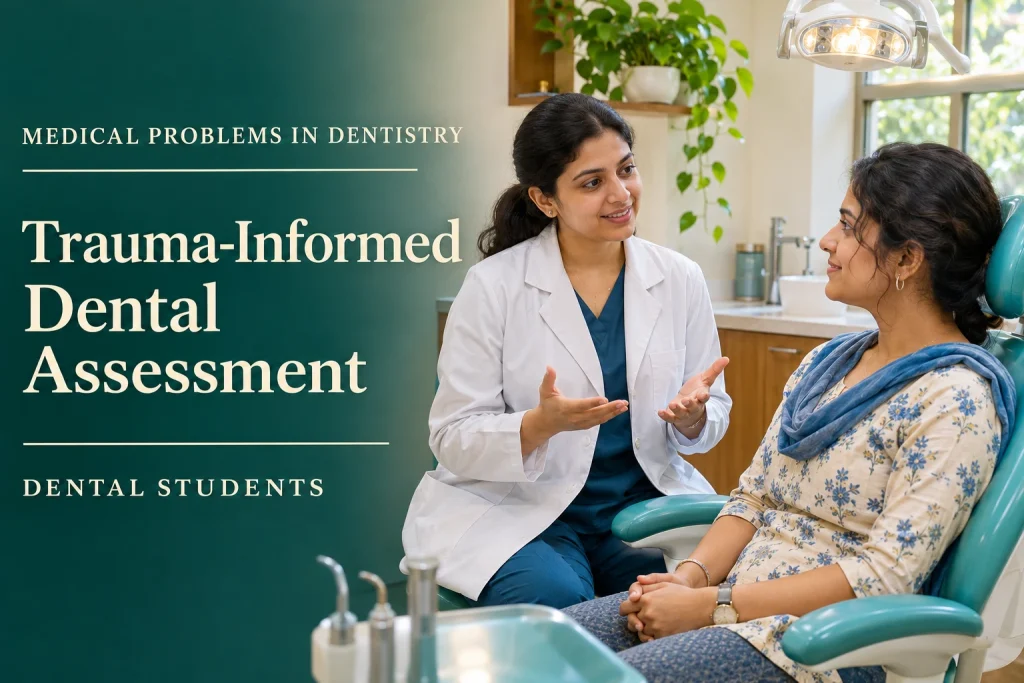
Medical Problems in Dentistry: Article 161 of 215 · Refugee, migrant and socially excluded populations · Complete student guide
Medical Problems in Dentistry · Student guide
A dental visit can involve close contact, unfamiliar sounds and a sense of reduced control. A trauma-informed approach asks how to make care understandable and safer for the individual. Cultural safety also requires attention to the clinician’s assumptions and the patient’s experience, rather than a checklist of beliefs attributed to a group.
In this guide: Learning objectives · Start with this clinical case · Understand the purpose of the approach · Start with predictable communication · Ask about preference, not presumed culture · Turn the principles into observable actions · Respond to distress without coercion · Protect disclosure and recognise limits · Document what helps rather than a stereotype · Viva and self-check
Learning objectives
- Offer choice and predictable steps without requiring a trauma disclosure.
- Ask about preferences without cultural stereotypes.
- Separate trauma-informed communication from trauma therapy and safeguarding decisions.
Start with this clinical case
Fictional teaching case. A patient becomes distressed when the chair is reclined without warning. The student asks what “trauma happened” and a relative answers on the patient’s behalf. How could the assessment regain trust and control without demanding a personal history?
Understand the purpose of the approach
SAMHSA describes a trauma-informed system as one that recognises the effects of trauma, responds through its practices and seeks to avoid retraumatisation. Safety, trust, collaboration and voice are relevant principles. This is an organisational and interpersonal approach, not a diagnosis applied to every anxious patient.[TRAUMA]
The clinician does not need a detailed account of a past event to explain the next step, ask permission or respect a pause. Do not use the label to assume a person has experienced abuse, to interpret every reaction psychologically or to avoid investigating pain.
Start with predictable communication
Introduce yourself, explain the purpose of the visit and ask what would make the assessment easier. Describe an examination step before touching or repositioning the patient. Agree a way to pause and respond when it is used. Avoid promising a completely painless or effortless visit that cannot be guaranteed.
The UK working definition emphasises safety, trust, choice and collaboration. The following dental examples apply those principles to ordinary assessment; they are not a validated therapy protocol or an Indian statutory checklist.[TICUK]
Ask about preference, not presumed culture
Ask which language works best, who the patient wants present, and whether there are preferences about explanation, privacy or the clinician involved. Treat the answer as individual information. Do not infer a refusal, belief or decision-making arrangement from religion, ethnicity, clothing or a family relationship.
If a preference cannot be met immediately, explain what is possible and discuss an alternative. A respectful conversation is more useful than pretending a constraint does not exist. Do not tell the patient that “people from your community” usually accept a particular treatment.
Turn the principles into observable actions
| Finding or question | Clinical implication | Student action |
|---|---|---|
| Unexpected movement or touch | May reduce predictability and control | Explain the step and ask permission first |
| Patient asks to pause | A need or limit has been expressed | Pause and clarify what would help |
| Relative speaks for the patient | The patient’s preferences may be obscured | Address the patient and agree the supporter’s role |
| Clinician assumes a cultural belief | Stereotyping may distort consent | Ask an open, individual question |
| A difficult experience is disclosed | The response needs privacy and appropriate support | Listen, avoid interrogation and seek the relevant senior pathway |
Respond to distress without coercion
Pause the procedure or discussion when safe and ask what the patient needs. Consider pain, communication difficulty, sensory discomfort and a misunderstanding of the plan. Avoid treating distress as evidence that the patient is uncooperative or lacks decision-making ability.
Staged assessment, a different appointment arrangement or another clinician may help in some cases. Explain why a change is proposed and agree the next step. Do not frame forced completion as a way to cure anxiety or use this overview to justify restraint or unsupervised sedation.
Protect disclosure and recognise limits
If the patient volunteers a difficult history, listen without demanding proof or unnecessary detail. Ask what they want the dental team to know for today’s care. Explain privacy honestly and do not promise absolute secrecy when legal or safeguarding duties could apply.
Consent, confidentiality and safeguarding need the appropriate Indian clinical and legal framework. The patients’ rights charter is relevant to dignity and privacy, but it does not replace a case-specific safeguarding pathway. Seek senior guidance when safety is in question; trauma-informed care is not a substitute for that responsibility.[CHARTER]
Document what helps rather than a stereotype
Record the agreed communication, stop signal, positioning preference and what was achieved. If relevant information is shared with another clinician, use an appropriate consent and confidentiality basis and include only what is necessary. Do not add an unconfirmed trauma diagnosis to explain a difficult appointment.
Invite feedback about what felt clear or uncomfortable and use it to improve the next visit. In a viva, describe actions the team can actually observe: explaining, asking, pausing and checking. These actions preserve clinical assessment while making participation more possible.
Viva and self-check
Must a patient disclose trauma to receive this approach? No. Predictability, permission and choice can be offered without requiring a personal account.
Is cultural safety a list of beliefs for each community? No. Ask the individual and examine the clinician’s assumptions and the patient’s experience.
Does trauma-informed care replace safeguarding? No. Relevant safety concerns still require the appropriate senior and legal pathway.
Continue through the series
- Previous: Dental Care for People Experiencing Homelessness: Prevention and Realistic Treatment Planning
- Next: Interrupted Records and Follow-Up: Planning Dental Care Across Services
- Browse all 215 student guides by subject
More in Refugee, migrant and socially excluded populations: Migrant and Refugee Oral Health: Access Barriers, History and Continuity of Care · Language Barriers and Interpreters in Dental Consultations · Dental Care for People Experiencing Homelessness: Prevention and Realistic Treatment Planning · Interrupted Records and Follow-Up: Planning Dental Care Across Services
Continue learning
- Informed consent in an Indian dental practice
- Structured medical history and examination
- Medical liaison and referral for complex dental patients
References and scope
Sources checked on 26 November 2026. This is an original student teaching guide. International clinical recommendations are identified by their issuing organisation. Use current local protocols, appropriate supervision and an individual clinical assessment.
- SAMHSA: Trauma-Informed Approaches and Programs
- UK Government: Working definition of trauma-informed practice
- National Council for Clinical Establishments: Charter of Patients’ Rights and Responsibilities (updated 2021)
Images are AI-generated educational illustrations of fictional people or equipment, not clinical records or diagnostic photographs.

Leave a Reply