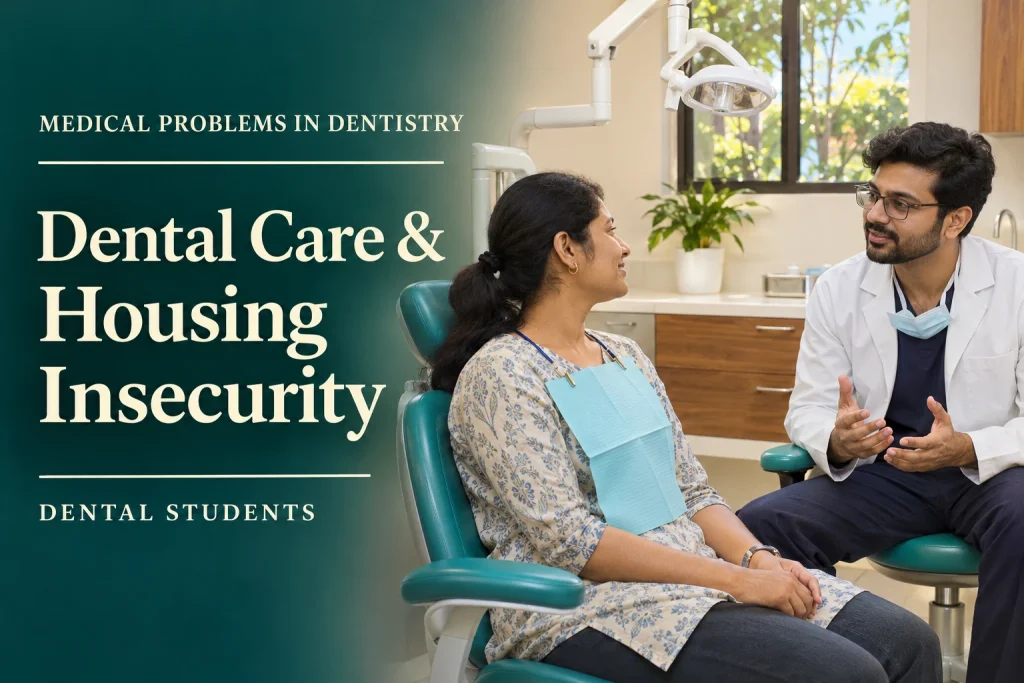
Medical Problems in Dentistry: Article 160 of 215 · Refugee, migrant and socially excluded populations · Complete student guide
Medical Problems in Dentistry · Student guide
A treatment plan can be clinically sound on paper and impossible in daily life. Housing insecurity may affect storage, hygiene facilities, transport, contact and attendance, but experiences vary. Ask what is feasible for the individual and build care around the actual oral findings and priorities.
In this guide: Learning objectives · Start with this clinical case · Begin with need, comfort and respect · Ask about feasibility without demanding a life story · Make prevention fit the environment · Compare an impractical plan with a workable question · Sequence care collaboratively · Protect consent and privacy · Keep the door open to continuing care · Viva and self-check
Learning objectives
- Identify practical barriers without reducing the patient to housing status.
- Adapt prevention and treatment sequencing collaboratively.
- Plan contact and review without blame or unsupported promises.
Start with this clinical case
Fictional teaching case. A patient with recurrent tooth pain is staying temporarily with different acquaintances. They have missed two appointments, have limited storage and cannot predict their work hours. The notes say “non-compliant”. How would you reassess the barriers and agree a workable next step?
Begin with need, comfort and respect
Assess the presenting complaint, urgent symptoms, oral function and the patient’s main concern. Use the same standards of examination and explanation as for any patient. Do not assume a particular mental-health condition, substance use or infection from appearance or living circumstances.
NICE’s indexed homelessness guidance supports person-centred, non-judgemental engagement and reducing access barriers. It is UK service guidance, not a statement of entitlement to a particular Indian service. Its principles can inform questions while the local clinical and referral arrangements are verified.[HOMELESS]
Ask about feasibility without demanding a life story
Explain why a practical question matters: whether a person has safe storage can affect aftercare, and travel time can affect a repeated-visit plan. Ask only for relevant information and give the patient room to decline. Avoid requiring an account of how homelessness began before offering dental assessment.
Explore access to water, a place to brush, ability to keep supplies, a reliable contact method and likely movement between locations. Different patients will need different adjustments. Record the useful barrier and agreed response rather than unnecessary sensitive details about where they sleep.
Make prevention fit the environment
Ask what the patient currently does and what supplies they can carry and retain. Agree a small achievable routine based on the oral assessment, not an idealised list dependent on equipment, money or a stable bathroom. Check whether a portable basic kit or a different routine would actually help before assuming it will.
Diet advice should take food availability into account. Ask what choices are possible and avoid shaming advice that presumes control over every meal. Where additional dental prevention is indicated, choose it from the individual’s risk and clinical needs rather than housing status alone.
Compare an impractical plan with a workable question
| Finding or question | Clinical implication | Student action |
|---|---|---|
| Repeated missed appointments | Transport, work, contact or other barriers may exist | Ask what prevented attendance and agree a feasible return route |
| No safe storage | Supplies or instructions may be lost | Choose a portable plan and usable information format |
| Several visits proposed | The sequence may be difficult to complete | Explain priorities and discuss realistic staging |
| Uncertain contact address | A standard reminder system may fail | Agree a safe contact method with permission |
| Cost is unclear | The patient cannot judge feasibility | Explain expected costs and verify referral options |
Sequence care collaboratively
Explain urgent needs, disease-control priorities and longer-term options separately. Ask which visits the patient can realistically manage and what outcome matters most. Do not automatically select extraction or deny restorative options because follow-up might be difficult. Discuss prognosis and practical demands honestly.
If a plan depends on specialist care, confirm how referral will work. A public hospital, dental college or outreach service may be useful, but actual capacity, costs and access rules need checking. Do not promise a free service, guaranteed appointment or funded transport that has not been verified.
Protect consent and privacy
Use understandable explanations of benefits, risks, alternatives and costs. Ask whether any support person should be involved and what can be shared. Housing insecurity does not remove an adult’s role in making decisions.
The Indian patients’ rights charter addresses information, records, consent and privacy. It provides a patient-centred reference, while establishment and state requirements still need their own assessment. Do not treat a social-service worker’s involvement as automatic permission to disclose the full dental record.[CHARTER]
Keep the door open to continuing care
Agree what to do if the patient cannot attend and how to re-enter care. NICE’s indexed guidance discourages disengaging people simply because appointments were missed. For a dental teaching case, translate that principle into a practical discussion of the barrier, a feasible follow-up route and safe documentation.[HOMELESS]
Write “unable to attend because transport was unavailable; next contact method agreed” when that is what happened. A judgemental label hides the information needed to improve care. Finish with a clear next step and the warning symptoms that require urgent help, adapted to the person’s circumstances.
Viva and self-check
Does housing status justify assuming a particular diagnosis? No. Clinical assessment and relevant individual history determine the diagnosis.
Should extraction automatically replace restorative care? No. Discuss clinical indications, options and practical demands without making the choice from housing status alone.
What is more useful than “non-compliant”? A factual account of the barrier, the patient’s priorities and the plan agreed to address it.
Continue through the series
- Previous: Language Barriers and Interpreters in Dental Consultations
- Next: Cultural Safety and Trauma-Informed Dental Assessment
- Browse all 215 student guides by subject
More in Refugee, migrant and socially excluded populations: Migrant and Refugee Oral Health: Access Barriers, History and Continuity of Care · Language Barriers and Interpreters in Dental Consultations · Cultural Safety and Trauma-Informed Dental Assessment · Interrupted Records and Follow-Up: Planning Dental Care Across Services
Continue learning
- Structured medical history and examination
- Informed consent in an Indian dental practice
- Medical liaison and referral for complex dental patients
References and scope
Sources checked on 26 November 2026. This is an original student teaching guide. International clinical recommendations are identified by their issuing organisation. Use current local protocols, appropriate supervision and an individual clinical assessment.
- NICE NG214: Integrated health and social care for people experiencing homelessness
- National Council for Clinical Establishments: Charter of Patients’ Rights and Responsibilities (updated 2021)
Images are AI-generated educational illustrations of fictional people or equipment, not clinical records or diagnostic photographs.

Leave a Reply