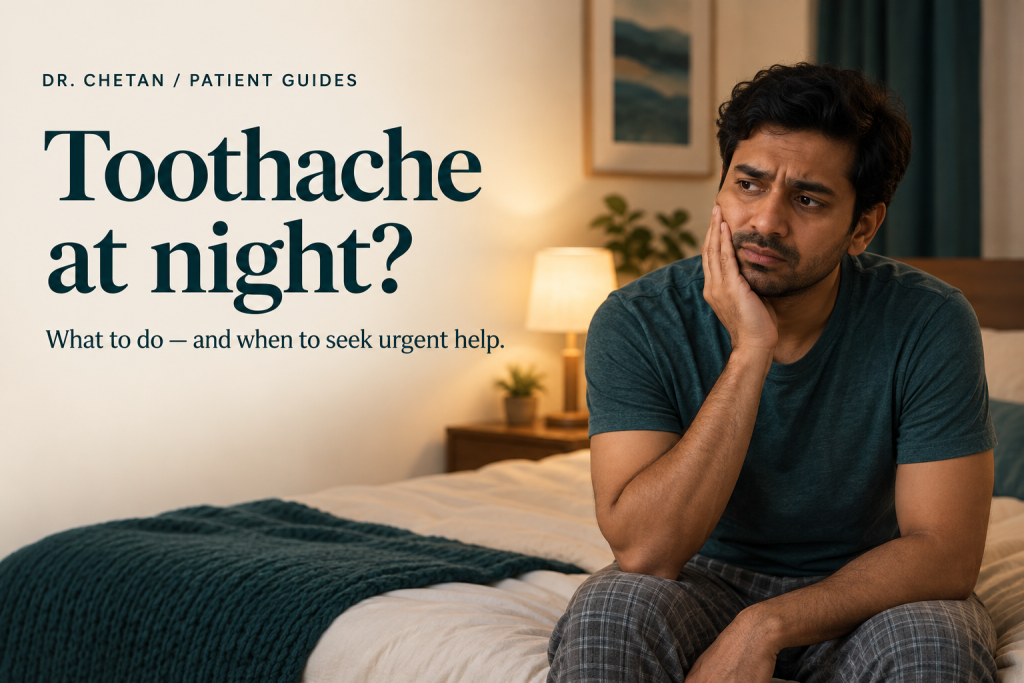
A tooth starts throbbing just as you are trying to sleep. Your usual clinic is closed, the pain is distracting and you are unsure whether to take something, call someone or wait.
The first decision is where to get help. Some symptoms need emergency medical care; others need urgent dental attention. Temporary relief can help while you arrange treatment, but it does not establish what is wrong or fix the cause.
First, check whether you need emergency help now
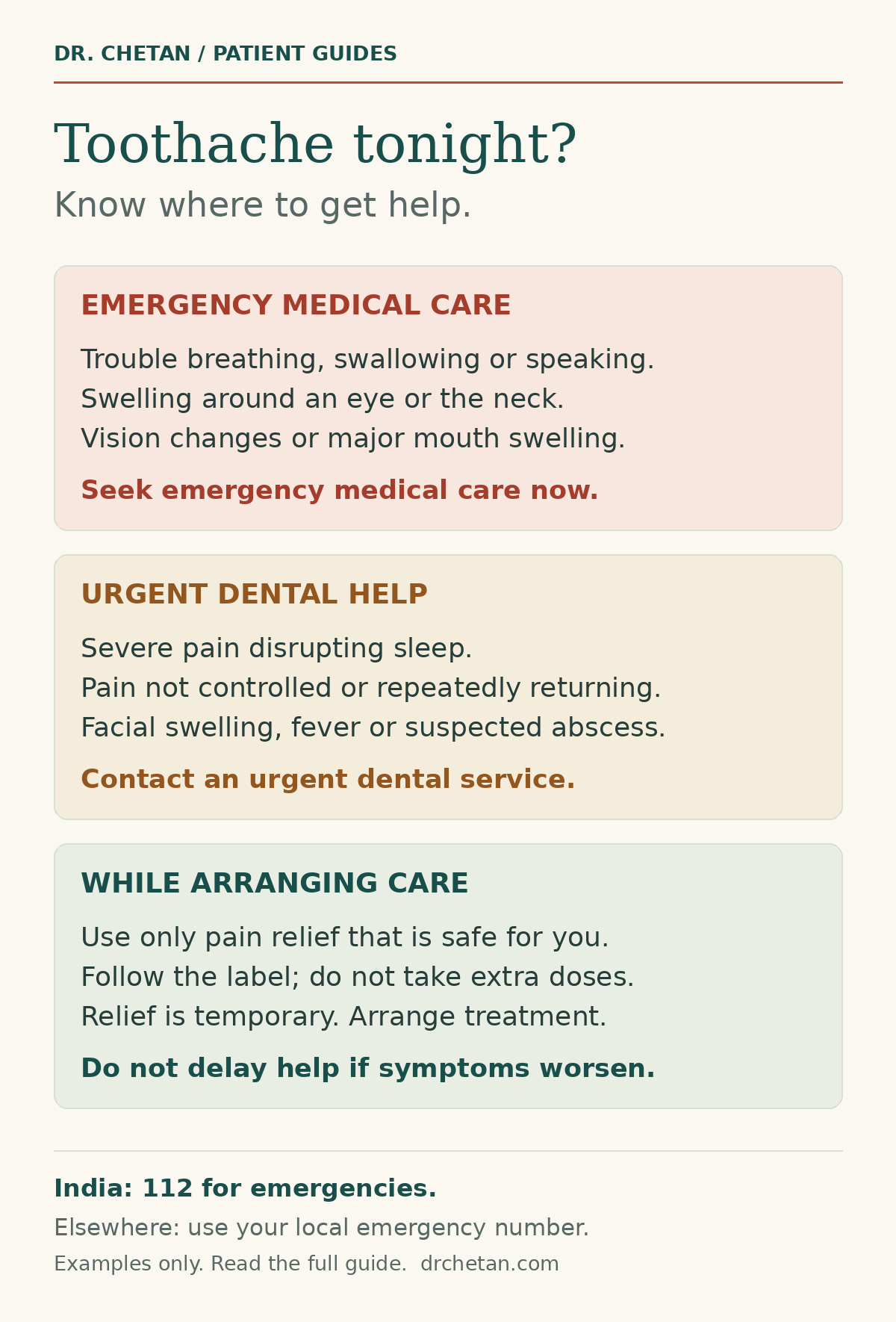
Seek emergency medical care immediately if tooth or mouth pain is accompanied by:
- Difficulty breathing, swallowing or speaking.
- Swelling around the eye or neck, a painful swollen eye or changes in vision.
- Extensive swelling inside the mouth or marked difficulty opening your mouth, especially with swelling or illness. [2]
Serious facial injury or heavy mouth bleeding that will not stop also needs emergency assessment. Do not spend time trying home remedies for these symptoms.
In India, call 112 for emergency assistance. If you are elsewhere, use your local emergency number or hospital emergency service. India’s 112 system includes health emergencies; it is not a routine dental-booking line.
When should you seek urgent dental care tonight?
Contact a dentist or an out-of-hours dental service urgently if you have:
- Severe tooth or mouth pain affecting sleep or normal activities, particularly when suitable pain relief is not helping.
- Pain that keeps returning despite pain relief.
- A swollen cheek or jaw, fever, a bad taste or pus, or symptoms suggesting a dental abscess.
Tell the service about swelling and fever when you call. Do not describe the problem only as “toothache” if you also have those symptoms.
Do not wait for routine opening hours if symptoms are severe, spreading or getting worse. Urgent dental services can advise where and how quickly you need to be seen.
How to find help when your dentist is closed
Start with your usual clinic’s telephone number. Its recorded message or published contact information may explain the emergency arrangements.
If you cannot reach them, contact another local urgent dental service. A local hospital may be able to tell you where dental or oral-and-maxillofacial services are available. Call to confirm availability rather than assuming that an online “24-hour” listing guarantees someone can treat you immediately.
If emergency warning signs develop while you are making calls, seek medical emergency care instead of continuing to search for a dental appointment.
What you can do while arranging treatment
These measures are for temporary comfort while you seek advice. They are not a reason to postpone treatment for severe pain or swelling.
1. Use pain relief only if it is suitable for you
Paracetamol, also called acetaminophen, and anti-inflammatory medicines such as ibuprofen are used for dental pain. The ADA’s guidance supports non-opioid medicines for temporary toothache relief, but the choice depends on your health, other medicines and contraindications.
Ask a pharmacist, dentist or doctor what you can safely take. Follow the product label and any instructions already given specifically to you. Do not take extra tablets or shorten the interval because the pain is intense.
Ibuprofen is not suitable for everyone. Get advice before using it if you have a history of stomach ulcers, kidney disease, certain heart or liver conditions, bleeding problems or a previous reaction to an anti-inflammatory medicine. Pregnancy, asthma and medicines such as anticoagulants also require checking.
Do not combine ibuprofen with another anti-inflammatory painkiller, such as naproxen, unless a clinician has specifically directed you to do so.
2. Check ingredients before taking another product
Different brand names can contain the same medicine. Cold-and-flu preparations and combination painkillers may already contain paracetamol. Check the active ingredients before adding a separate paracetamol tablet.
Keep a note of the medicine name, strength, amount and time taken. That is more reliable than trying to remember several doses during a difficult night.
If you have taken more than the label allows, get urgent medical advice rather than waiting to see how you feel. Paracetamol overdose can damage the liver.
For a child, do not use an adult medicine schedule or estimate a dose. Ask for age- and weight-appropriate advice. Children under 16 should not be given aspirin unless prescribed by a doctor.
3. Avoid foods and drinks that trigger the pain
Choose soft food if you need to eat, and avoid chewing on the painful tooth. Very hot, very cold or sugary items may make toothache worse.
You do not need to keep testing the tooth with ice, sweets or hot drinks to find out whether it still hurts. Note what triggered the pain and tell the dentist.
4. Keep the mouth gently clean
Use a soft toothbrush and clean gently. Do not repeatedly force floss, toothpicks or other objects into a sore area. Sharp instruments are not a safe way to explore the cause of pain or remove something you cannot easily reach.
For an adult who can reliably spit, an optional salt-water rinse may offer temporary comfort: dissolve half a teaspoon of salt in a glass of comfortably warm water, rinse gently and spit it out. Do not swallow it. This is not appropriate for young children who may swallow the solution.
A rinse does not remove decay or cure an infection inside a tooth.
5. Try a comfortable resting position
If lying flat makes the pain feel worse, resting with your head a little higher may help. A cold pack wrapped in a cloth against the outside of the cheek may also offer comfort; avoid direct ice contact with skin and take breaks. Stop if it makes the pain worse.
Neither a pillow nor a compress treats the underlying dental problem. Do not use these measures to delay help for increasing swelling.
Things not to do
Do not put aspirin on the tooth or gum. It can injure the gum tissue; a tablet is not a dressing for a painful tooth.
Do not try to puncture or squeeze a swelling. A suspected dental abscess needs professional treatment.
Do not keep increasing the painkiller dose. More than the recommended amount can be dangerous.
Do not assume pain relief means the tooth has healed. Medicines provide temporary symptom control while the cause is assessed and treated.
Should you start antibiotics?
Do not start leftover antibiotics, use someone else’s prescription or buy a course simply because a tooth hurts.
Antibiotics are not the answer to most toothaches arising from inflamed or infected tissues inside or around a tooth. Dental treatment often matters more. Antibiotics may be needed for particular infections, including those with systemic involvement, but a clinician must assess the situation.
Fever or spreading swelling is a reason to seek professional assessment urgently, not a reason to select an antibiotic yourself.
What to tell the dentist when you call
A short, clear account helps the team triage you. Have these details ready if possible:
- Where the pain seems to be and when it started.
- Whether it is constant, comes in episodes or is brought on by biting or temperature.
- Whether you have swelling, fever, a bad taste, difficulty opening the mouth or trouble swallowing.
- Any recent injury, filling, extraction or other dental treatment.
- The exact medicines and amounts already taken, with the times.
- Important medical conditions, allergies, regular medicines and whether you are pregnant.
You do not need to identify the diagnosis yourself. Saying “lower left pain that woke me up, with cheek swelling since this evening” is more useful than guessing which procedure you need.

Why can toothache feel worse at night?
Some dental pain feels worse when you lie down. Toothache can also be difficult to localise: pain from one tooth may seem to come from a nearby area.
Night-time pain alone does not identify the cause. Possible problems include decay, a crack, a loose or broken filling, an inflamed or infected tooth or surrounding tissues, and other dental conditions.
The useful next step is an examination, rather than deciding from the time of day that you definitely need a root canal or an extraction.
What might the dentist do?
Treatment depends on the cause. Some teeth need a filling or repair; others may need root canal treatment or removal. An abscess may need drainage and treatment of its source.
Tell the dentist if symptoms improved after pain relief or changed during the night. Improvement is useful information, but it should not replace the examination you arranged.
Questions patients often ask
Can I wait until morning?
That depends on the symptoms. Emergency warning signs need immediate medical care. Severe or worsening pain, swelling or symptoms of an abscess need urgent professional advice; do not assume that waiting is appropriate simply because it is night.
Does a dental abscess go away if the pain stops?
A dental abscess does not resolve on its own and needs dental treatment. Keep the appointment or seek urgent advice even if the pain changes.
Which painkiller is best?
There is no single safe choice for every reader. Your medical history, other medicines and the ingredients you have already taken matter. Ask a pharmacist or clinician to help you choose; this article does not prescribe an individual medicine schedule.
What if the pain returns tomorrow night?
Recurring pain still needs assessment. Avoid turning temporary measures into a nightly routine. Contact a dentist and explain that the pain is returning despite your efforts to manage it.
For tonight, focus on three tasks: recognise warning signs, contact the appropriate service and use only temporary relief that is safe for you while arranging treatment.
References
- NHS: How to find an NHS dentist in an emergency.
- NHS: Dental abscess.
- American Dental Association: Acute Pain Management: Toothache.
- Government of India: Emergency Response Support System — 112.
- NHS England: Clinical guidance: unscheduled urgent and non-urgent dental care.
- NHS: Ibuprofen for adults.
- NHS: Paracetamol for adults.
- NHS: Toothache.
- American Dental Association, MouthHealthy: Dental Emergency — What if I break a tooth?.
- Gloucestershire Community Dental Service: Advice for Managing Dental Problems at Home.
- American Dental Association: Antibiotics for Dental Pain and Swelling Guideline.
- NHS inform: Toothache.
Leave a Reply