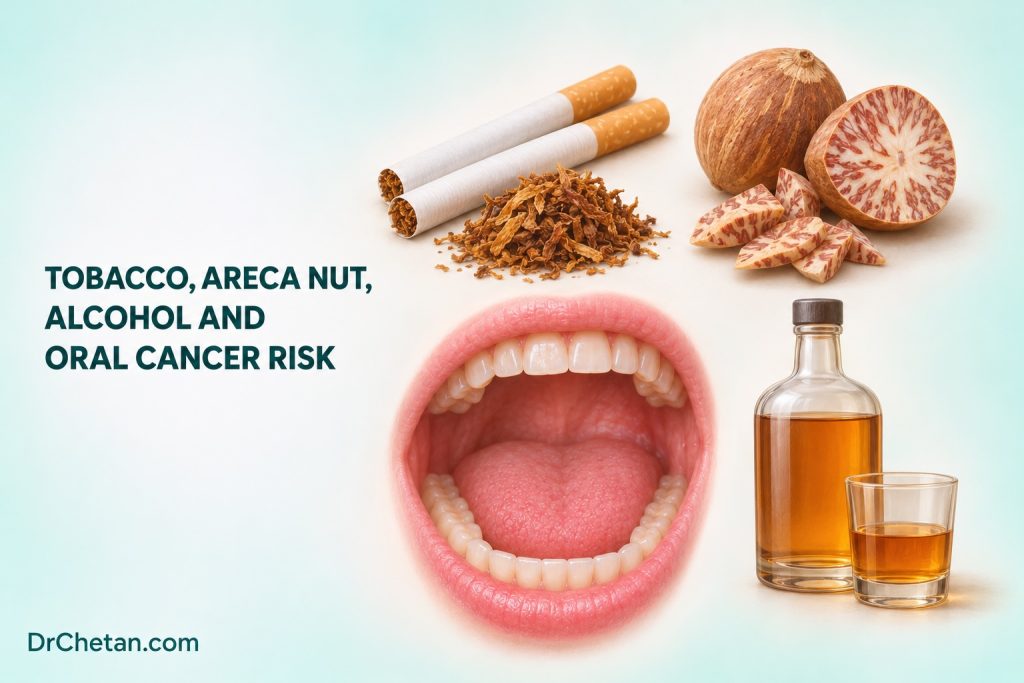
A patient reports never using tobacco. When asked what they chew after meals, they describe a packet of supari most days and a homemade betel quid on weekends. A tobacco-only question would have missed both exposures. For dental students, the practical task is to identify what a person uses, how it contacts the mouth and which findings need assessment. Smoked tobacco, smokeless tobacco, areca nut and alcohol are established causes of oral cancer. Their patterns of use, mechanisms and clinical implications differ.
Identify the ingredients before assigning the exposure
The same name can describe different formulations. Paan commonly refers to betel leaf wrapped around a filling that may contain areca nut, lime and tobacco. Supari refers to areca nut, which may be plain, flavoured or packaged with other ingredients. Pan masala commonly includes areca nut and can be sold separately from tobacco. Gutka typically combines areca and tobacco with other ingredients. Local names, home recipes and separately added tobacco make the patient’s description or package information more useful than a category inferred from a label alone.
| Exposure | What to establish in the history | Why it matters |
|---|---|---|
| Smoked tobacco | Cigarette, bidi or other product, units per day, years and quit periods | Combustion generates carcinogens. Product differences limit conversion into cigarette equivalents. |
| Smokeless tobacco | Product and preparation, frequency, duration in the mouth, placement and swallowing or spitting | Tobacco can deliver nicotine and carcinogens without combustion. Carcinogen content varies by product. |
| Areca nut or betel quid | Whether the person uses supari, pan masala or quid, and exactly what is added | Areca nut is carcinogenic even without added tobacco and is strongly associated with oral submucous fibrosis. |
| Alcohol | Typical beverage, serving size, frequency, heavier occasions and change over time | Ethanol exposure depends on volume and strength. Concurrent tobacco use can compound risk. |
When the composition is uncertain, write it that way. “Uses flavoured supari twice daily, ingredients beyond areca uncertain” preserves what is known. “Holds homemade betel quid with added tobacco in the right lower buccal sulcus” captures two exposures and a placement site. Ask about former products as well as current ones. Some people quit one form and take up another, or alternate across workdays and social occasions.
What smoking and smokeless tobacco do to oral tissues
Tobacco smoke contains carcinogens, including polycyclic aromatic hydrocarbons and tobacco-specific nitrosamines. Compounds can be metabolically activated and react with DNA. Repeated exposure increases opportunities for unrepaired DNA damage and selection of cells with growth advantages. Tobacco also affects the tissue environment. These processes help explain why years of exposure matter and why risk cannot be estimated by looking at an irritated area once.
Smokeless tobacco exposes the mucosa to tobacco-derived chemicals without smoke. Tobacco-specific nitrosamines are an important group, but their concentrations vary with the product and its processing. Nicotine dependence helps maintain repeated use. Carcinogenic risk and the degree of nicotine delivery are different properties of the same product. Reducing smoke exposure by switching to a tobacco-containing oral product leaves important oral exposure in place.
A patient may place the product against one cheek or in a specific sulcus. Examine that location and document the appearance, consistency and extent of any change. Then examine the remaining accessible oral mucosa and neck as appropriate. A placement-associated change can coexist with a separate lesion. A white patch still needs its own differential, and focal induration, persistent ulceration or progressive change can justify prompt biopsy or specialist referral.

Areca nut can matter even when tobacco is absent
IARC classifies areca nut and betel quid without tobacco as carcinogenic to humans. Areca preparations contain alkaloids, including arecoline, and can produce reactive species and nitrosation products in the oral environment. The biology involves multiple pathways and varies with preparation and exposure. The important clinical point is that a patient who says a product is tobacco-free may still be using a carcinogenic ingredient.
Oral submucous fibrosis is a chronic disorder strongly linked to areca use. Altered collagen turnover and fibrosis can lead to blanching, palpable fibrous bands and restricted mouth opening. Patients may report burning with spicy foods or increasing difficulty opening the mouth. Record interincisal opening and which surfaces were difficult to see. A new focal ulcer, red area or firm change in fibrotic mucosa requires separate assessment. The fibrosis can restrict access just when the clinician needs a closer look.
Ask about the form in which areca is used and whether the person adds tobacco later. A patient who uses pan masala during the day and adds tobacco to a quid after dinner has exposures that should be recorded separately. Cessation advice can then address both products and the occasions that sustain them. A plan that mentions tobacco alone may leave the areca use untouched.
Alcohol and combined exposure
Ethanol in alcoholic drinks is metabolised to acetaldehyde. Acetaldehyde can damage DNA and proteins, and it can be produced in the oral environment. Alcohol can also affect how mucosa is exposed to other compounds. Epidemiological studies show increased risk of oral cavity cancer with alcohol consumption, particularly at higher exposure levels. Record the typical volume and strength where possible. A large peg of spirits and a small serving of a lower-strength beverage provide different amounts of ethanol.
People who smoke and drink heavily have higher risks of several upper aerodigestive tract cancers than people with either exposure alone. Pooled observational research has reported more-than-multiplicative joint effects for some site and exposure combinations. The exact estimate depends on the site, exposure definition and reference group. In a dental record, document tobacco and alcohol separately so both are visible. One habit can be a trigger for the other, which also matters when discussing change.
Interpret population numbers carefully
A 2024 analysis by Rumgay and colleagues estimated that smokeless tobacco or areca use accounted for approximately 120,200 oral cancer cases worldwide in 2022, or 30.8% of the cases in their analysis. The estimated fraction was 57.5% in southcentral Asia. These are model-based population attributable fractions. They depend on the prevalence of exposures, the risk estimates used, the cancer definition and assumptions about causal effects. The regional percentage cannot be treated as an India-specific estimate or as an individual probability of developing cancer.
When comparing studies, first check what was counted. “Head and neck cancer” can include several sites and mixes diseases with different risk profiles. Clinical oral cavity and oropharyngeal primary sites are separate, even though some population coding categories do not follow the same boundaries. A study of tobacco and alcohol in oral cavity SCC, a study of HPV-associated oropharyngeal SCC and a registry estimate for lip and oral cavity cancers answer different questions. Match the population and the outcome to the claim you want to make.
Read risk as a comparison with a defined group
A relative risk compares the incidence of disease in two groups. The absolute risk is the probability or rate in a defined population and time period. A large relative difference can occur when the baseline rate is low. An attributable fraction addresses a third question, how much of the burden a model links to an exposure in a population. These measures can all be appropriate, but they cannot be substituted for one another when talking with a patient.
Product changes also complicate estimates. Someone may have used smoked tobacco for years, added a smokeless product later and subsequently reduced alcohol. A current yes-or-no response cannot capture that history. Ask for an approximate sequence by age, employment or other milestones the patient remembers. Record major changes and uncertainty. Use the information to guide a prevention plan rather than calculating a personal cancer probability from one study or one ingredient.
Consider both dose and contact
Daily frequency and years of use describe different parts of cumulative exposure. Holding a quid at the same site adds information about local contact, but site patterns from a population do not diagnose a lesion in an individual. There can also be exposure elsewhere in the mouth through saliva or combined products. Document the placement site, examine the rest of the accessible mucosa and compare the findings over time. If a lesion appears suspicious, do not use an estimated dose or an uncertain product label to delay diagnostic assessment.
Apply the exposure history to a clinical decision
A long-standing quid habit and a new buccal lesion. A patient has kept a tobacco-containing quid in the right sulcus for years. They now have a focal red-white patch with a firm area. Record the product, duration, placement and findings. The exposure makes the site important to examine, and the firm focal change warrants prompt specialist assessment or biopsy within local competency. A label such as “quid irritation” would leave the tissue question unanswered.
Tobacco-free supari and limited opening. A younger adult reports daily use of tobacco-free flavoured areca and progressive reduction in opening. Document measured opening, burning symptoms, mucosal colour and bands if present. Explain the areca association, support cessation and arrange assessment for possible oral submucous fibrosis. If a suspicious area cannot be seen adequately, state that limit in the referral.
An unexplained ulcer without a recognised exposure. A patient who reports no tobacco, areca or alcohol has an enlarging lateral-tongue ulcer. The clinical finding still governs urgency. Examine the mouth and neck, record progression and arrange prompt assessment when features are suspicious. An exposure history can raise concern and guide prevention. It cannot safely rule out malignancy.
A useful record ends with an action. Document the product and the patient’s goals, offer support for cessation, and record the next assessment for any lesion. Tobacco cessation lowers risk over time, while the pace and magnitude of change depend on exposure and the population studied. A suspicious finding still needs a diagnostic pathway even after the person stops.

Leave a Reply