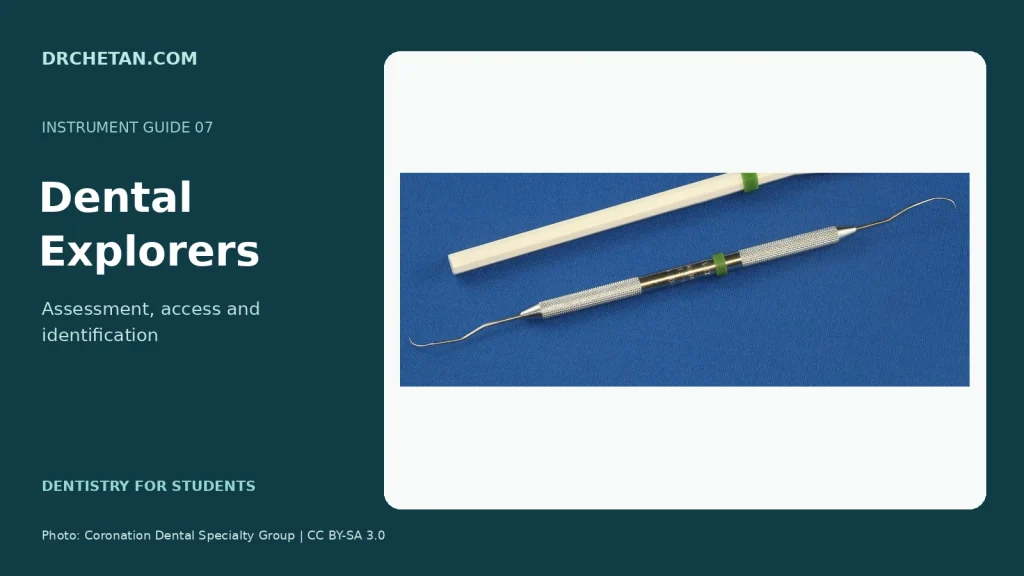
Dental explorers are fine-tipped assessment instruments. Their curved or angled working ends provide access and tactile information, but different patterns serve different purposes. The name alone does not tell you how to use an instrument safely.
A learning guide for dental students. Clinical instrument use requires practical training and supervision.
Parts and identifying features
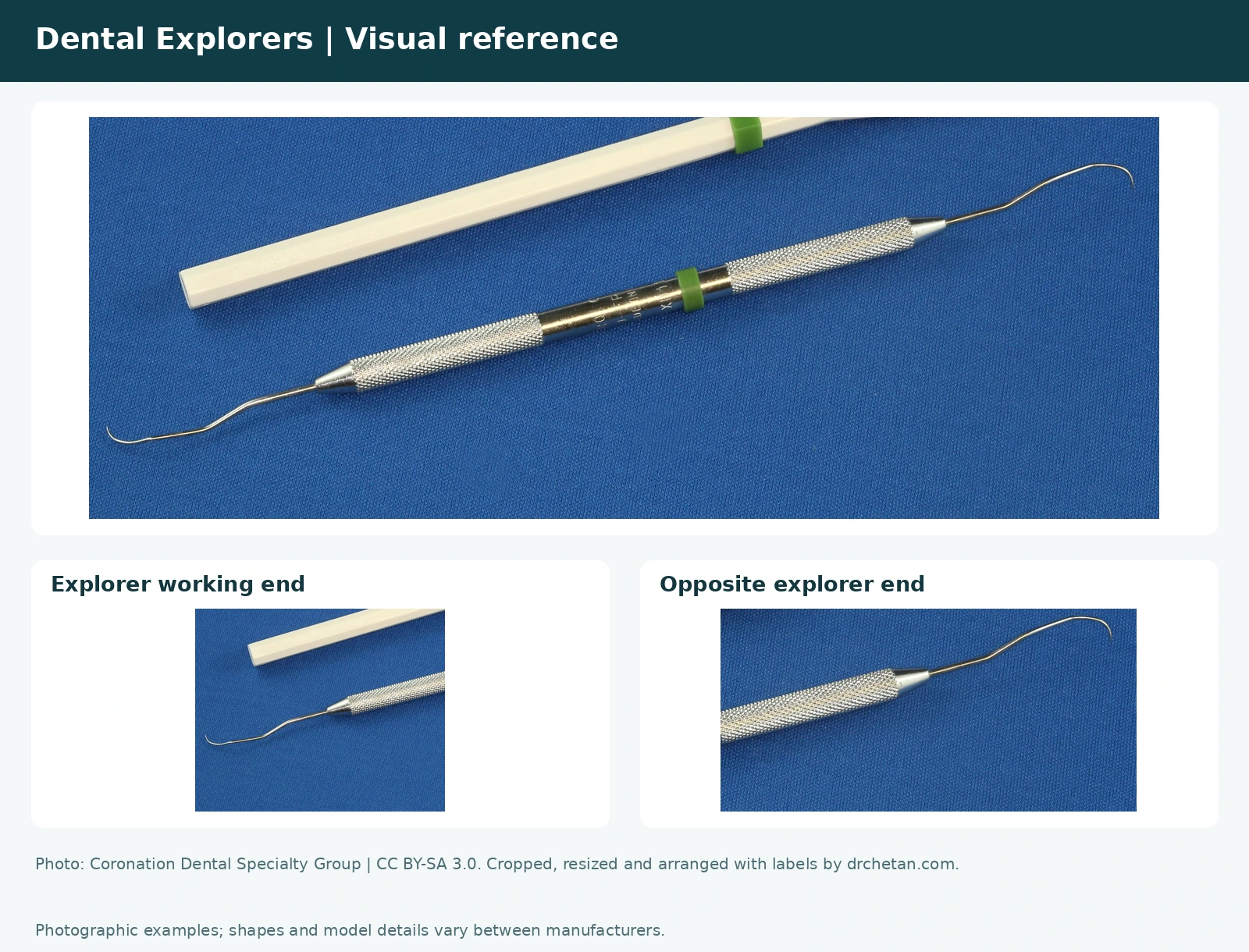
Identify the handle, shank and fine working tip. A double-ended explorer has a working end at each side of the handle; these may be complementary or different patterns. Shank curvature positions the tip for access, while the fine terminal portion transmits tactile information.
Look closely at the terminal tip rather than judging from the handle colour. Numbers can describe an explorer pattern, a handle or another manufacturer’s product code. They are useful identification aids when linked to the correct catalogue.
Photographic reference
Common explorer patterns
| Pattern | Recognition clue | Typical assessment role |
|---|---|---|
| No. 23, shepherd’s hook | A curved hook-like working end | Assessment of accessible tooth and restoration surfaces; not a licence to force the tip into fissures. |
| ODU 11/12 | Paired, fine curved working ends | Periodontal exploration and detection of deposits, including subgingival areas where access and training permit. |
| 17/23 combination | Two different ends on one handle | Combines access characteristics; identify each end separately. |
| DG16 endodontic explorer | Long, slender, angled ends | Locating and assessing canal orifices within a prepared access cavity. |
A DG16 is not a root canal file: locating an orifice does not establish canal patency or working length. Likewise, a periodontal explorer detects surface changes; it does not remove deposits in the way a scaler does.
Explorer, periodontal probe or scaler?
A periodontal probe has calibrated markings used for periodontal measurements. An explorer has a fine assessment tip. A scaler or curette has a working blade designed for deposit removal. Some handles combine an explorer and probe, so identify the end in front of you.
For a viva, connect the visible design with its function: “The fine curved tip is for tactile exploration; it has no millimetre scale for measuring pocket depth.” This is more useful than memorising a number without examining the instrument.
Why a sharp “stick” is not a caries diagnosis
Do not teach that forcing an explorer into a fissure and obtaining a catch proves caries. Forceful sharp probing can damage a demineralized surface. A catch also depends on fissure shape and tip geometry.
Caries assessment starts with a clean, well-lit surface and appropriate drying, together with the patient’s history and risk assessment. Gentle tactile assessment using a suitable rounded or ball-ended instrument may provide additional information. Radiographs are selected when clinically indicated; they are not replaced by a sharp explorer.
The practical lesson is to interpret findings together. An instrument supplies information; it does not make the diagnosis by itself.
Before use and examination mistakes
Inspect the tip for distortion, fracture or damage. A bent working end can change adaptation and tactile feedback. Handle fine points carefully and reprocess reusable instruments according to the manufacturer’s instructions and the clinic’s infection-control protocol.
Common mistakes include calling every pointed instrument a probe, confusing an 11/12 explorer with an 11/12 Gracey curette, and treating a DG16 as a canal preparation instrument. State the instrument family before discussing a pattern number.
Frequently asked questions
Is an explorer the same as a dental probe?
The terms are sometimes used loosely, but a calibrated periodontal probe measures, whereas an explorer principally provides tactile assessment.
What is a shepherd’s hook explorer?
It is the familiar curved No. 23 explorer pattern. Exact dimensions and handle options depend on the manufacturer.
What is an ODU 11/12 explorer used for?
Periodontal exploration and deposit detection. Its role differs from an 11/12 Gracey curette, which is a cutting instrument.
What does a DG16 do?
It helps identify canal orifices during endodontic access; it is not a substitute for files or working-length determination.
Does an explorer catching in a fissure prove decay?
No. A catch alone is insufficient, and forceful probing risks damaging the tooth surface.
References and further reading
- HuFriedyGroup: dental explorer patterns
- HuFriedyGroup: DG16 endodontic explorer
- American Dental Association: caries risk assessment and management
- ORCA–EFCD consensus: caries lesion activity and progression assessment
Explore more dental instrument guides and articles for dental students.
Featured-image photograph: Coronation Dental Specialty Group — source photograph (CC BY-SA 3.0). Resized and arranged with title; adapted visual: CC BY-SA 4.0.

Leave a Reply