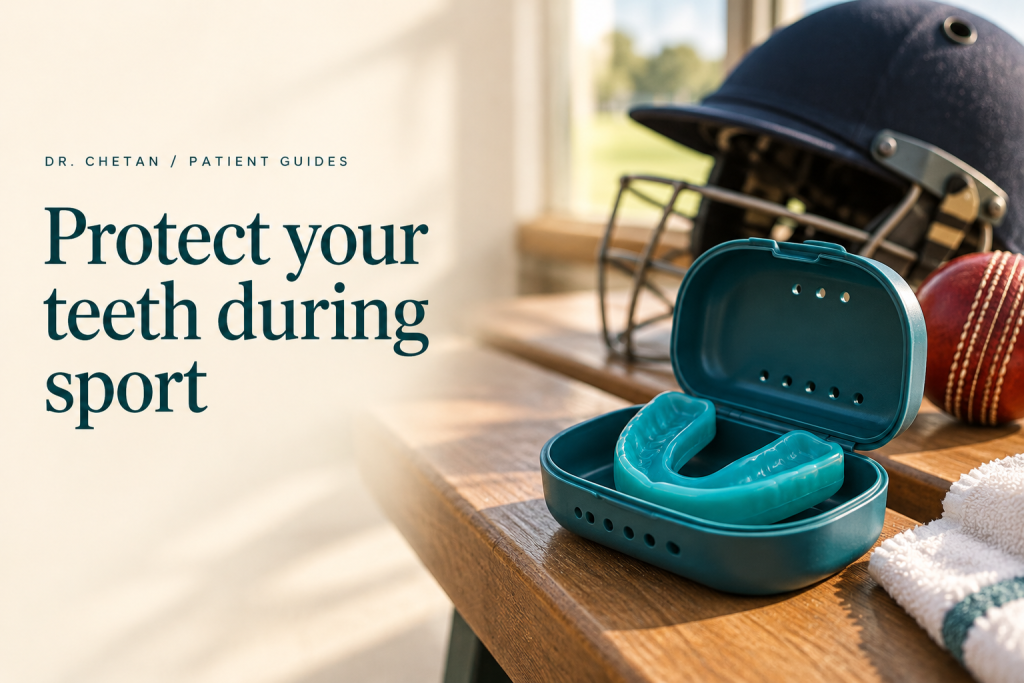
You remembered the bat, shoes and helmet. Is a mouthguard part of the kit too?
A properly fitted sports mouthguard helps reduce the risk and severity of dental injuries. It cannot prevent every injury and does not replace a helmet, face protection or safe play. Fit and consistent use matter more than a guard that stays unused in the kit bag.
Who should consider a mouthguard?
Consider protection whenever there is a meaningful risk of a ball, equipment, another person or a fall striking the mouth. Cricket is one example, alongside hockey, football, rugby, martial arts and other activities with impact risk. Injuries can occur during practice as well as competition.
A recreational game is still a game with moving bodies and equipment. Ask your dentist about the sports you actually play, how often you play and any previous injury. The answer should not depend only on whether a league makes a mouthguard mandatory.
For a child joining a cricket camp, add “mouthguard fit checked” to the same preparation list as checking the helmet. For an adult returning to sport after dental work, ask whether the old guard still accommodates the changed teeth.
Custom, boil-and-bite and stock options
| Type | How it is fitted | What to consider |
|---|---|---|
| Custom-made | Made for your mouth through a dental team | Can be tailored for fit and comfort; involves appointments and a higher initial cost. |
| Boil-and-bite | Adapted from a mouth-formed product following its instructions | Fit depends on correct adaptation; ask for help if uncertain. |
| Stock | Ready-made with limited adaptation | Often less secure or comfortable; may require clenching to keep it in place. |
Custom guards generally offer better retention and comfort. A suitably fitted mouth-formed option may be considered when appropriate; the choice should account for the sport, dentition, budget and ability to use it correctly. Do not assume all guards sold in a sports shop offer the same fit.
Follow the specific fitting instructions. Do not improvise temperatures or remould a device around braces without professional advice.
What should a suitable fit feel like?
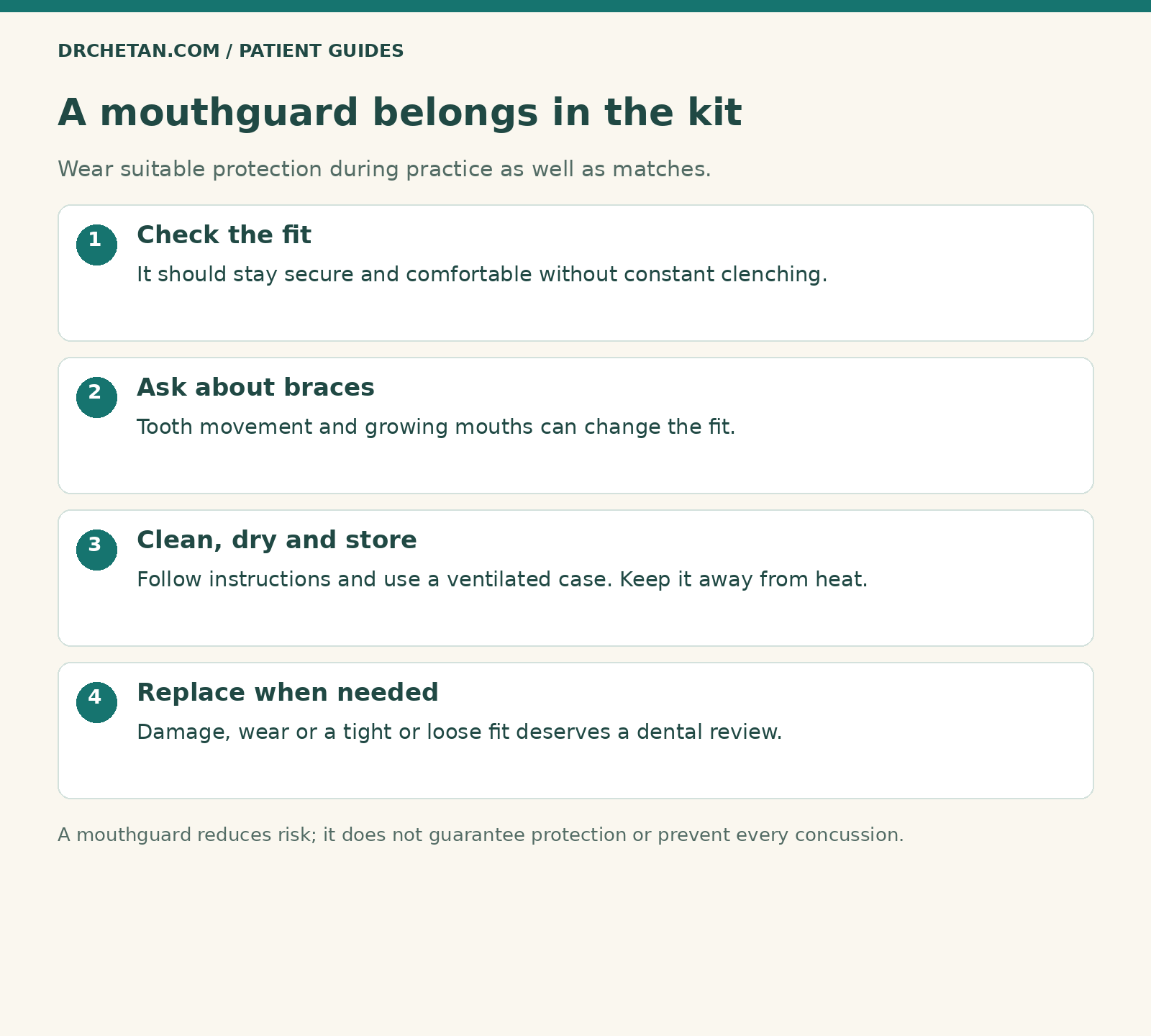
The guard should stay comfortably and securely in place, with appropriate coverage and no sharp or irritating edges. You should be able to breathe and communicate adequately. Repeatedly clenching just to retain a loose guard or removing it to breathe is a reason to have the fit assessed.
Bring it to a dental appointment and demonstrate the problem. “It feels bulky at the back” or “it drops when I open my mouth” gives the dentist something specific to assess. A reassuring label on the box does not establish that the fit is right in your mouth.
What if you have braces or a changing bite?
Ask the orthodontist to help select a guard that accommodates the appliance and planned tooth movement. Braces increase the importance of a barrier between brackets and the lips or cheeks. Some situations need protection of both arches.
Do not use an ordinary removable retainer as a sports mouthguard. Tell the orthodontist which removable appliance you wear and follow their instructions about removing or storing it during play.
Children and teenagers may need more frequent fit checks as teeth erupt and jaws grow. A guard that fitted earlier in the season may later feel tight or loose. Review it when the bite changes rather than assuming the same device should last a fixed number of years.
Cleaning and storing the mouthguard
- Rinse before and after use.
- Clean as your dentist and the manufacturer advise; cool soapy water is an option for many guards, followed by thorough rinsing.
- Allow it to dry and keep it in a sturdy, ventilated case.
- Keep it away from hot water, direct sun and other heat that can distort it.
- Do not share it. Bring it to dental reviews and check it regularly for damage.
If a guard falls onto the ground, clean it before putting it back in. Do not put a damp, dirty device straight into a sealed kit pocket. The case also needs appropriate cleaning and drying.
Do not apply a household disinfectant, boiling routine or cleaning tablet unless it is suitable for the material and recommended. A product designed for another dental appliance is not automatically right for your guard.
When should you replace it?
Arrange replacement or adjustment when the guard is damaged, worn, loose, tight or no longer comfortable. Check again after dental treatment, tooth eruption or orthodontic changes. Bring concerns to the dentist instead of cutting or reshaping the device yourself.
A practical habit is to inspect it while packing for training. Look for changes from its usual shape and feel. If you constantly forget it, keep the clean, dry case with the rest of the essential kit rather than in a separate bathroom drawer.
What protection can it not promise?
A guard lowers risk; it does not make an impact harmless. Evidence for preventing concussion is less consistent than evidence for dental injury protection, so do not buy or use one as a guarantee against concussion.
Continue using the sport’s other recommended protective equipment and follow safe-play rules. If a head impact causes symptoms, stop play and seek appropriate assessment even when the mouthguard looks intact. Equipment appearance is not a medical clearance.
If an injury happens despite the guard
Stop play. Serious head-injury symptoms, breathing problems or heavy uncontrolled bleeding need emergency medical care. A tooth that is knocked out, badly broken or moved out of position needs prompt dental attention.
For a whole permanent tooth that is out, act immediately: handle it by the crown, avoid damaging the root and seek emergency dental care. If it cannot be safely replanted, keep it moist in milk. Never replant a baby tooth.
Keep the dentist’s contact details available to the player, parent or coach. An emergency plan prepared before a match is easier to follow than searching while a child is distressed.
Questions players and parents often ask
Do I need one for practice?
Use protection whenever the activity carries the relevant risk, including practice. A training ball or collision can still cause injury.
Does a cricket helmet remove the need?
It does not establish that the teeth have adequate protection. Discuss a mouthguard as part of the overall protective kit.
Can a night guard be used instead?
Do not assume an appliance for a different purpose provides suitable sports protection. Ask the dentist who supplied it.
Can we share a guard between siblings?
No. Mouthguards are personal devices and their fit is individual.
References and further reading
- American Dental Association: Athletic mouth protectors
- Oral Health Foundation: Mouthguards
- AAPD: Prevention of sports-related orofacial injuries
- ADA MouthHealthy: Mouthguards
- Oral Health Foundation: Keeping your mouth safe while playing sport
- NHS: Knocked-out tooth
- NHS: Head injury and concussion
Sources checked 30 October 2026. This is general patient information. An examination and individual advice may be needed.

Leave a Reply