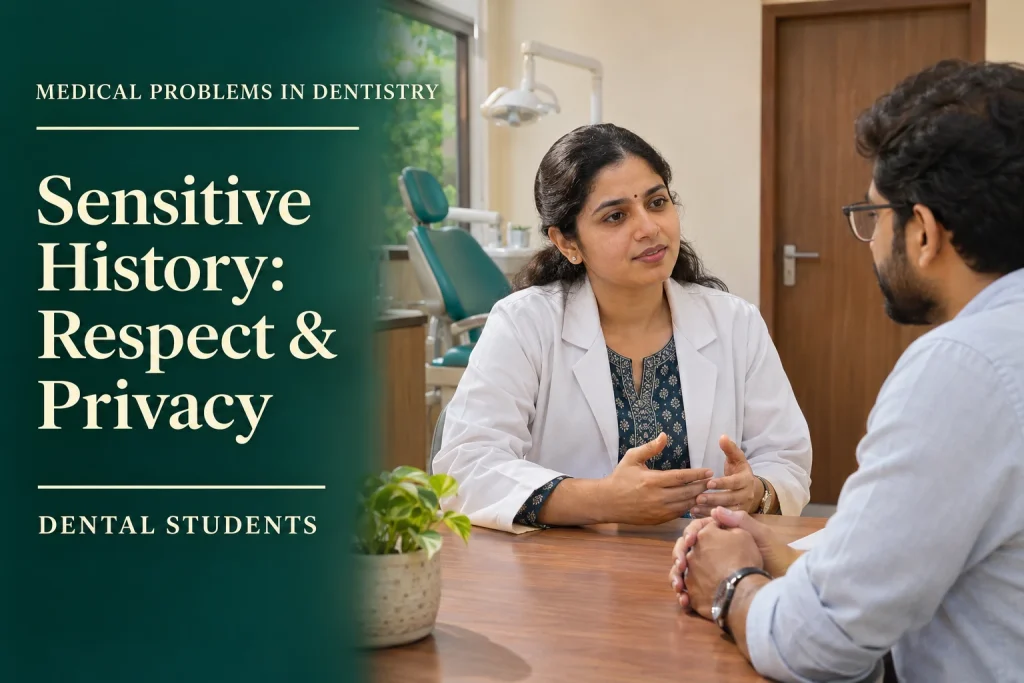
Medical Problems in Dentistry: Article 134 of 215 · Sexually transmitted and other bacterial infections · Complete student guide
Medical Problems in Dentistry · Student guide
A sensitive history is a clinical conversation with a purpose. Oral ulcers, throat symptoms or a known infection may make exposure questions relevant, but a dentist should not turn every consultation into an interrogation. The useful outcome is enough reliable information to assess the oral problem, explain options and connect the patient with appropriate care.
In this guide: Learning objectives · Start with this clinical case · Start with the presenting problem and ask permission · Make privacy a practical part of the appointment · Ask about exposure without assigning an identity · Separate the different consent decisions · Use a focused consultation table · Record facts and arrange appropriate care · Return to the case and identify the next decision · Viva and self-check
Learning objectives
- Explain why an exposure question is relevant before asking it.
- Use neutral language and distinguish consent to discussion, testing and disclosure.
- Document a focused history and arrange a respectful referral.
Start with this clinical case
Fictional teaching case. An adult with a persistent oral ulcer is accompanied by a relative who answers every question. The patient quietly mentions a previous infection but asks whether the whole family will be told. How would you create a private opportunity to talk, without promising confidentiality that has no exceptions?
Start with the presenting problem and ask permission
Begin with the symptom timeline, previous episodes, medicines, other lesions and any investigations already performed. Explain the link between the proposed question and the clinical problem. For example: “Some infections can affect this area; would you be comfortable discussing possible exposures?” Allow the patient to ask why that information would change care.
CDC’s sexual-history guide recommends a tailored, non-judgmental approach and describes partners, practices, protection, past infections and pregnancy intention as the Five Ps. This is a memory aid for sexual-health assessment, not a requirement to collect every detail at every dental visit.[SEXHIST]
Make privacy a practical part of the appointment
Ask the patient whether they would like a private discussion. Do not assume that a spouse, parent of an adult, employer or accompanying friend is entitled to hear the history. If language support is required, agree a suitable interpreter and explain their role. Avoid using a relative as the automatic interpreter for a sensitive conversation.
A closed door is only one part of privacy. Consider who can hear the discussion, where notes appear and how appointment reminders are sent. Ask which contact method is safe. These practical questions can prevent an apparently routine referral message from revealing information to someone the patient did not choose.
Ask about exposure without assigning an identity
When relevant, ask what contact occurred and which anatomical sites were involved. A person’s marital status, appearance, occupation or sexual identity does not establish either exposure or absence of exposure. Use the patient’s own terms where they are clear, and clarify unfamiliar words without ridicule.
Start open and narrow only when necessary. “What concerns you about this symptom?” may reveal previous tests or treatment. If the patient declines a question, document that respectfully, explain any effect on assessment and offer another opportunity. Declining a history is not itself evidence of a particular diagnosis.
Separate the different consent decisions
Consent to discussing an infection does not automatically authorise a test, a clinical photograph or disclosure to another person. Explain what a proposed test can and cannot show, where it will be performed and who will discuss the result. Follow the current testing service’s counselling and consent process.
India’s HIV and AIDS Act includes informed-consent requirements and specified exceptions for HIV testing, together with protections and exceptions governing disclosure. Do not add an undisclosed HIV test to a dental investigation panel or promise that HIV-related information can never be shared under any circumstances. Complex questions require the responsible clinician and applicable procedure.[HIVACT]
Use a focused consultation table
| Finding or question | Clinical implication | Student action |
|---|---|---|
| Companion answers for an adult | The patient may not have had space to speak | Offer a private conversation and confirm the patient’s preference. |
| Exposure information could change testing | The anatomical site may matter | Explain the reason and ask only relevant questions. |
| Patient declines a question | Assessment may remain incomplete | Respect the choice and explain next steps without judgement. |
| A test is proposed | Discussion is not test consent | Explain the test and follow the appropriate consent pathway. |
| A referral needs sensitive details | Information sharing has a purpose and limits | Agree appropriate sharing and use secure clinical channels. |
Use this as a communication exercise, not a script to be read mechanically. A good student can explain why each question is being asked and can stop when the needed information has been obtained.
Record facts and arrange appropriate care
Describe symptoms, relevant reported exposure, previous testing and the agreed plan. Distinguish a suspected diagnosis from a confirmed laboratory result. Avoid moral labels, speculation about a partner or unnecessary intimate detail. An oral finding should not become a permanent infection label without supporting assessment.
NACO’s Act resources emphasise rights and protection from discrimination. A referral should help the person reach appropriate assessment, rather than exclude them from ordinary dental care. Confirm the destination, urgency, safe contact method and who will explain results. Check local service arrangements instead of assuming availability.[NACO]
Return to the case and identify the next decision
First hear the patient directly and offer privacy. Explain the ulcer assessment, including non-infectious possibilities, and the purpose of any exposure questions. Discuss confidentiality and its relevant limits in understandable language. Do not contact the family about an unconfirmed infection simply because they attended together.
For a student role-play, practise summarising the history in two sentences and asking the patient whether the summary is accurate. Then describe the referral without disclosing irrelevant details. Where abuse, coercion or a child’s safety is raised, involve the supervising clinician promptly and follow applicable safeguarding duties; this adult consultation guide does not replace those procedures.
Viva and self-check
Does marital status exclude an STI? No. Assess relevant exposure without assumptions.
Does agreeing to talk authorise an HIV test? No. Discussion and testing are separate decisions.
What makes documentation useful? Relevant facts, diagnostic uncertainty, consent and a clear follow-up plan.
Continue through the series
- Previous: Antimicrobial Stewardship in Dentistry: Infection, Drainage and Appropriate Antibiotic Use
- Next: Denture Stomatitis and Angular Cheilitis: Differential Diagnosis and Predisposing Factors
- Browse all 215 student guides by subject
More in Sexually transmitted and other bacterial infections: Oral Syphilis: Stages, Lesions, Testing and Referral · Gonococcal and Other Bacterial Oropharyngeal Infection: Dental Recognition and Referral · Bacterial Infections in Immunocompromised Patients: A Dental Assessment Framework · Antimicrobial Stewardship in Dentistry: Infection, Drainage and Appropriate Antibiotic Use
Continue learning
- Structured medical history and examination
- Informed consent in an Indian dental practice
- Medical liaison and referral for complex dental patients
References and scope
Sources checked on 26 November 2026. This is an original student teaching guide. International clinical recommendations are identified by their issuing organisation. Emergency contact information is specific to India. Use current local protocols, appropriate supervision and an individual clinical assessment.
- CDC: Guide to Taking a Sexual History (2024)
- India: HIV and AIDS (Prevention and Control) Act, 2017
- NACO: HIV and AIDS Act information and resources
Images are AI-generated educational illustrations of fictional people or equipment, not clinical records or diagnostic photographs.

Leave a Reply