Medical Problems in Dentistry: Article 135 of 215 · Fungal disease · Complete student guide
Medical Problems in Dentistry · Student guide
A red palate under a denture and soreness at the mouth corners may be related, but neither finding should be reduced to “fungus” without assessment. The denture, surrounding tissues, daily care, medicines and general health all matter. Students need to identify the pattern, correct contributing factors and recognise when the presentation needs a different investigation.
In this guide: Learning objectives · Start with this clinical case · Examine with the prosthesis removed · Ask what happens during an ordinary day · Assess the mouth corners separately · Teach local care with material compatibility · Connect findings with the next step · Prescribe only after checking the whole plan · Make recurrence a reason to reassess · Viva and self-check
Learning objectives
- Assess denture fit, wearing habits and the distribution of inflammation.
- Distinguish angular fissures from ulcers and other lip disease.
- Plan local measures, medicine checks and review.
Start with this clinical case
Fictional teaching case. A 68-year-old denture wearer reports recurring cracks at both mouth corners and redness beneath the upper denture. She sleeps in it because she dislikes being without teeth. A previous gel helped briefly, but she cannot recall its name. What needs examination before another prescription?
Examine with the prosthesis removed
Ask permission to remove the denture and inspect all covered and uncovered tissues. Describe the extent and location of redness, tenderness, ulceration or other change. Examine the fitting surface and the prosthesis itself. A history of denture use is not a substitute for seeing the tissues beneath it.
SDCEP describes denture stomatitis as a condition in which local measures can be effective; a contributing prosthesis may need adjustment or replacement. Routine systemic antifungal treatment is not required for every case. These points support an assessment of the whole denture environment rather than repeated medicine alone.[DENTURE]
Ask what happens during an ordinary day
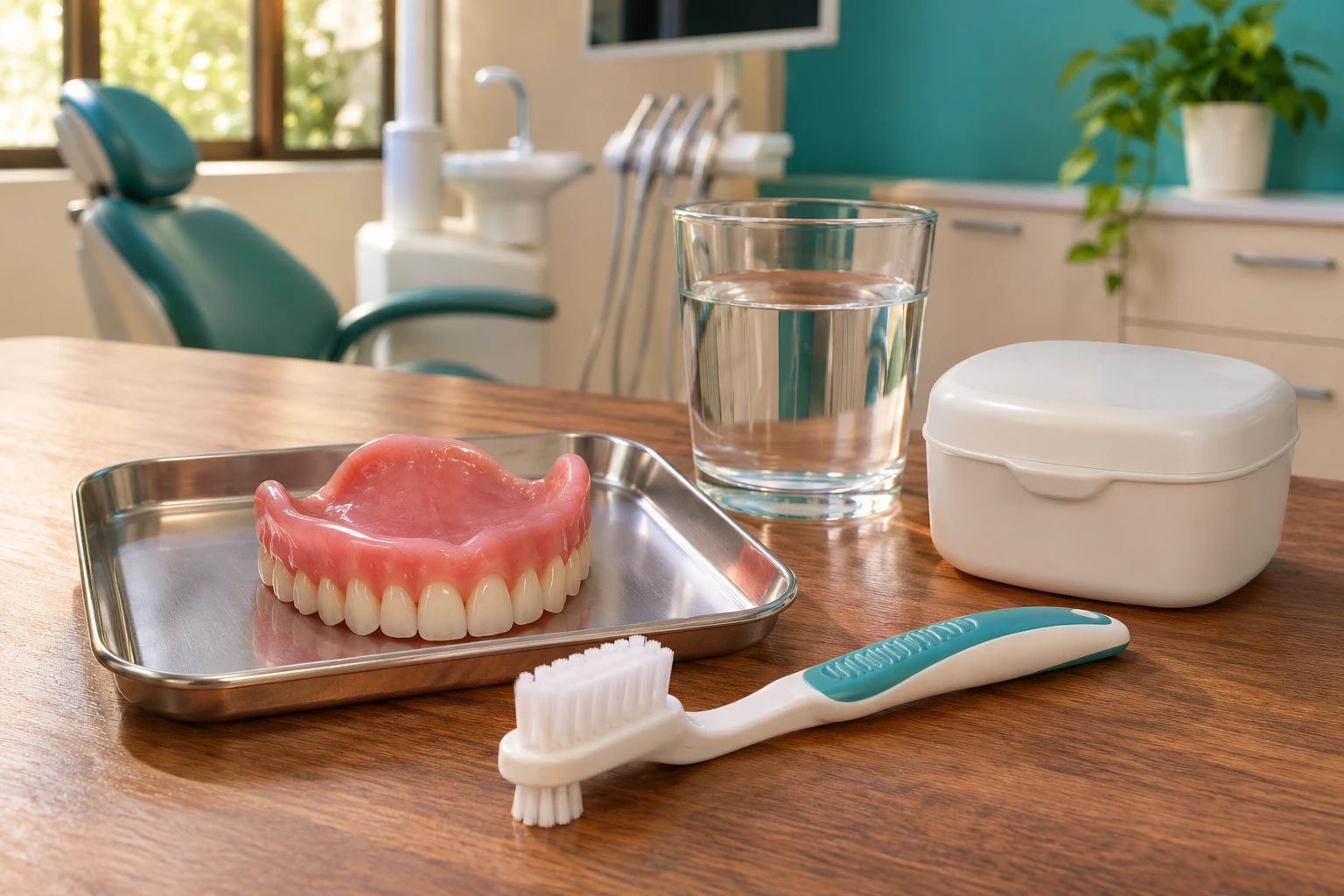
Ask how long the denture has been used, when it is removed, how it is cleaned and whether the patient can handle the brush or storage box comfortably. Explore barriers such as limited hand function, poor vision, lack of privacy or embarrassment. A workable care plan must fit the patient’s actual circumstances.
Do not describe recurrence as proof that the patient ignored instructions. Ask them to demonstrate their usual cleaning approach. This often shows whether the difficulty is understanding, access, dexterity or an unsuitable prosthesis. Record what assistance is available and agree a small number of practical changes.
Assess the mouth corners separately
Describe whether the corners show fissuring, moisture, crusting or an isolated persistent lesion. Ask about pain, duration, recurrence, skin products and other symptoms. Examine the remainder of the mouth and lips. Do not assume that a unilateral ulcer or a changing lip lesion is simply angular cheilitis.
SDCEP notes associations with Candida in denture wearers and bacterial infection in other presentations, and advises consideration of factors such as diabetes or haematinic deficiency when response is poor. These are reasons for directed assessment, not a diagnosis of deficiency from a photograph or an automatic prescription for supplements.[ANGULAR]
Teach local care with material compatibility
Explain tissue and denture care together. SDCEP’s local measures include cleaning the prosthesis, caring for the palate and allowing denture-free periods. The specific cleaning product must suit the denture material and its manufacturer’s instructions; a recommendation for an acrylic appliance cannot automatically be used for metal-containing components.[LOCAL]
Ask the patient to repeat the agreed steps in their own words. Make clear which products belong outside the mouth and how the denture is rinsed and stored. Do not improvise a household bleach concentration or suggest mixing cleansers. If a carer assists, teach the same agreed procedure to that person with the patient’s involvement.
Connect findings with the next step
| Finding or question | Clinical implication | Student action |
|---|---|---|
| Inflammation in a denture-bearing area | Local denture factors may contribute | Inspect tissues, fit and daily care. |
| Bilateral corner fissures with a denture | Related oral and local factors may coexist | Assess the palate and corners together. |
| Persistent isolated ulcer or atypical change | A different diagnosis may be present | Arrange appropriate specialist assessment. |
| Brief benefit followed by recurrence | A contributing factor may remain | Review the diagnosis, prosthesis and care plan. |
| Several medicines or uncertain previous gel | A new prescription needs a safety check | Reconcile medicines before selecting treatment. |
The table does not identify an organism from appearance. It separates what has been observed from the reason for further assessment.
Prescribe only after checking the whole plan
If an antifungal is indicated, verify the diagnosis, exact medicine list, allergies and appropriate formulation before prescribing under supervision. “Topical” does not mean that interactions can be ignored. Avoid reissuing a previously unnamed product simply because it temporarily reduced soreness.
Explain how the medicine fits alongside correction of local factors. Document what improvement will be assessed and who will review it. A prescription without a plan for the denture or mouth-corner environment is an incomplete response to the teaching case.
Make recurrence a reason to reassess
At review, compare the original findings with the current tissues and ask whether the agreed daily changes were feasible. Confirm the actual medicine used and whether new symptoms developed. If the presentation persists or becomes atypical, reconsider the differential and arrange relevant investigation or referral rather than indefinite repeat treatment.
In the case, removal and examination of the upper denture, an assessment of its fit, a realistic denture-free plan and identification of the previous gel all come before another blind course. For a viva, explain which findings would support the working diagnosis and which would make you change it.
Viva and self-check
Are all cracked mouth corners candidiasis? No. Consider local, bacterial and systemic contributors.
Does every red denture-bearing palate need fluconazole? No. Assess local factors and the actual treatment indication.
What should follow recurring symptoms? Reassess the diagnosis, prosthesis, medicines and care plan.
Continue through the series
- Previous: Taking a Sensitive Sexual and Infection History in Dental Practice
- Next: Antifungal Medicines in Dentistry: Interactions, Selection and Referral Limits
- Browse all 215 student guides by subject
More in Fungal disease: Antifungal Medicines in Dentistry: Interactions, Selection and Referral Limits · Mucormycosis and Invasive Fungal Disease: Oral and Maxillary Red Flags · Deep Fungal Infection Presenting as Oral Ulceration: When to Biopsy or Refer
Continue learning
- Structured medical history and examination
- Medical liaison and referral for complex dental patients
- Infection-control programme for an Indian dental clinic
References and scope
Sources checked on 26 November 2026. This is an original student teaching guide. International clinical recommendations are identified by their issuing organisation. Emergency contact information is specific to India. Use current local protocols, appropriate supervision and an individual clinical assessment.
Images are AI-generated educational illustrations of fictional people or equipment, not clinical records or diagnostic photographs.

Leave a Reply