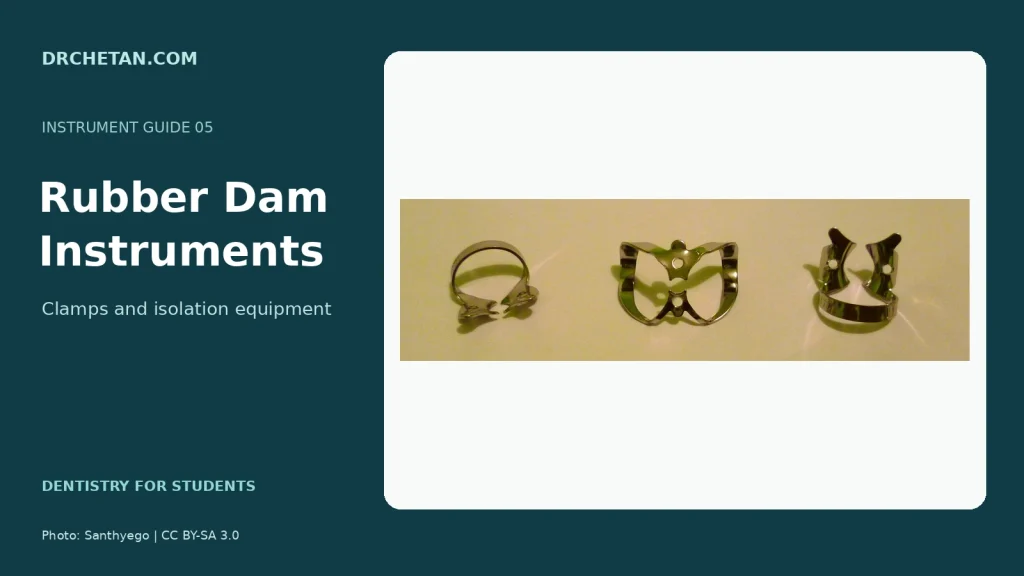
A rubber dam kit contains several components that work together to isolate the operating field. Students should recognise each component and explain its role before learning to use the kit under supervision.
Why isolation matters
Dental dam isolation helps control moisture, improves visibility and reduces oral contamination of the operating field. It also provides a barrier that reduces the risk of swallowing or aspirating instruments and materials. A well-placed sheet and a suitable seal are essential; simply possessing a clamp and frame does not establish effective isolation.
The American Association of Endodontists’ position statement identifies dental dam isolation as integral to nonsurgical endodontic treatment. This is a clinical purpose of the kit, beyond its role in an instrument-identification examination.
Photographic reference
Rubber dam sheet
The sheet forms the barrier around the isolated tooth or teeth. Latex and non-latex products are available. Material choice should take patient and staff allergies into account.
Rubber dam punch
The punch creates holes in the sheet. Many designs have a rotating plate with several hole sizes and a plunger. A positioning template can help plan the hole location.
Clamps or retainers
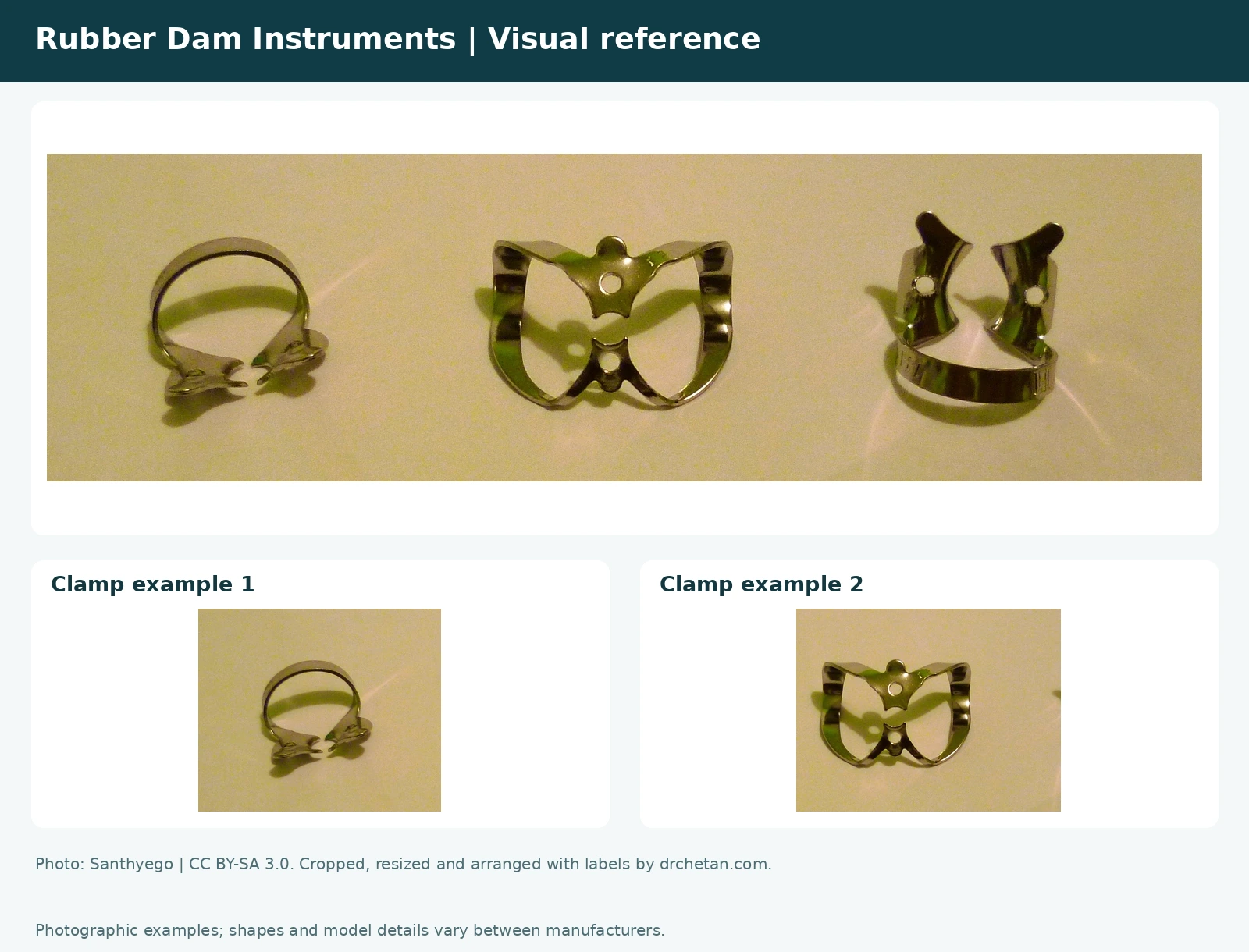
A clamp retains the dam around a tooth. Its bow, jaws and holes for clamp forceps are key features to identify. Clamps vary in shape and size and may be winged or wingless. Selection and fit depend on the tooth and clinical situation; a number must be checked against the manufacturer’s chart.
Clamp forceps
These forceps engage the clamp’s holes to carry and position it. Recognise the two tips and their relationship to the clamp; do not confuse them with extraction forceps.
Frame and accessories
The frame supports the dam sheet and retracts it away from the operating field. Other accessories can include a template, floss and stabilising materials. The full setup varies with the procedure and the clinician’s technique.
Winged and wingless clamps
Wings are lateral projections that can support the sheet when the clamp and dam are carried together. A wingless design lacks these projections. Both designs need secure, appropriate contact with the tooth; the presence of wings is not proof of a better fit. The choice also depends on access and the placement technique being taught.
Clamp safety and common mistakes
Inspect the clamp before use and avoid overstretching it, which can distort or fracture it. A floss safety tie helps retrieval if a clamp dislodges or breaks. It does not correct an unstable fit. Check that the clamp is stable and that soft tissues are not trapped.
A sheet may tear when holes are poorly punched or the dam is under excessive tension. Leakage and a rocking clamp require correction before proceeding. A peer-reviewed clinical guide to dental dam explains clamp inspection, retrieval ties, fit and these common problems.
The kit in one view
| Component | Recognition clue | Role |
|---|---|---|
| Sheet | Flexible latex or non-latex barrier | Isolates the field |
| Punch | Plunger and perforated rotating plate on common designs | Makes appropriately sized holes |
| Clamp | Bow, jaws and forceps holes | Retains the dam at a tooth |
| Clamp forceps | Tips that engage the clamp holes | Carries, expands and removes a clamp |
| Frame | External supporting frame | Supports and retracts the sheet |
How to identify the set in a practical
- Find the punch and its perforating plate.
- Identify the frame that supports the sheet.
- Look at a clamp’s bow, jaws and forceps holes.
- Match the clamp forceps tips to those holes.
- Explain the role of the sheet and why material choice matters.
Viva questions
What does the punch do?
It creates holes in the dam sheet.
What is the function of the frame?
It supports the sheet away from the operating field.
What is a winged clamp?
A clamp design with wings that assist in retaining the sheet during placement; the design differs from wingless clamps.
Are all clamp numbers interchangeable between manufacturers?
Use the manufacturer’s chart and inspect the design rather than assuming identical fit.
Does latex allergy prevent dental dam isolation?
No. A suitable non-latex dam is available; check the materials and relevant allergy history when selecting the setup.
Is floss a substitute for a secure clamp?
No. A retrieval tie is an additional precaution; the clamp still needs stable, appropriate contact.
Further reading
HuFriedyGroup: Rubber dam kit and accessories · Rubber dam template
Continue learning in the Dental Instruments and Dental Students collections.
References checked 31 October 2026. Educational identification guide for use alongside textbooks and supervised clinical teaching.
Featured-image photograph: Santhyego — source photograph (CC BY-SA 3.0). Resized and arranged with title; adapted visual: CC BY-SA 4.0.
Leave a Reply