
Being told that a tooth needs root canal treatment can raise several questions at once: Will it hurt? How many appointments will there be? Is the tooth still useful afterwards?
Root canal treatment removes inflamed or infected pulp from inside a tooth, cleans and seals the canal system, and aims to retain a tooth that can be restored. A final restoration is part of completing care; finishing the work inside the roots is not always the final step.
Why might a tooth need root canal treatment?
The pulp is the soft tissue inside the tooth containing nerves and blood vessels. Deep decay, a crack or an injury can damage it. Problems inside the pulp can lead to pain and infection around the root.
Symptoms may include prolonged sensitivity, pain on biting, swelling or a gum swelling that drains. Some affected teeth cause little discomfort. The dentist combines the history, examination, tests and appropriate X-rays to reach a diagnosis. A symptom checklist alone cannot tell you that a root canal is required.
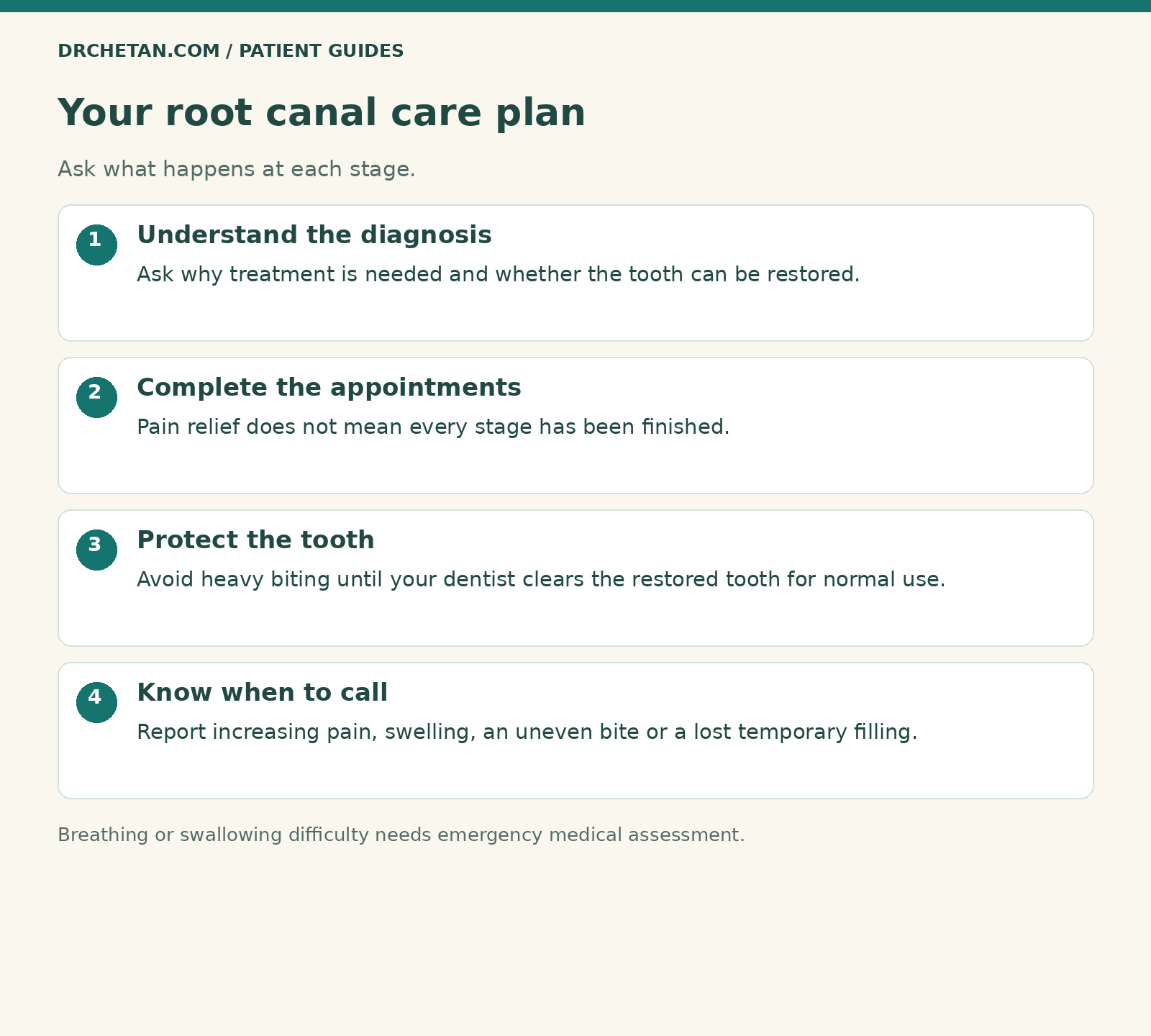
Ask the dentist to explain what the findings show and whether the tooth has enough sound structure and support to be restored. Saving the tooth is a treatment goal, not a guarantee for every tooth.
Are there alternatives?
The options depend on the condition of the pulp and the rest of the tooth. The clinician may discuss other pulp treatment in suitable cases, root canal treatment, extraction or a specialist assessment. Do not assume that every deep cavity automatically has the same treatment.
If extraction is an option, ask about its consequences and whether replacement would be needed. If a crack or other damage makes the tooth unrestorable, root canal treatment may not be a useful way to retain it.
Ask for the expected benefits, the main risks and the full sequence of appointments before making your decision. Request an estimate that includes the final restoration and reviews, so the plan is clear.
How many appointments will you need?
The number and length vary with the tooth, the canal anatomy and the clinical situation. Treatment may be completed in one visit or spread over several. A temporary filling can seal the tooth between visits.
More appointments do not automatically mean something has gone wrong. Ask what the dentist plans to do at each stage and when the permanent filling or crown will be arranged.
Keep the return appointments even if the tooth feels comfortable. Relief of pain does not establish that all treatment and restoration have been completed.
What happens during treatment?
- Assessment and planning. The dentist examines the tooth and uses appropriate imaging to plan the procedure.
- Making the area comfortable. Local anaesthetic is usually used. You remain awake unless a separate sedation plan has been agreed.
- Isolating the tooth. A protective rubber dam helps keep saliva away and protects the mouth during treatment.
- Reaching and cleaning the canals. An opening allows instruments and disinfecting solutions to clean and shape the canal system.
- Filling and sealing. The prepared canals are filled and the tooth opening sealed, temporarily or definitively as appropriate.
- Restoring the tooth. A permanent filling, onlay or crown is planned according to the remaining tooth and biting forces.
The details differ between teeth. Ask the clinician to explain any part of the procedure you do not understand.
Will a root canal hurt?
With effective local anaesthesia, treatment should be comfortable. You may notice pressure or vibration. Tell the dentist if you feel pain rather than trying to stay silent until the appointment is over.
Agree a hand signal before treatment, especially if you feel anxious or need breaks. Say if previous anaesthetic injections did not work well or if opening your mouth for a long time is difficult.
Afterwards, the tissues around the tooth can still feel tender for a few days. Removing the pulp does not remove all sensation from the surrounding gum and supporting tissues. Soreness should improve rather than steadily worsen.
Can antibiotics replace the treatment?
Usually, antibiotics do not resolve the underlying problem inside a tooth. Dental treatment addresses the source. For most pulpal or localised periapical pain in otherwise healthy adults, the ADA recommends prioritising appropriate dental treatment rather than routine antibiotics.
Antibiotics may be needed when infection is spreading, there is systemic illness such as fever, or other individual factors change the risk. A clinician should make that decision. Do not start leftover tablets or use somebody else’s prescription.
If the pain disappears before the appointment, still attend. Describe what changed and let the dentist reassess; pain relief alone is not proof that the tooth has recovered.
Why does the final filling or crown matter?
A root-filled tooth needs a dependable restoration to seal and protect it. Back teeth often need coverage such as a crown, but the choice depends on the remaining structure and the individual tooth. Ask why a particular restoration is being recommended.
Until the tooth is definitively restored and your dentist has cleared it for normal use, avoid heavy biting on it. A temporary filling is a stage in treatment rather than a reason to cancel the restoration appointment.
If the temporary filling or crown comes out, contact the practice promptly. Do not use household glue or leave the tooth open while waiting for pain to start.
What should you do during recovery?
- Follow the written instructions from the clinician who treated you.
- Wait for numbness to wear off before chewing so you do not injure your lip, cheek or tongue.
- Choose comfortable foods and protect the treated tooth from heavy biting.
- Brush and clean between teeth gently, unless you received different instructions.
- Use medicines only as directed and check suitability with a pharmacist or clinician if you are unsure.
- Attend restoration and review appointments.
Regular care still matters: the remaining tooth can develop decay and the restoration can need maintenance. Successful treatment can retain a useful tooth for many years, but no lifetime promise applies to every case.
When should you contact the dentist?
Call promptly for severe or increasing pain, visible swelling, a bite that feels uneven, loss of the temporary restoration or a return of the original symptoms. Do not wait for a planned review if the condition is deteriorating.
Breathing or swallowing difficulty, or swelling affecting the neck or eye area, needs emergency medical assessment. Ordinary post-treatment tenderness should not be used to explain away these symptoms.
When calling, state which tooth was treated, the date, whether the pain is improving or worsening, any swelling and which medicines you have taken. These details help the team advise you.
References and further reading
- AAE: Root canal explained
- NHS: Root canal treatment
- University of Bristol Dental School: Root canal treatment
- AAE: Post-treatment care
- Oral Health Foundation: Root canal treatment
- ADA: Antibiotics for dental pain and swelling
- HSE: Dental abscess
Sources checked 30 October 2026. This is general patient information. An examination and individual advice may be needed.

Leave a Reply