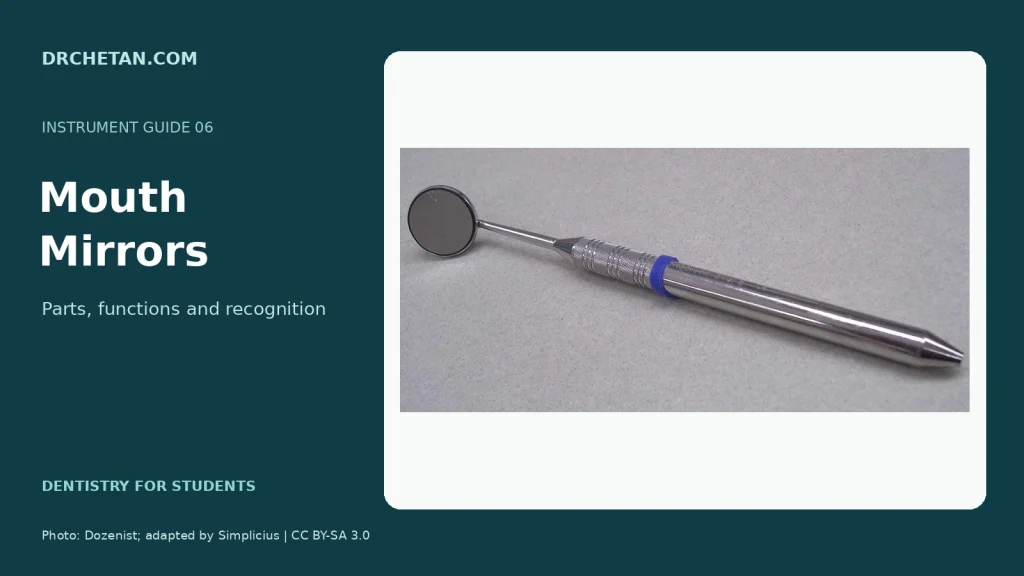
A mouth mirror provides indirect vision, reflects light and gently retracts soft tissues. Understanding its design helps students explain why one mirror gives a clear view while another produces glare or a confusing double image.
A learning guide for dental students. Clinical instrument use requires practical training and supervision.
Parts of a mouth mirror
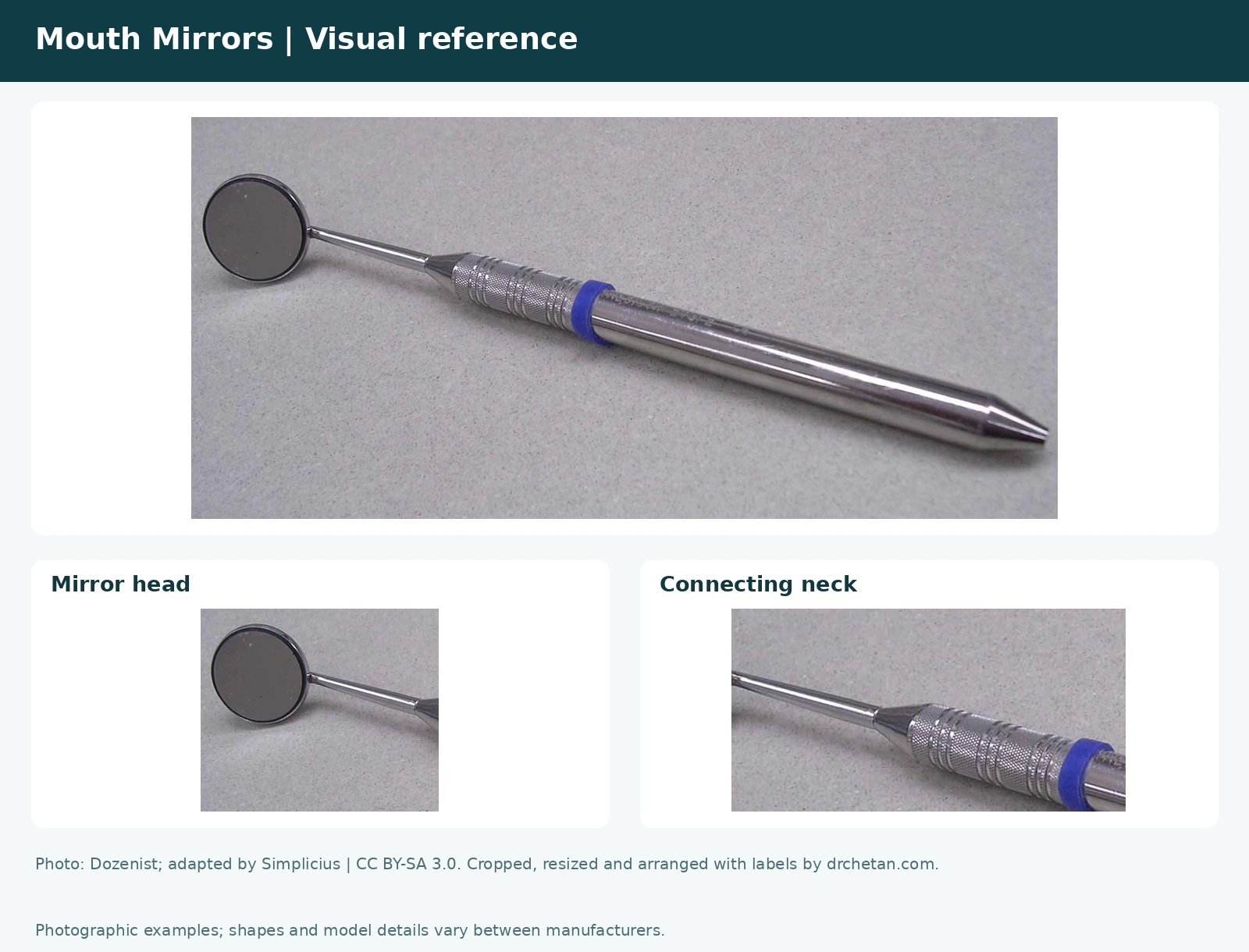
The handle provides a stable grip. A connecting neck or shank positions the head, which contains the reflecting surface and its backing or frame. Some mirrors are one-piece instruments; others have replaceable heads that screw into a compatible handle.
Handle length and thread connection are product specifications, not universal constants. A head that looks correct may still have an incompatible connector. Check the actual model before replacing it.
Photographic reference
Three functions to explain in a viva
- Indirect vision: seeing a surface that cannot be viewed comfortably along a direct line of sight.
- Indirect illumination: directing reflected light towards the area being examined.
- Retraction: moving the cheek, lip or tongue gently to improve access and visibility.
For example, a mirror can reveal the palatal surfaces of upper anterior teeth without requiring the operator to bend into an awkward viewing position. These functions may be used together, but improving the light and improving the viewing angle are separate adjustments.
Types: use separate descriptions
| Feature | What it describes | Important distinction |
|---|---|---|
| Front-surface versus rear-surface | Where the reflective coating lies | A front-surface design reduces the secondary reflection associated with light passing through the glass. |
| Plane versus concave | Shape of the reflecting surface | Plane mirrors do not intentionally magnify; concave mirrors can magnify at a suitable viewing distance. |
| Single-sided versus double-sided | Number of reflecting faces | A double-sided mirror may also be front-surface: these are not competing categories. |
| Reusable versus single-use | Intended reprocessing pathway | A plane mirror is not necessarily disposable; follow the product labelling. |
A rear-surface mirror can produce a faint secondary image, often called ghosting. Scratches, deposits and fogging are different causes of poor visibility; changing the viewing angle will not repair a damaged reflective surface.
Sizes and choosing a head
Numbers such as 4 and 5 identify common mirror sizes, but students should confirm the diameter in the manufacturer’s catalogue. A larger head provides a broader view; a smaller head may fit a restricted space more easily. Neither is automatically the best choice for every patient.
Do not infer thread compatibility, magnification or reusability from the size number. During an identification exercise, describe what you can see and then confirm the marking against the supplied instrument catalogue.
Care and common student mistakes
Check that the head is secure and that the image is clear before use. Manage fogging with an approved method compatible with the mirror. Avoid abrasive cleaning or improvised heating that could damage the surface.
Reusable heat-tolerant mouth mirrors should be cleaned and heat sterilized between patients, following their instructions for use. A surface wipe alone is not adequate reprocessing. Discard single-use mirrors after use.
Viva answer: “This is a mouth mirror. Its head provides indirect vision and reflected illumination, and its smooth backing can assist gentle soft-tissue retraction.” Add the specific size or surface type only when identified.
Frequently asked questions
Is a front-surface mirror always magnifying?
No. Front-surface describes the location of the coating; magnification depends on the surface shape and viewing geometry.
Are all flat mirrors disposable?
No. Plane mirrors are available in reusable and single-use designs.
Why does a mouth mirror sometimes show a double image?
A rear-surface design may give a secondary reflection from the glass. Inspect for other problems such as contamination or surface damage too.
Can any replacement head fit any handle?
No. The thread or connector must match the handle specification.
What should I remember first for an examination?
Identify the head and handle, then state indirect vision, indirect illumination and gentle retraction.
References and further reading
- HuFriedyGroup: mirrors and product specifications
- HuFriedyGroup: double-sided front-surface mouth mirror
- CDC: sterilization and disinfection in dentistry
Explore more dental instrument guides and articles for dental students.
Featured-image photograph: Dozenist; adapted by Simplicius — source photograph (CC BY-SA 3.0). Resized and arranged with title; adapted visual: CC BY-SA 4.0.

Leave a Reply