A dental materials guide for students, connecting classification and setting mechanisms with properties, applications, limitations, and common manipulation errors.
An impression material must first flow into the area being recorded, then become stable enough to preserve that record during removal, disinfection, transport, and cast production. Different materials achieve this in different ways. Some form water-based gels. Others become rubber-like through polymerisation. Impression compound softens with heat and becomes rigid as it cools.
For a dental student, the most useful comparison is not a list of isolated advantages. Ask: What makes this material set? How does it behave during removal? What could change its dimensions before the cast is made? Those questions explain many of the differences between alginate, agar, elastomers, and compound.
This guide covers the major conventional families. Product formulations vary, so exact powder–water ratios, mixing schedules, temperatures, storage conditions, disinfection procedures, and pouring windows must come from the instructions for the actual material. A generic class description cannot replace those instructions.
In this guide:
- First understand what an impression records
- Classification: use two separate questions
- The properties students should keep separate
- Alginate: the irreversible hydrocolloid
- Agar: the reversible hydrocolloid
- Syneresis, evaporation, and imbibition
- Elastomers: one broad group, several different chemistries
- Impression compound: reversible softening, rigid after cooling
- The main comparison in one table
- Match the material to the task, not to a single slogan
- Tray retention and technique can defeat a good material
- Common manipulation errors and what to investigate
- Disinfection, storage, and laboratory communication
- Five worked revision cases
- Twenty viva questions with explained answers
First understand what an impression records
An impression is a negative reproduction of a surface. A cast made from it is a positive reproduction. A visually smooth impression is not necessarily dimensionally accurate: the surface can look acceptable even after movement, tray flexure, or storage-related distortion.
The required information depends on the purpose. A diagnostic cast, a preliminary edentulous impression, a definitive impression for a prepared crown, and functional border moulding do not place identical demands on the material.
The term accuracy therefore needs context. It includes the ability to record relevant detail and preserve the spatial relationships that matter for the intended restoration or appliance. Successful material selection also depends on tray design, tissue management, handling, and laboratory procedures.
Classification: use two separate questions
Is the material elastic or rigid after setting?
Elastic materials can deform during removal and recover towards their original form. This helps when recording suitable undercut anatomy. Elastic does not mean that every undercut can be crossed without tearing, excessive force, or permanent deformation.
Rigid or non-elastic materials do not provide the same recoverable deformation. Set impression compound belongs here. Its ability to soften on heating does not make it elastic at the time an impression is removed.
Is the setting change physical or chemical?
- Agar: temperature-dependent, physically reversible sol–gel transition.
- Alginate: chemically induced, irreversible gel formation.
- Conventional elastomers: chemical reactions create an elastic polymer network.
- Impression compound: reversible thermal softening and hardening; the cooled material is rigid.
Reversibility and elasticity are different classifications. Agar is reversible and elastic after gelation; compound is reversible but rigid after cooling. Alginate is irreversible but elastic after setting.
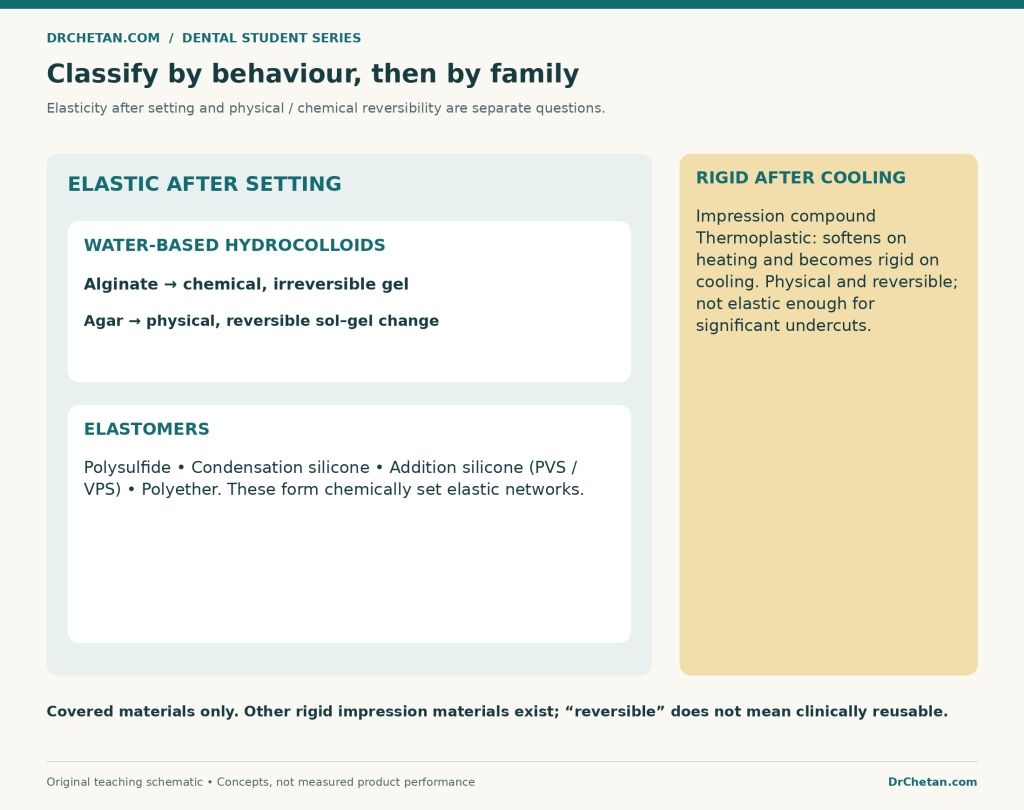
Figure 1. Classification of the materials covered in this article. Other impression-material families also exist; this is not an exhaustive list of every material used in dentistry.
The properties students should keep separate
| Property | What it means | Why it matters |
|---|---|---|
| Viscosity or consistency | Resistance to flow before setting, influenced by the conditions of use | Determines handling and the role of a wash, tray material, or putty |
| Working time | The period available for the specified manipulation, according to the manufacturer’s definition | Mixing, delivery, and seating must fit the permitted interval |
| Setting time | The specified time to reach the required set condition under stated conditions | An apparently firm surface does not establish that removal is appropriate |
| Elastic recovery | Recovery after deformation | Helps preserve shape after removal from suitable undercuts |
| Tear resistance | Resistance to tearing, especially in thin sections | Important where narrow extensions of material are stretched during removal |
| Stiffness after setting | Resistance to deformation of the set material | A stiff impression can be difficult to remove from undercuts or separate from a cast |
| Wettability | How a liquid spreads over or interacts with the relevant surface | Affects recording and cast-surface quality, alongside fluid control |
| Dimensional stability | Resistance to size or shape change over time | Determines whether the recorded relationships survive storage and pouring |
An elastic material can still be relatively stiff. A fluid material can set into a stiff solid. A hydrophilic material can absorb water and change dimensions. These are different properties, not contradictory descriptions.
Light body, medium body, heavy body, and putty describe consistency within a system. They are not separate polymer families. A light-body material is not automatically the least accurate, and a putty is not automatically the strongest or most appropriate wash material.
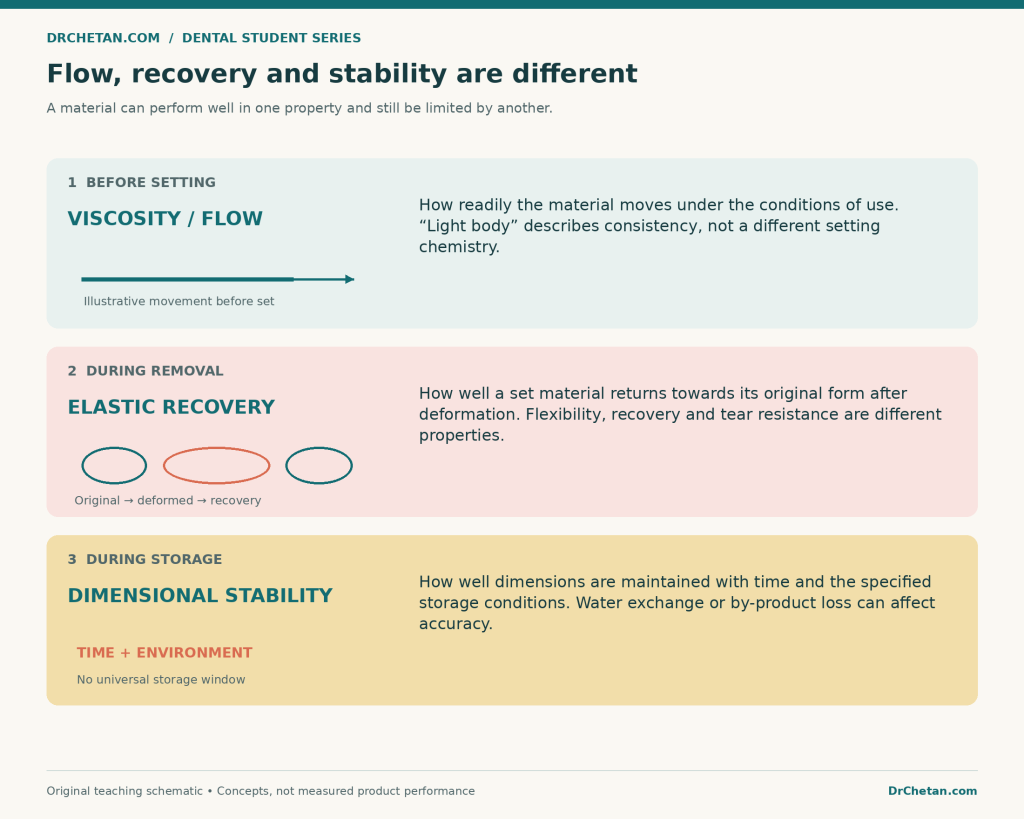
Figure 2. Three different questions: how does it flow, how does it recover, and how well does it preserve dimensions? The graphic contains no measured rankings or universal numerical values.
Alginate: the irreversible hydrocolloid
Alginate is a water-based elastic impression material commonly supplied as powder to be mixed with water. Its familiar applications include diagnostic and orthodontic casts, opposing-arch records, and selected preliminary or removable-prosthodontic impressions. Whether a particular material is suitable for a working cast depends on the procedure and its instructions. It is generally not the first choice for a demanding definitive impression of fine crown margins.
How alginate sets
The central event is conversion of a soluble alginate into a calcium-crosslinked gel. The powder commonly contains a soluble alginate salt, a calcium source, a retarder, and fillers or other modifying ingredients.
| Component group | Main teaching role |
|---|---|
| Soluble alginate salt | Supplies the polymer that will form the gel network |
| Calcium sulfate | Supplies calcium ions involved in crosslinking |
| Phosphate retarder | Initially competes for calcium, providing a useful manipulation interval |
| Fillers and modifiers | Adjust consistency, strength, handling, gypsum compatibility, appearance, or other formulation properties |
Initially, the retarder delays rapid gel formation. As that control is exhausted, calcium crosslinking produces the gel. This is not simply a liquid becoming cold. Reheating a set alginate impression does not restore the original usable mixture.
Why changing the water ratio is a poor way to adjust setting
The powder–water ratio affects the formulated material, not just the clock. Adding extra water to make a mixture easier to handle can also alter its strength, consistency, and other properties. Too little water can make mixing and detail reproduction more difficult.
Use the supplied measuring system and the product’s ratio. Water temperature can influence the reaction rate: warmer water generally speeds setting and cooler water slows it. That does not justify inventing a new temperature or ratio outside the instructions. Water quality and ambient conditions can also matter.
Advantages and limitations
Alginate offers relatively simple equipment requirements and convenient handling for appropriate applications. Its major limitations include vulnerability to tearing in thin regions and dimensional change associated with its water-containing gel structure.
A common learning mistake is to call alginate “inaccurate.” A properly made alginate impression may be appropriate for its intended task. The problem is using it for a demand it cannot reliably meet, or losing the recorded dimensions through poor handling or storage.
Does every alginate need the same pouring schedule?
No. For many conventional products, prompt pouring after the required cleaning and disinfection is important. However, some extended-pour formulations have a longer validated window under specified storage conditions.
For example, the reviewed Hydrogum 5-family instructions permit casting immediately after disinfection or within five days, with a specified conservation method. That is a product-specific example, not permission to keep any alginate for five days or to store an impression in any convenient way. Follow the labelling supplied in your market for the actual product.
Agar: the reversible hydrocolloid
Agar is also water-based, but its gelation is physically reversible with temperature. Heating converts the gel to a sol; cooling allows a gel network to form again. In suitable dental systems, the sol flows to record the tissues and then gels through controlled cooling.
Why agar needs conditioning equipment
Conventional agar impression systems use controlled liquefaction, storage, and tempering stages. A water-cooled tray supports gelation after placement. These stages have different purposes: maintaining material in the sol state is not the same as preparing it to contact oral tissues safely.
The need for controlled equipment and timing is an important difference from a powder-and-water alginate mix. Specific temperatures and durations depend on the system; a generic textbook temperature should not be treated as the operating setting for every product.
What is thermal hysteresis?
For agar, the gel-to-sol transition on heating and the sol-to-gel transition on cooling occur at different temperatures. This difference is thermal hysteresis. The gel must be heated substantially more to liquefy than the temperature at which the sol gels during cooling.
Do not describe hysteresis as an additional chemical setting reaction or assume that agar behaves like water freezing and melting at one simple transition temperature. Also, physical reversibility is a material property; it is not, by itself, authorisation to reuse a patient impression clinically.
Composition and practical limitations
Water is the principal medium and agar provides the gel-forming network. Traditional formulations include modifiers such as borates and potassium sulfate. Borate additions can influence gel properties and gypsum compatibility, while sulfate additions can help counter interference with gypsum setting. Composition varies between clinical and laboratory products.
Agar can reproduce fine detail well in an appropriate system. However, its water-based nature creates storage problems, and its thin extensions can tear. Clinical impression taking and laboratory cast duplication are different uses; a laboratory duplicating agar is not automatically an interchangeable intraoral product.
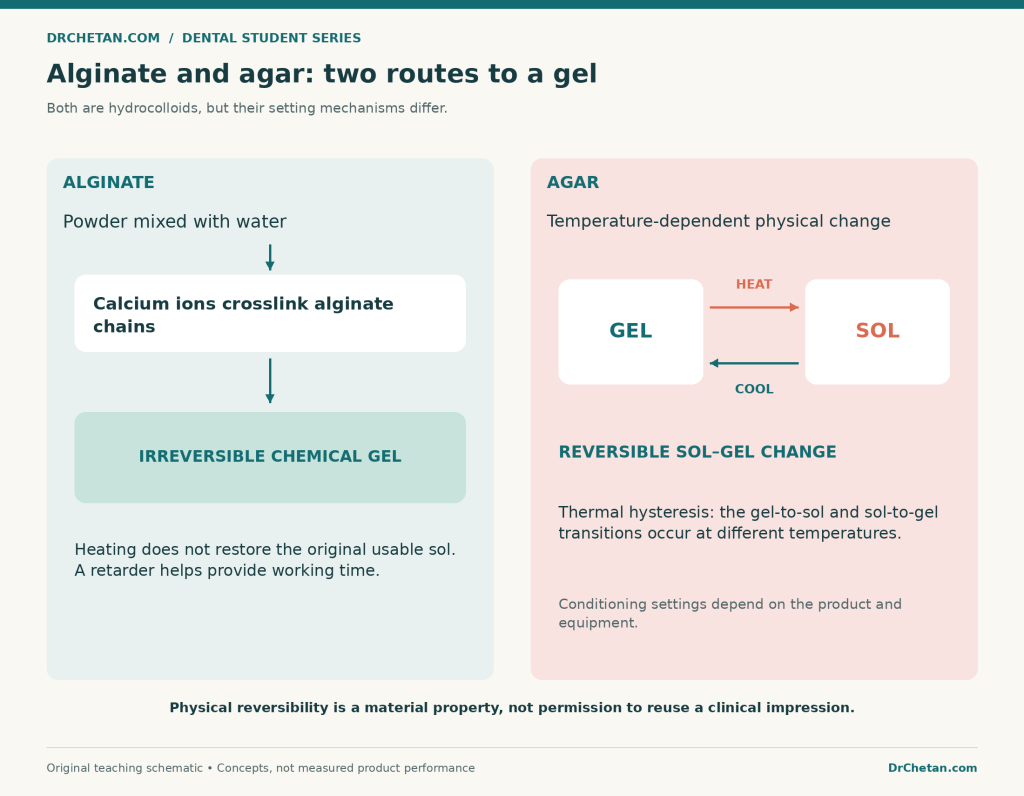
Figure 3. “Reversible” refers to the thermal sol–gel behaviour. The arrows do not represent a clinical reuse protocol or a complete chemical reaction equation.
Syneresis, evaporation, and imbibition
These terms explain why a hydrocolloid that recorded a surface correctly can still produce a distorted cast later.
- Syneresis: fluid is expelled from the gel network, which can contribute to contraction. It is not simply another word for drying in air.
- Evaporation: water is lost to the surrounding air, potentially contributing to shrinkage.
- Imbibition: the gel absorbs water, potentially causing swelling.
Syneresis can occur even in a humid environment. Conversely, placing a hydrocolloid impression in water to prevent drying can introduce swelling. Neither “keep it wet” nor “keep it completely dry” is a universal preservation rule. Use the specified method for the material and pour within its validated interval.
The resulting dimensional change is not necessarily a neat uniform expansion or contraction of every point. Tray restraint and the geometry of the impression can produce more complex distortion. The diagrams below show water movement conceptually, not a numerical prediction for cast size.
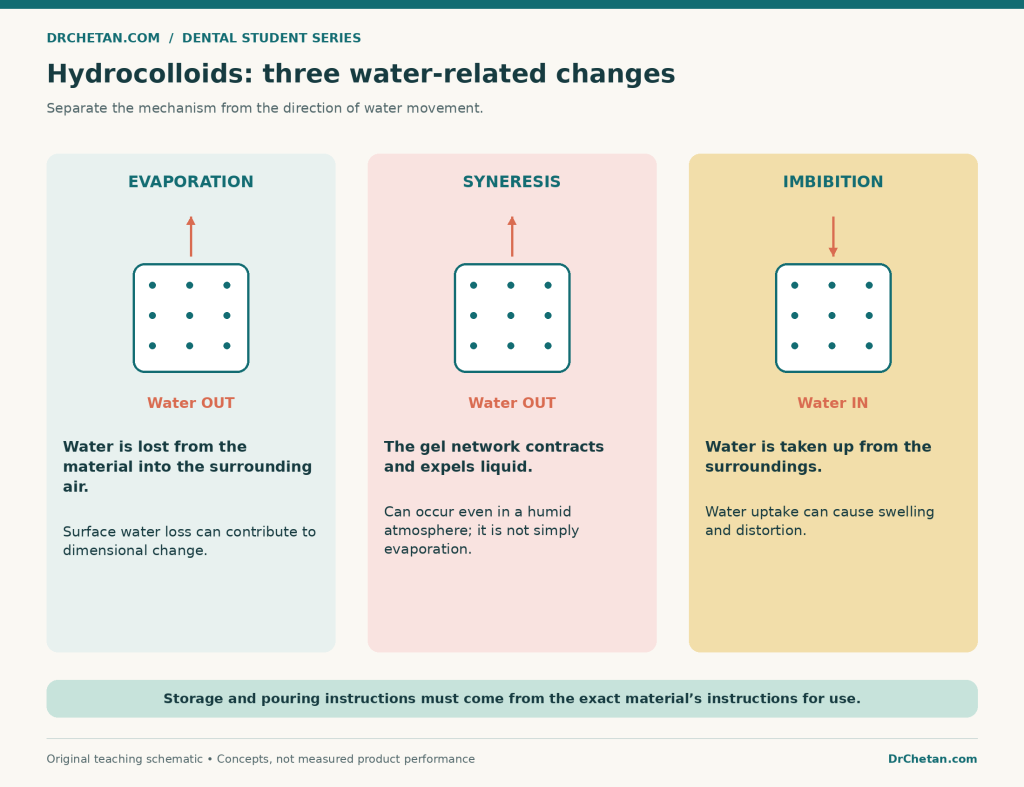
Figure 4. Water movement helps explain instability. Syneresis and evaporation are separate processes; the drawing groups their possible contraction consequence without equating their mechanisms.
Elastomers: one broad group, several different chemistries
Conventional elastomeric impression materials form rubber-like polymer networks through chemical reactions. The principal families compared here are polysulfide, condensation silicone, addition silicone, and polyether.
The word silicone is not enough to identify the reaction. Condensation and addition silicones differ in their chemistry and storage behaviour. Likewise, a product described as an alginate alternative may actually be a silicone: clinical role and chemical classification are separate questions.
Polysulfide
Classical polysulfide materials use a reactive polymer with mercaptan groups and a curing system that produces crosslinking. Water is a reaction by-product. Continued reaction and loss of by-product can affect dimensions, making the pouring schedule important.
Polysulfides are associated with useful flexibility and relatively good tear resistance in conventional comparisons. Their working and setting characteristics can be relatively lengthy, and odour, taste, and handling may be less pleasant than some alternatives. These are family-level tendencies; exact performance depends on the product and test conditions.
They have been used for appropriate removable and fixed prosthodontic impressions. The manufacturer’s product range may include multiple viscosities for different roles. A statement about a regular-body material is not automatically a description of that manufacturer’s light or heavy body.
Condensation silicone
Conventional condensation silicones form a crosslinked silicone network with an alcohol by-product, commonly described as ethyl alcohol in the standard dental materials account. Loss of this volatile component contributes to contraction after the impression is made.
These materials offer useful handling and elastic recovery, but pouring delay is a key limitation compared with many addition silicones. It is misleading to say that all “silicone impressions” can be stored for the same long interval.
Correct proportioning and homogeneous mixing matter. Do not alter the base–catalyst ratio casually to create more working time. A completed impression with patchy or streaky material may reflect a mixing or setting problem that a good-looking outer surface does not resolve.
Addition silicone: PVS or VPS
Polyvinyl siloxane and vinyl polysiloxane are common names for this family. The conventional setting chemistry is a platinum-catalysed addition reaction, usually described as hydrosilylation. It does not intentionally generate the volatile small-molecule condensation by-product associated with conventional condensation silicones.
This helps explain the good dimensional stability and elastic recovery offered by many PVS materials. It does not mean zero polymerisation shrinkage, immunity to tray distortion, or a universal unlimited storage period.
Some formulations or conditions can produce hydrogen through side reactions, affecting the surface of a subsequently poured gypsum cast. Products may contain hydrogen-scavenging components, and recommended minimum pouring delays vary. For example, GC describes an EXAFLEX formulation with a hydrogen scavenger allowing immediate gypsum pouring. Check the actual instructions rather than applying either “always pour immediately” or “always wait an hour” to every PVS.
Hydrophilic PVS still needs fluid control
The underlying silicone chemistry is relatively hydrophobic, but many products include formulation changes to improve wetting. The label “hydrophilic” should not be read as permission to leave blood, pooled saliva, or other uncontrolled fluid over the recording area.
Another important issue is contamination. Instructions for particular PVS products warn that some latex or sulfur-containing materials, soaps, lotions, or incompatible dental materials can interfere with setting. The useful lesson is to follow the product’s compatibility guidance; do not reduce it to an unqualified claim that every glove or every haemostatic agent has the same effect.
Polyether
Traditional dental polyether systems set through cationic ring-opening polymerisation of reactive terminal groups. The principal reaction does not rely on loss of an alcohol by-product as conventional condensation silicone does. Polyether’s polar chemistry provides good wetting characteristics.
Polyether can reproduce detail well, but many conventional formulations are relatively stiff after setting. This matters around undercuts and during cast separation. “Elastic” does not mean easy removal from every anatomy.
Water uptake is another consideration. A material with good affinity for water can also change dimensions if stored improperly in a wet environment. Manufacturer guidance for the reviewed Impregum family calls for dry storage and warns against sealing an impression in a bag while it is still moist. Follow the instructions for your formulation rather than transferring a hydrocolloid storage habit to polyether.
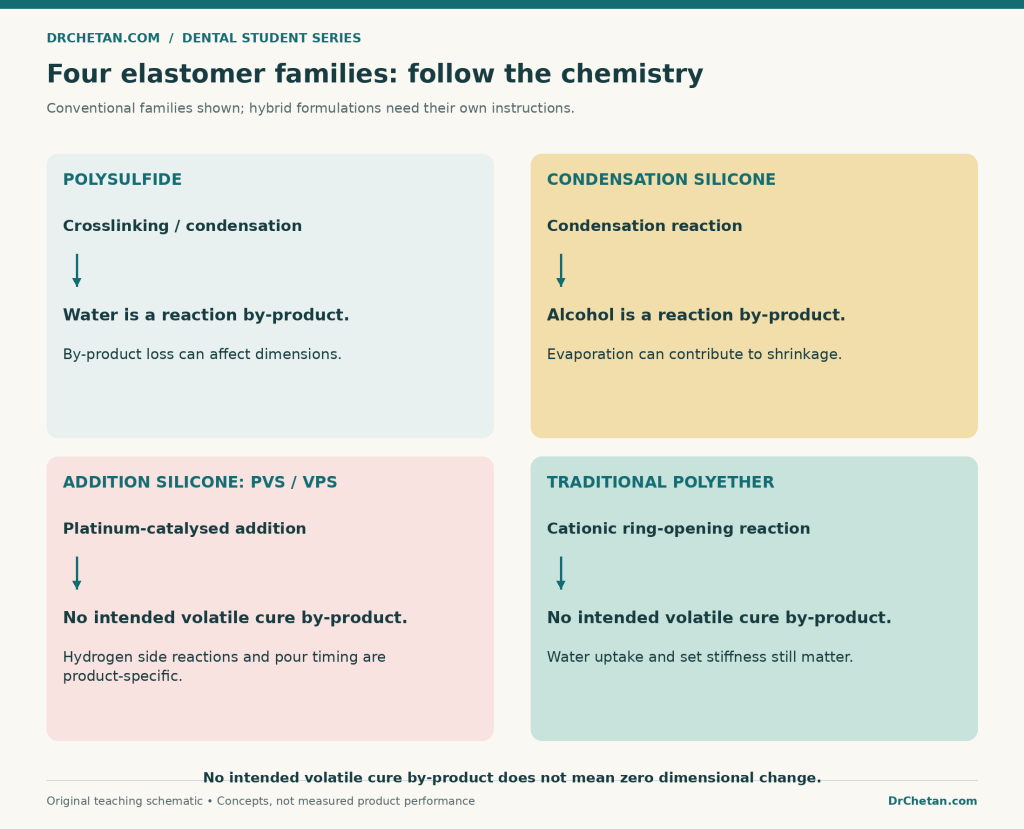
Figure 5. A simplified undergraduate chemistry comparison. “No intended volatile by-product” does not mean no dimensional change, no side reactions, or no storage restrictions. Hybrid materials require their own classification.
Impression compound: reversible softening, rigid after cooling
Impression compound is a thermoplastic material. Heat makes it workable; cooling makes it rigid again. This is physical thermal behaviour rather than a new polymer network forming during a chemical cure. Commercial forms include cakes and sticks, with formulation-dependent softening characteristics.
Common teaching applications include selected preliminary edentulous impressions and border moulding with suitable stick compounds. GC’s PERI COMPOUND is an example of a product specifically described for border moulding. That is an application-specific product description, not proof that any stick of coloured compound has identical properties.
Why compound is unsuitable for significant undercuts
The cooled material does not provide the same elastic recovery as an impression elastomer. Trying to withdraw a rigid record through significant undercut anatomy can cause distortion or locking. Selection therefore depends on the recorded area and technique, not simply on whether compound can be softened again later.
Thermal handling errors
Compound has relatively low thermal conductivity, so surface temperature and internal softening or cooling may differ. A softened exterior does not prove that the whole mass is uniformly workable; a cooled surface does not prove that the entire impression is stable. Overheating can also change handling and damage the material.
Condition the material according to its instructions, using the prescribed safe contact temperature. Colour is not a universal temperature code across manufacturers. The ability to re-soften compound is useful in appropriate adjustments, but repeated uncontrolled heating and cooling can introduce a distorted record.
The main comparison in one table
| Material | Setting mechanism | Main strengths in appropriate use | Main limitations to remember |
|---|---|---|---|
| Alginate | Irreversible chemical gelation | Convenient for many study, opposing, orthodontic, or preliminary records | Thin-section tearing; water-related instability; pouring window depends on formulation |
| Agar | Reversible temperature-dependent gelation | Fine detail reproduction in a properly conditioned system | Special equipment, temperature control, tearing, and water-related storage change |
| Polysulfide | Chemical crosslinking; water by-product in classical systems | Flexibility and useful tear resistance | Handling and setting demands; time-related dimensional change |
| Condensation silicone | Condensation cure with alcohol by-product | Useful flow and elastic recovery | Volatile by-product loss and contraction; pouring schedule matters |
| Addition silicone / PVS / VPS | Platinum-catalysed addition cure | Good dimensional stability and elastic recovery in many formulations | Contamination, fluid control, compatibility, and product-specific pouring limits |
| Polyether | Traditional cationic ring-opening cure | Good wetting and detail reproduction | Set stiffness, undercuts, and water uptake during improper storage |
| Impression compound | Softens on heating; hardens on cooling | Suitable preliminary edentulous and border-moulding applications | Rigid after cooling; thermal gradients, contraction, and limited undercut tolerance |
These are qualitative teaching comparisons, not numerical rankings of every product. A modern formulation may differ from the conventional family description.
Match the material to the task, not to a single slogan
For a diagnostic or opposing cast, convenience and the required level of accuracy may make an appropriate alginate useful. Confirm the intended use, tray, handling, and pouring arrangements.
For a definitive crown or bridge impression, elastomeric systems are commonly considered because of the relevant detail reproduction, recovery, and stability requirements. The material still needs a recording field and technique capable of capturing the margins.
For border moulding, an appropriate thermoplastic compound or a specifically indicated alternative may be selected. The purpose is different from merely choosing the thinnest material available.
For a deep undercut, stiffness, material thickness, recovery, and removal planning become important. A highly detailed record that cannot be removed without distortion is not a successful record.
These examples illustrate reasoning, not an automatic selection algorithm. Patient factors, the impression purpose, the anatomy, the compatible tray, and the actual product determine the choice.
Tray retention and technique can defeat a good material
A rigid, suitable tray supports the material and limits unwanted movement. Tray flexure can distort the impression as the tray recovers. Inadequate retention can allow the impression to detach or move independently of its support.
Use an adhesive or retention method intended for the material and tray. A perforated tray does not make every adhesive unnecessary, and one bottle of adhesive should not be assumed compatible with every polymer. Observe any specified application and drying interval.
Also distinguish consistency from technique. A one-step putty–wash technique, a two-stage technique, and a monophase technique are different workflows. Materials must be compatible and manipulated within the relevant working intervals. A very stable polymer cannot correct distortion caused by seating after working time or inadequate space for the wash.
Common manipulation errors and what to investigate
| Finding | Possible causes to investigate | Useful principle |
|---|---|---|
| Grainy, non-uniform alginate | Poor mixing, incorrect dosing, deterioration, or unsuitable conditions | Check the product, ratio, measuring system, and mixing instructions |
| Voids in the impression | Entrapped air, poor delivery, unsuitable flow, or uncontrolled fluid | Consider the whole recording process rather than blaming the brand immediately |
| Drag marks or poorly defined margins | Movement, late seating, inadequate working time, or fluid interference | Check timing, stability, and the recording field |
| Torn thin extensions | Inadequate bulk, premature removal, undercut strain, or material limitations | Recovery and tear resistance are different requirements |
| Unset patches or streaks | Incomplete mixing, incorrect proportioning, contamination, or incompatibility | Identify the cause before assuming that longer waiting will solve it |
| Impression detached from tray | Unsuitable tray, inadequate retention, wrong adhesive, or insufficient drying | The impression and its support must remain an effective unit |
| Cast dimensions differ after delay | Water movement, by-product loss, storage error, or continued material change | Follow the validated storage and pouring window |
| Bubbles or defects on the cast surface | Impression defects, gypsum handling, wetting issues, contamination, or gas-related effects in some systems | A cast defect may arise after an apparently acceptable impression |
One appearance can have more than one cause. The table is a troubleshooting framework, not a diagnosis of an unseen impression.
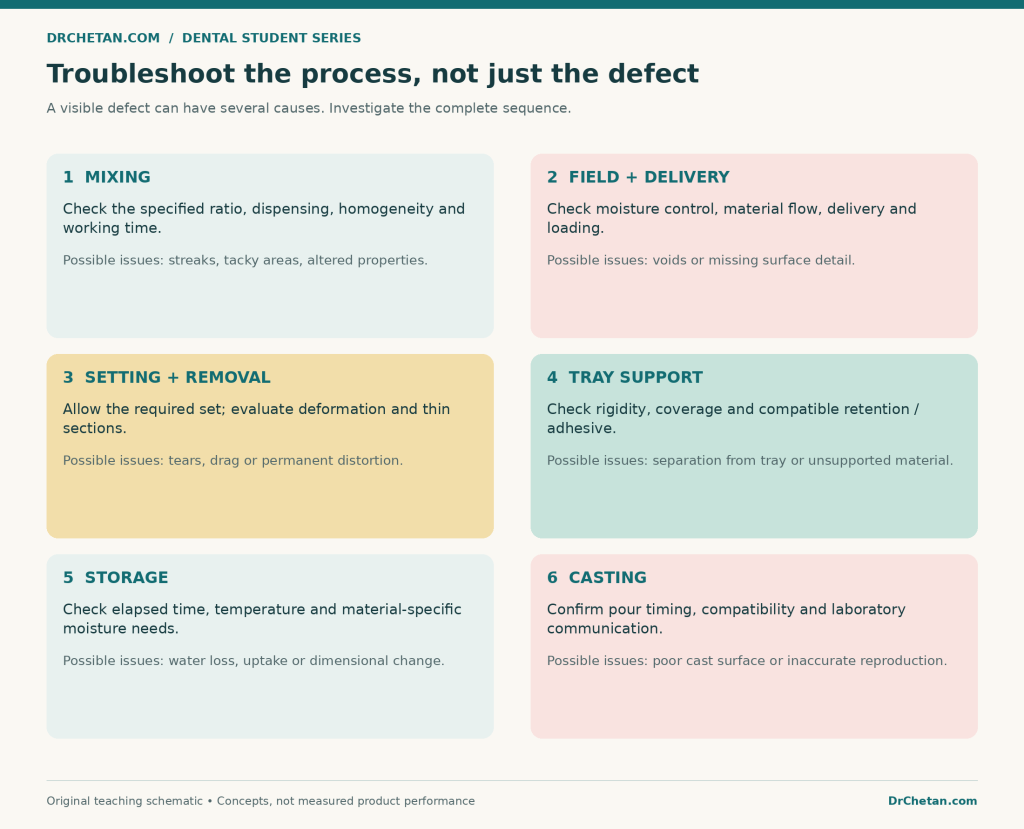
Figure 6. Investigate possible causes in sequence. The diagram does not claim that one visible defect proves a particular mistake.
Disinfection, storage, and laboratory communication
Cleaning and disinfection are part of preserving a usable and appropriately handled impression. A brief rinse alone is not the same as a validated disinfection process. Conversely, prolonged immersion in an unsuitable liquid may damage a dimensionally sensitive material.
Use the impression material’s compatibility guidance together with the disinfectant’s specified method, concentration, and contact time. Do not apply one remembered recipe to every hydrocolloid, silicone, polyether, and compound. Provide the laboratory with the necessary information about disinfection and the material’s permitted handling and pouring interval.
Keep powder or cartridge shelf life separate from the storage window of a completed impression. An unopened alginate powder that is in date does not imply that a set impression made from it remains accurate for that same interval.
Five worked revision cases
Case 1: alginate stored in water overnight
An alginate impression is submerged to prevent drying, and the cast is made the next day. The student’s explanation is that a hydrocolloid “likes water.” The reasoning problem is confusion between hydrophilicity and dimensional preservation. Imbibition can cause swelling; the product’s prescribed storage and pouring method must be checked.
Case 2: a five-day claim is transferred to another product
A student reads an extended-pour claim for one formulation and applies it to an unrelated alginate. The problem is not knowing that extended-pour products exist; it is treating a conditional product claim as a rule for an entire material family.
Case 3: tacky areas in an addition-silicone impression
Some regions remain unset while others appear cured. Possible explanations include mixing failure or inhibition from contamination. Review the exact product’s compatibility instructions and the handling history. Do not identify a particular contaminant solely from the appearance or assume that extra waiting will correct every inhibited region.
Case 4: a stiff polyether impression in marked undercuts
The student assumes that “elastic” guarantees easy removal. Elasticity describes recoverable deformation; it does not eliminate stiffness or undercut-related difficulties. Anatomy, material bulk, selection, and the actual product’s guidance must be considered before making the impression.
Case 5: compound looks firm at the surface
An impression is removed while its surface appears cooled, but deeper material is not uniformly stable. Thermal gradients are relevant because compound does not conduct heat rapidly. Judge conditioning and cooling using the specified procedure rather than a superficial appearance alone.
Twenty viva questions with explained answers
- What is the difference between an impression and a cast? An impression is a negative record; the cast is a positive reproduction made from it.
- Are elasticity and reversibility the same property? No. One concerns deformation and recovery, while the other concerns whether the setting change can be reversed under appropriate conditions.
- Why is alginate irreversible? Chemical calcium crosslinking produces its gel; routine reheating does not restore the original usable mixture.
- What is the role of phosphate in conventional alginate? It acts as a retarder, delaying rapid gel formation by initially competing for calcium.
- Should extra water be used simply to increase working time? No. Changing the specified ratio also changes the formulated material’s properties.
- How does water temperature affect alginate setting? Warmer water generally accelerates and cooler water retards the reaction; use the product’s specified conditions.
- What makes agar reversible? Its temperature-dependent physical sol–gel transition can be reversed by controlled heating and cooling.
- What is thermal hysteresis in agar? Gel liquefaction on heating and gelation on cooling occur at different temperatures.
- Does reversible agar gelation authorise reuse between patients? No. Physical reversibility does not establish a clinical reuse or infection-control protocol.
- How do syneresis and evaporation differ? Syneresis expels fluid from the gel network; evaporation loses water to the surrounding air.
- What is imbibition? Water absorption by the gel, potentially causing swelling.
- Which by-products are associated with classical polysulfide and condensation silicone? Water for polysulfide and alcohol for conventional condensation silicone.
- Why is addition silicone usually more dimensionally stable than conventional condensation silicone? Its principal addition cure avoids the latter’s volatile alcohol by-product, although other changes and handling errors remain possible.
- Can a PVS impression always be poured immediately? No. The formulation and its instructions determine the pouring window; gas-related side reactions and scavenger systems can matter.
- Does hydrophilic mean immune to saliva or blood interference? No. Better wetting does not remove the need for suitable fluid control.
- Why can polyether be elastic yet difficult to remove? Many formulations are relatively stiff after setting, especially relevant around undercuts.
- What sets impression compound? Cooling hardens the softened thermoplastic material; this is not a chemical polymerisation cure.
- Does “light body” identify a separate chemical family? No. It describes consistency within a material system.
- Why can a dimensionally stable material still give a distorted impression? Tray flexure, movement, inadequate retention, late seating, or other technique errors can distort the record.
- Which instructions govern disinfection and storage? The actual material’s compatible handling guidance together with the disinfectant’s specified protocol; no single universal recipe covers every product.

Leave a Reply