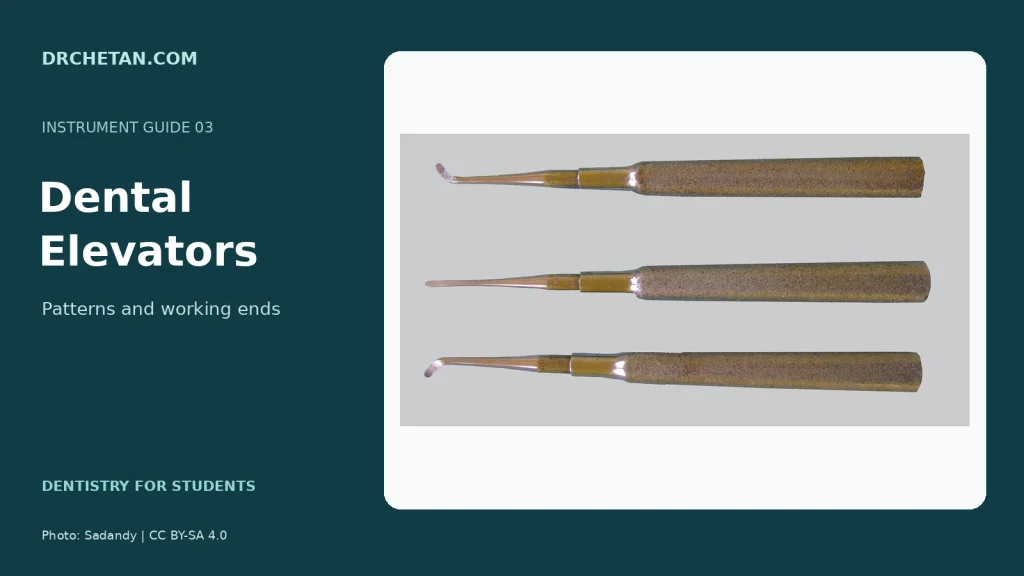
Dental elevators are surgical instruments used during tooth and root removal. Their designs vary, and recognising the working end is the key to identifying the instrument presented in a practical examination.
Parts of a dental elevator
Most elevators have a handle, a shank and a working end or blade. Look at the blade from the front and side, then follow the shank back to the handle. Note whether the blade is straight, curved, triangular or offset.
Photographic reference
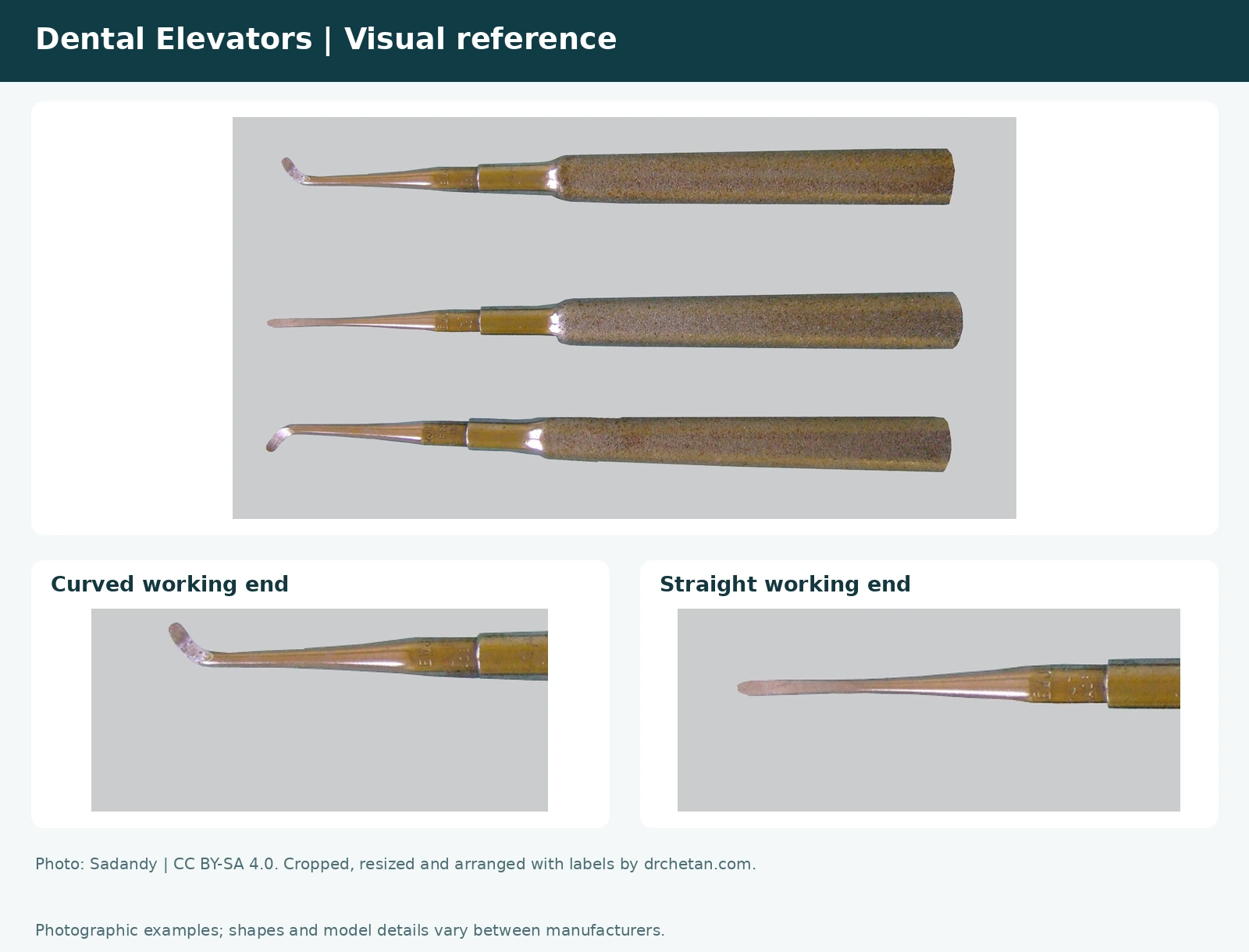
Straight elevators
A straight elevator has a blade aligned broadly with its shank. Sizes and blade contours differ. In an examination, describe the blade’s contour and identify it as a straight pattern before attempting a specific number.
Coupland elevators: a straight pattern
Coupland elevators belong to the straight elevator family. They have a gouge- or chisel-like working end; numbered sizes are available. Compare the blade profile and width with the straight elevators in your own teaching kit. Catalogue names and variants can differ.
Cryer elevators
Cryer elevators have a triangular working end set at an angle to the shank. They are commonly supplied as paired left- and right-handed designs. Their distinctive working ends help distinguish them from straight patterns.
Elevators, luxators and periosteal elevators
These names describe different instrument designs and roles. A periosteal elevator is designed to reflect tissue; a dental elevator is designed for tooth or root removal. Luxators and periotomes have their own working-end designs. Examine the actual instrument rather than treating these names as interchangeable.
What do elevators do?
Elevators assist luxation: loosening a tooth or root within its socket. Mechanical explanations include wedge, lever and wheel-and-axle principles, depending on the design and application. These principles explain how an instrument can transmit substantial force; they do not make every elevator suitable for every root.
Straight patterns are used for suitable tooth or root luxation. Cryer patterns are associated particularly with lower molar root removal when the surgical situation provides appropriate access and support. A triangular blade is an identification clue, not a reason to apply it blindly to any retained root. South Valley University’s teaching material illustrates the designs and their mechanical principles.
Comparison for practical identification
| Instrument | Main identification clue | Common confusion |
|---|---|---|
| Straight elevator | Blade broadly aligned with shank | A broad family, rather than a single numbered instrument |
| Coupland | Straight pattern with a gouge/chisel-like blade | Describing it as a separate opposite of a straight elevator |
| Cryer | Angled, triangular blade; paired designs | Assuming the right/left label alone determines every clinical application |
| Periosteal elevator | Working end designed for tissue reflection | Confusing its name with a tooth-luxating elevator |
Safety and learning
An adjacent tooth that is to be retained must not be used as a fulcrum. Uncontrolled force can injure teeth, bone and soft tissues. Limited access or failure to obtain movement calls for reassessment of the plan rather than simply more force.
Instrument recognition is only one part of surgery. Case selection, anatomy, controlled technique and protection of adjacent structures are learned under direct supervision. Do not use this identification article as a procedural substitute.
Viva questions
What are the main parts?
Handle, shank and working end.
What distinguishes a Cryer elevator?
Its angled, triangular working end and paired designs.
Why are there several Coupland sizes?
They provide different working-end dimensions; the exact selection depends on the case and instrument set.
Is a periosteal elevator the same as a tooth elevator?
No. They are designed for different tasks.
Is Coupland an alternative name for every straight elevator?
No. Coupland is one named straight pattern; other straight designs have different blade contours and sizes.
Can an elevator be chosen from a root’s location alone?
No. Anatomy, imaging, access, available support and the planned approach all matter.
Further reading
HuFriedyGroup: Surgical catalogue, elevators · Miniature Cryer example
Continue learning in the Dental Instruments and Dental Students collections.
References checked 31 October 2026. Educational identification guide for use alongside textbooks and supervised clinical teaching.
Featured-image photograph: Sadandy — source photograph (CC BY-SA 4.0). Resized and arranged with title; adapted visual: CC BY-SA 4.0.

Leave a Reply