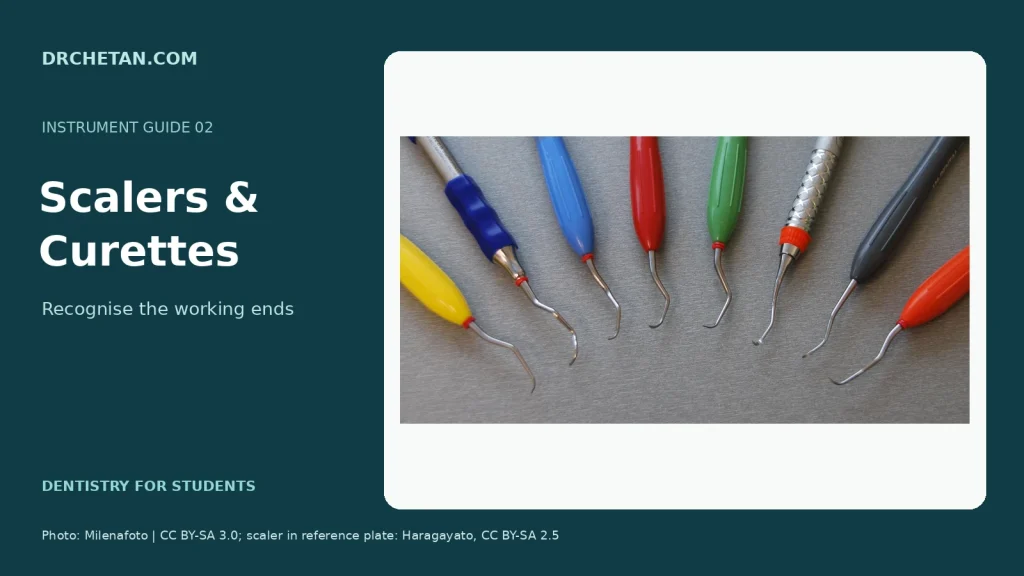
Manual periodontal instruments may look similar until you examine their working ends. The shape of the tip, back and blade face provides a practical starting point for identification.
Sickle scalers
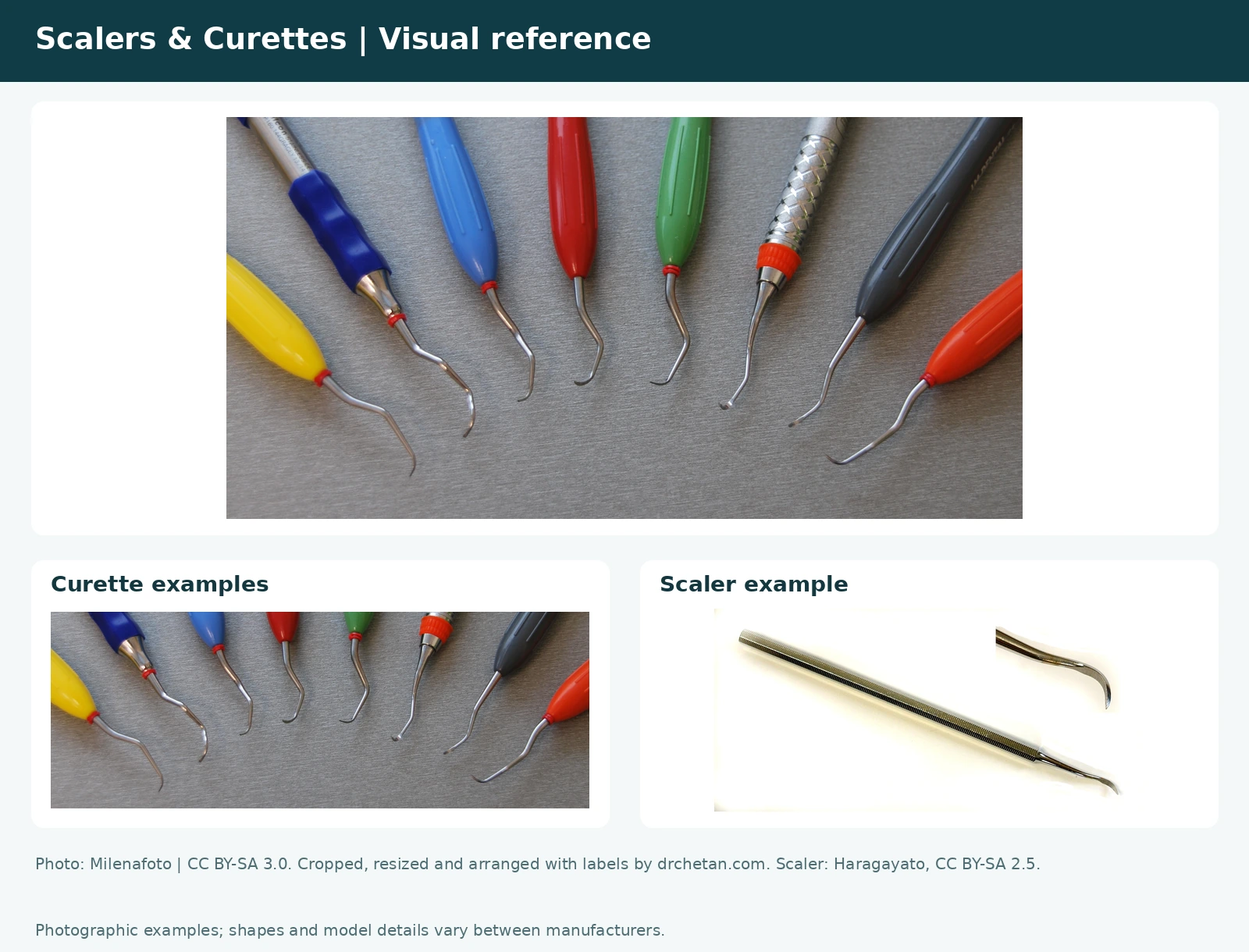
A sickle scaler has two cutting edges that meet at a pointed tip and a pointed back, producing a triangular cross-section. It is commonly used for supragingival deposits. Designs include straight and curved blades with different shank configurations.
Photographic reference
Universal curettes
Universal curettes have two cutting edges, a rounded toe and a rounded back. Their blade face is approximately perpendicular to the terminal shank. Barnhart and Columbia are examples of universal designs. The shank and blade dimensions differ across patterns.
Gracey curettes
Gracey curettes are area-specific instruments. Their offset blade face forms an approximately 70-degree angle with the terminal shank; the lower cutting edge is the functional cutting edge. Each working end is designed to adapt to a particular area or surface.
Blade geometry versus working angulation
The terminal shank is the final portion of the shank next to the blade. The face is the top surface of the working end; a cutting edge is the junction of that face with a lateral surface. A curette’s rounded toe and back help distinguish it from a pointed sickle.
The approximately 70-degree Gracey face-to-shank angle describes the instrument’s construction. It is not an instruction to hold the instrument at 70 degrees throughout treatment. The blade-to-tooth working angle changes during insertion and instrumentation and is taught with adaptation, a fulcrum and controlled strokes. Holding a handle at a memorised angle does not establish correct blade adaptation.
Comparison at a glance
- Sickle: pointed tip, triangular cross-section and two cutting edges.
- Universal curette: rounded toe and back, two cutting edges and a face approximately 90 degrees to the terminal shank.
- Gracey curette: rounded toe and back, offset face and one functional lower cutting edge.
Common Gracey numbers
Standard sets commonly include 1/2 and 3/4 for anterior teeth, 11/12 for mesial posterior surfaces and 13/14 for distal posterior surfaces. Other patterns and modified shanks are available; verify the specific manufacturer’s identification guide.
Gracey pattern reference
| Common pattern | Traditional area of application |
|---|---|
| 1/2 and 3/4 | Anterior teeth |
| 5/6 | Anterior teeth and premolars |
| 7/8 and 9/10 | Facial and lingual surfaces of posterior teeth |
| 11/12 | Mesial surfaces of posterior teeth |
| 13/14 | Distal surfaces of posterior teeth |
| 15/16 and 17/18 | Modified posterior mesial and distal patterns, respectively |
Use the manufacturer’s application guide with the particular pattern. Longer shanks and shorter blades are modifications within the Gracey family, rather than different rules for counting cutting edges. The two numbers on a double-ended instrument identify its two blade designs.
Practical identification checklist
Look at the tip first, then the back, cutting edges and blade-face angle. Follow the terminal shank towards the working end. Do not infer the instrument solely from its handle colour or a photograph taken from one angle.
Viva questions
Which instrument has a pointed tip?
The sickle scaler.
How many functional cutting edges does a Gracey blade have?
One: the lower cutting edge.
What is the main difference between universal and Gracey curettes?
Universal curettes have a non-offset face and two cutting edges; Gracey blades are offset and have one functional edge.
Are all curette shanks identical?
No. Shank bends and blade sizes vary with design and intended access.
Can universal curettes be used below the gumline?
Yes. Their rounded toe and back allow subgingival adaptation when used appropriately. “Universal” refers to application across tooth surfaces; it does not make all blade dimensions suitable for every site.
Does a rounded toe mean the instrument is blunt?
No. The outline of the toe and the sharpness of the cutting edges are different properties.
Further reading
HuFriedyGroup: Sickle scalers · Universal curettes · Gracey curettes
Continue learning in the Dental Instruments and Dental Students collections.
References checked 31 October 2026. Educational identification guide for use alongside textbooks and supervised clinical teaching.
Featured-image photograph: Milenafoto — source photograph (CC BY-SA 3.0). Resized and arranged with title; adapted visual: CC BY-SA 4.0.

Leave a Reply