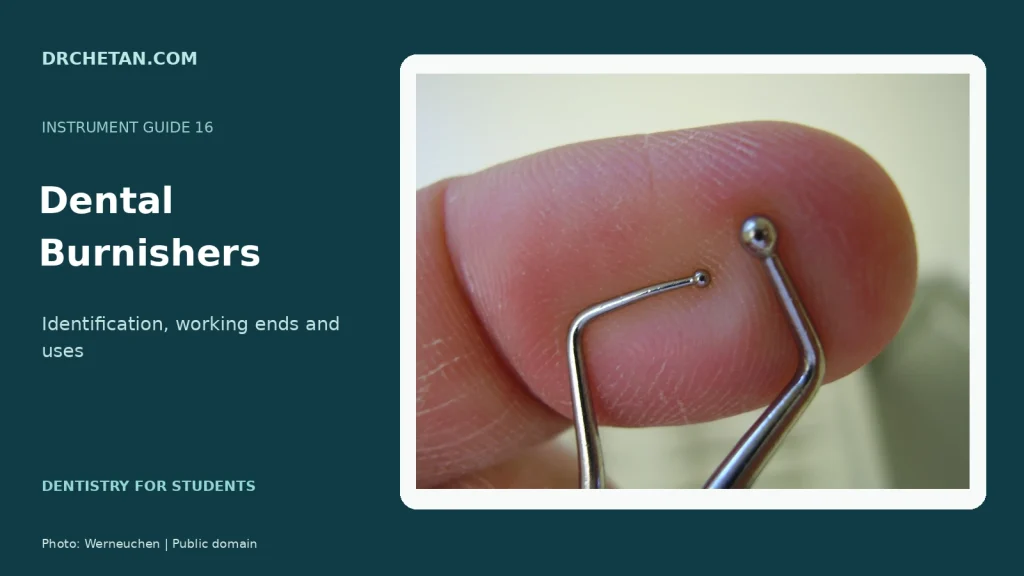
A dental burnisher usually has a smooth, rounded working surface for adapting or contouring restorative material. The shape of that surface is the best starting point for identifying it on an instrument tray.
A learning guide for dental students. Clinical instrument use requires practical training and supervision.
Photographic reference
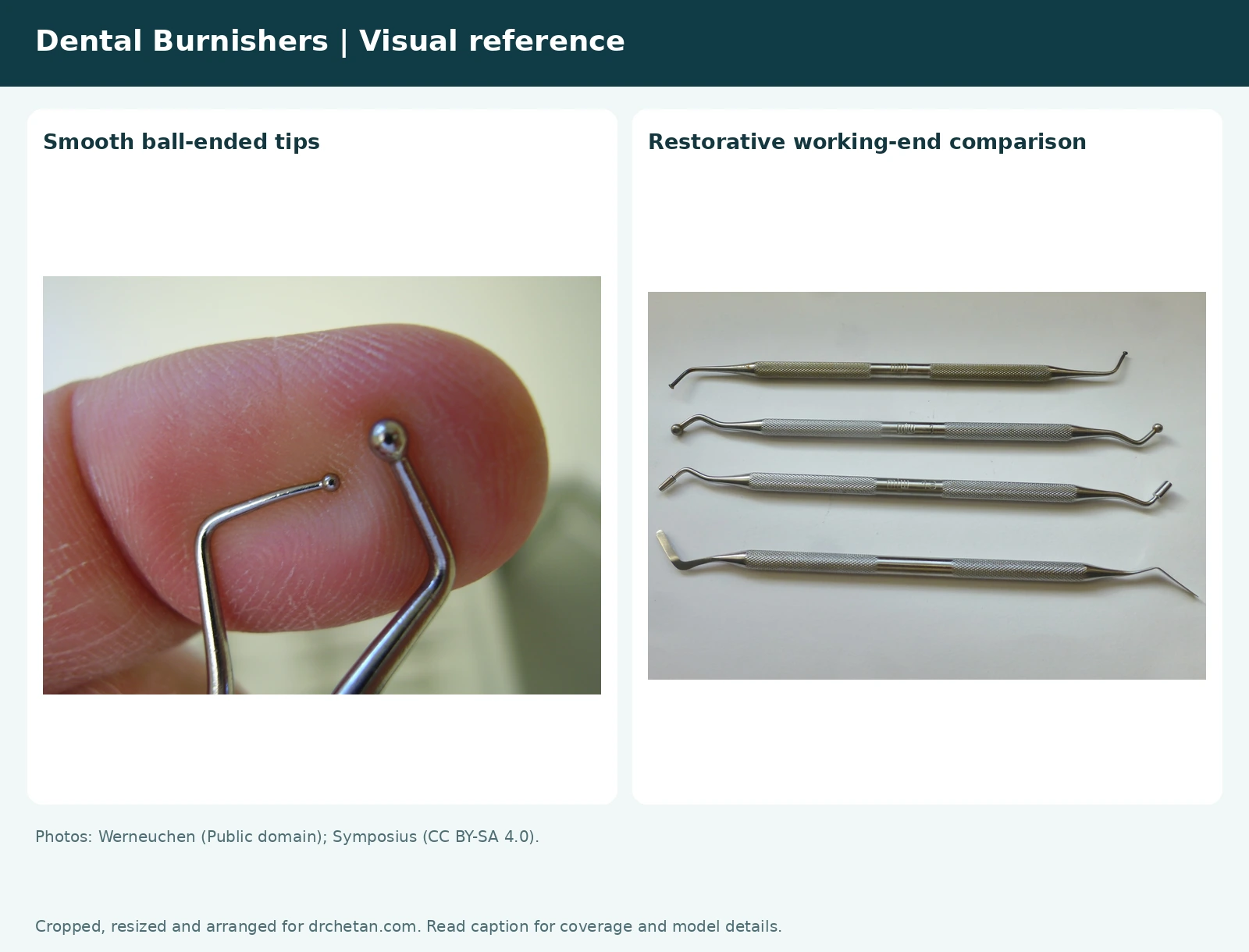
What makes an instrument a burnisher?
Look for a smooth working end without the sharp cutting edge expected on a carver. A burnisher acts mainly through controlled pressure and contact with the material. It may be single-ended or double-ended; the shank positions the tip for access, while the handle provides grip.
The term describes a function as well as a familiar group of shapes. Some modern composite instruments combine a burnisher-like end with a placement or sculpting end. Identify both ends separately instead of assuming that every instrument with one rounded tip is a simple ball burnisher.
Common burnisher shapes
| Shape | Recognition point | Broad restorative role |
|---|---|---|
| Ball | A smooth spherical or nearly spherical tip | Localised adaptation, contouring and selected matrix-band adaptation |
| Football / ovoid | An elongated, rounded tip | Contours broader or sloping surfaces |
| Beavertail | Broad, flattened, rounded paddle-like end | Smooths or contours a relatively broad accessible surface |
| Acorn | Rounded conical form with a fuller base | Helps develop occlusal form in suitable restorative material |
| T-ball | A transverse T-like end that incorporates a ball | Provides a different approach to selected surfaces |
These are descriptive names, not universal dimensions. A manufacturer may combine different shapes or diameters on one instrument. Compare the tip profile and catalogue description before assigning a number.
Burnishers in amalgam and composite work
In amalgam teaching, burnishing is discussed in relation to adapting and smoothing suitable material surfaces. It is a different action from packing material with a condenser or removing excess with a sharp carver. Timing and pressure depend on the material and the taught technique; a shape-identification guide is not a complete amalgam-placement protocol.
For composite, polished or appropriately coated rounded instruments may help adapt and shape the uncured material. A rounded tip can blend a contour, while a finer sculpting end can develop detail. A burnisher cannot compensate for poor isolation, an inadequate matrix or incomplete curing.
Burnishing is also different from the finishing and polishing sequence used to refine a restoration after the material has reached the appropriate state. A smooth metal hand instrument does not replace every abrasive finishing or polishing step.
Burnisher, carver, condenser or probe?
| Look-alike | Main distinction |
|---|---|
| Carver | A defined cutting edge removes excess material and develops anatomy |
| Condenser / plugger | A terminal face is designed to press or pack material; faces may be smooth or serrated |
| Periodontal probe | A calibrated measuring tip is intended for periodontal assessment |
| Explorer | A fine working end is intended for selected examination tasks |
| Liner applicator | Often has a much smaller rounded tip for placing small quantities of lining material |
A ball burnisher is not a calibrated periodontal measuring instrument. A small ball at an instrument tip also does not prove that the instrument is a burnisher: some periodontal probes have a ball-ended measuring tip. Check the markings, proportions and intended use together.
How to describe a burnisher in a practical examination
- Identify the family: a restorative burnisher.
- Describe the working end: ball, ovoid, flattened paddle or another confirmed shape.
- Describe whether the instrument is single-ended or double-ended.
- Give its broad role, then distinguish it from a cutting carver or packing plugger.
- Use the engraved code only after confirming it against the manufacturer’s range.
Example: “This is a double-ended ball burnisher. The smooth rounded tips provide different contact areas for suitable restorative adaptation and contouring. It is not a periodontal probe because it has no calibrated measuring tip.”
Common mistakes and instrument care
Do not identify a beavertail burnisher simply because an instrument looks flat from one angle. Rotate it and examine its edges: a flat plastic instrument, enamel hatchet or carver may have a similar silhouette but a different working surface.
Inspect for roughness, pitting, damage and residual restorative material. A scratched or contaminated surface can impair handling. Follow the instrument’s cleaning and sterilisation instructions, including any restrictions for coated tips. Avoid abrasive cleaning methods that the manufacturer has not approved.
Do not transfer the manufacturer’s coating claim from one product to another. A dark or gold appearance does not establish an instrument’s composition, permitted reprocessing method or clinical indication.
Frequently asked questions
Is a ball burnisher a periodontal probe?
No. It has a restorative shaping role and is not a calibrated instrument for periodontal measurements.
What is the difference between a football and a ball burnisher?
The ball tip is approximately spherical. A football or ovoid tip is elongated, giving a different contact profile.
Can a burnisher remove excess material like a carver?
Its principal action is controlled pressure and contouring. A sharp carver is designed for cutting away excess; do not treat them as universally interchangeable.
Does burnishing replace polishing?
No. Contouring with a smooth instrument and finishing or polishing with appropriate abrasives are different stages.
Are burnisher numbers standard across brands?
No. Confirm the shape, dimensions and intended use in the relevant manufacturer’s catalogue.
References and further reading
- HuFriedyGroup: dental burnishers
- HuFriedyGroup: restorative instrument catalogue
- FDA AccessGUDID: manufacturer-listed football/ball burnisher
Featured-image photograph: Werneuchen — source photograph (Public domain). Resized and arranged with title. Adapted visual: CC BY-SA 4.0.
Explore more dental instrument guides and articles for dental students.

Leave a Reply