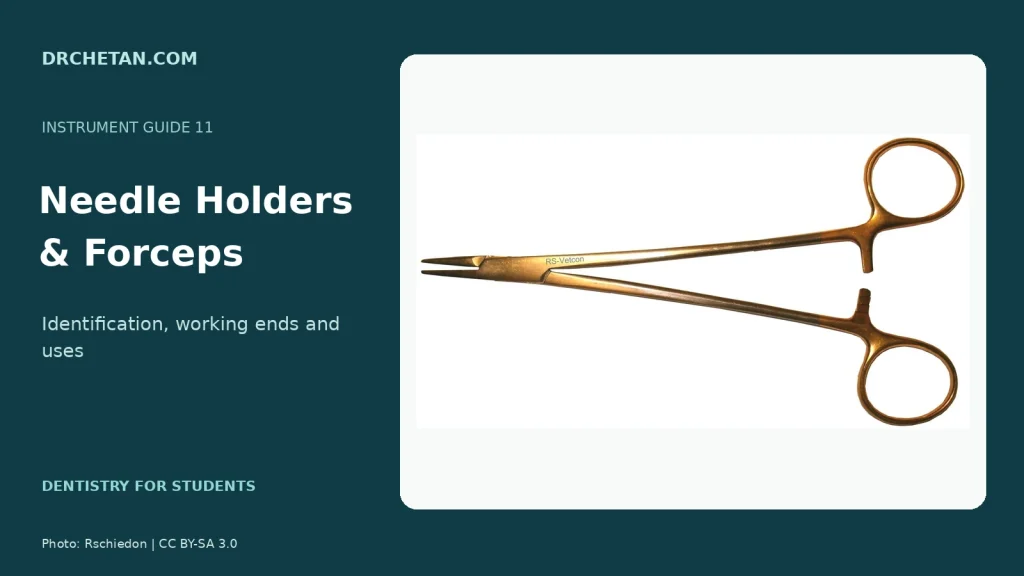
Needle holders grip a suture needle, haemostats clamp selected tissues or vessels, and tissue forceps help hold tissue. They can look similar on a tray, but their working ends are designed for different tasks.
A learning guide for dental students. Clinical use requires practical training and supervision.
Photographic reference
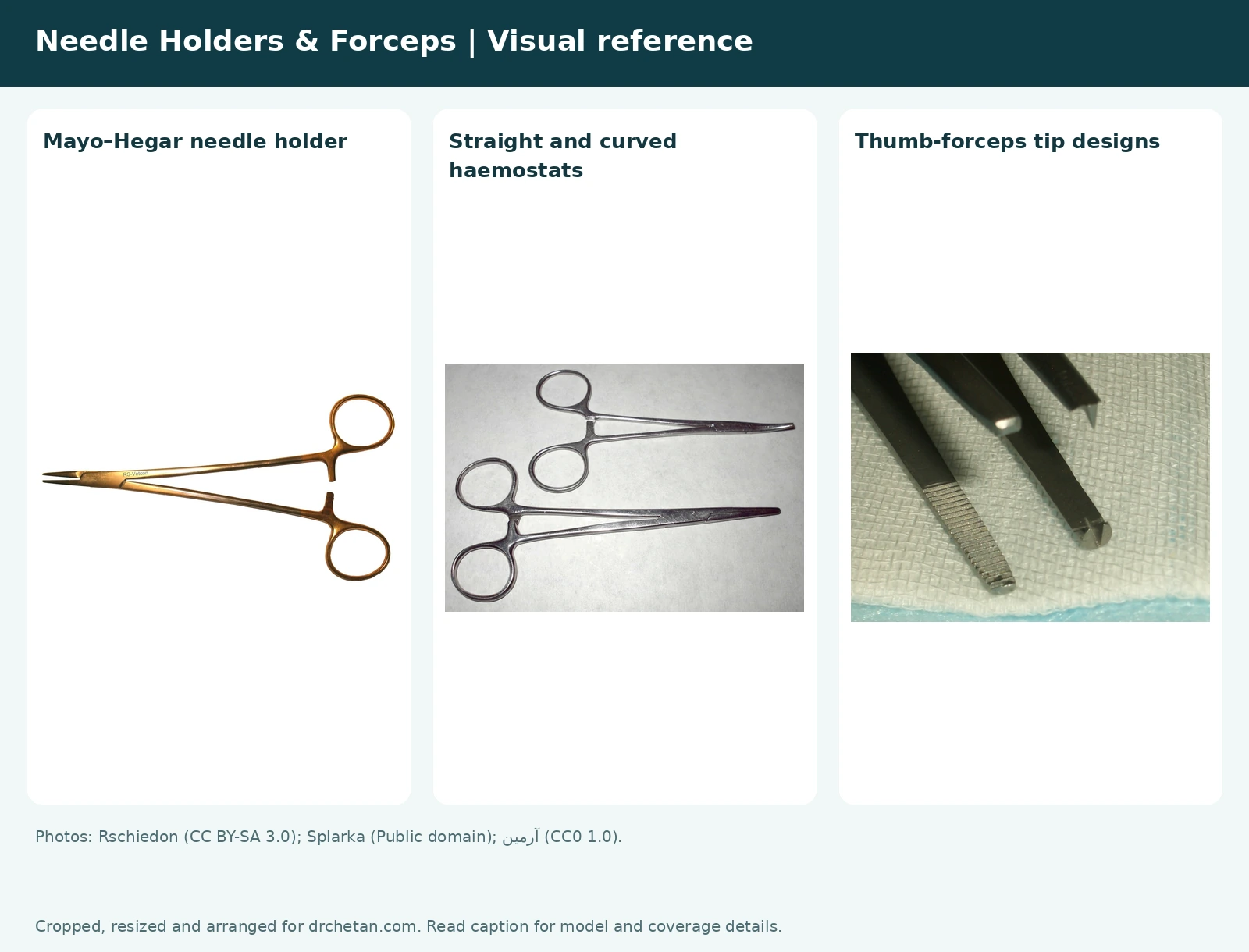
Start with the jaw, then examine the handle
A ring handle and a ratchet do not identify an instrument on their own. A needle holder and a haemostat may both have these features. Begin at the working end: examine its length, thickness, surface pattern and intended gripping surface, then use the handle and manufacturer marking to confirm the identification.
Use this sequence in a practical examination: family ? named pattern ? distinguishing feature ? broad use. For example: “This is a Mayo–Hegar needle holder; it has relatively short, stout jaws and ring handles with a ratchet; it is designed to control a surgical needle.”
Quick comparison
| Instrument family | Recognition clues | Broad role |
|---|---|---|
| Needle holder | Often short, robust gripping jaws; ring, palm or spring handle designs | Holds and guides a suture needle |
| Haemostat / artery forceps | Typically longer, slimmer jaws; straight or curved patterns, usually a locking ratchet | Clamps a selected vessel or tissue under direct control |
| Thumb tissue forceps | Spring arms, no scissor hinge; toothed or non-toothed tips | Holds tissue during examination or surgery |
These are typical clues, not an infallible naming system. Fine microsurgical needle holders can have delicate jaws, and locking tissue forceps also exist. Confirm the exact instrument against its catalogue or tray inventory.
Needle holders: common patterns
- Mayo–Hegar: a familiar ring-handled needle holder with a locking ratchet. Compare the compact gripping jaws with the more slender jaws of a typical haemostat.
- Olsen–Hegar: combines a needle holder with scissors behind the gripping jaws. The scissors are the key recognition point; it is not simply a Mayo–Hegar with a different handle.
- Mathieu: has a palm-operated handle and a locking mechanism, rather than the familiar pair of finger rings.
- Castroviejo: a spring-handled design often associated with fine suturing. Locking and non-locking versions exist; inspect the actual model.
Jaw size and surface design must suit the needle. A fine needle can be distorted by an unsuitable heavy holder or excessive pressure. Gold-coloured handles often accompany tungsten-carbide inserts, but colour alone does not prove the jaw material or quality.
Haemostats: straight, curved and named patterns
Mosquito and Kelly forceps are common names students encounter. Mosquito patterns are generally smaller and finer than standard Kelly patterns, but length varies by manufacturer. Straight versus curved describes jaw shape, not a separate clinical purpose in every case.
Serration extent can help distinguish named patterns within a specified manufacturer’s range. Do not memorise “all artery forceps have identical serrations” or identify a model solely by length. A curved haemostat is also not an extraction forceps: its narrow jaws are not designed to engage a tooth in the same way.
A ratchet maintains closure; it does not make blind clamping safe. Structures must be identified before clamping. This guide explains recognition, not how to control surgical bleeding or retrieve roots.
Tissue forceps: toothed and non-toothed tips
Adson forceps are a common thumb-forceps pattern. Available versions include serrated, non-toothed tips and toothed tips such as 1 × 2: one tooth on one jaw interlocks with two on the other. The number describes the tip arrangement, not the handle size.
Teeth may obtain a secure hold with less squeezing in suitable tissue, while a non-toothed forceps can still crush tissue if compressed excessively. “Non-toothed” does not automatically mean “atraumatic.” Delicate or specially designed atraumatic forceps should be identified by their actual tip design and indication.
Cotton pliers primarily handle small materials. Their angled tips may resemble some tissue forceps, but they should not automatically be substituted for a surgical tissue-holding instrument.
Common identification errors and care
- Calling every ratcheted instrument an artery forceps. Inspect its jaws first.
- Confusing an Olsen–Hegar cutting section with a haemostat jaw.
- Calling every short thumb forceps an Adson without checking its pattern.
- Using handle colour as the only clue to tungsten-carbide inserts.
- Closing instruments tightly for storage or sterilisation without checking the reprocessing instructions.
Inspect alignment, ratchet function, jaw wear and corrosion according to the manufacturer’s instructions. Hinged instruments require effective cleaning and processing in the specified open or unlocked position. Damaged jaws can slip or damage a needle; remove faulty instruments from use.
Viva practice
Question: Two ring-handled instruments both have a ratchet. How would you distinguish them? Answer: Compare jaw proportions and gripping surfaces, look for a cutting section, then confirm the named pattern and marking. Do not use the ratchet alone as the deciding feature.
Frequently asked questions
Are needle holders and artery forceps interchangeable?
They have different intended gripping tasks. A haemostat may damage or inadequately control a needle, while a needle holder is not a universal tissue clamp.
Do all needle holders have finger rings?
No. Mathieu and Castroviejo designs demonstrate alternative handle arrangements.
What does 1 × 2 mean on tissue forceps?
One tooth on one tip interlocks with two on the opposing tip.
Are non-toothed forceps always atraumatic?
No. Serrations, jaw shape, pressure and the tissue being handled all affect injury risk.
Does a gold handle guarantee tungsten carbide?
No. Confirm the manufacturer’s specification; handle colour is only a possible supporting clue.
References and further reading
- HuFriedyGroup: needle-holder designs
- HuFriedyGroup: Olsen–Hegar combination instrument
- HuFriedyGroup surgical catalogue: haemostats
Featured-image photograph: Rschiedon — source photograph (CC BY-SA 3.0). Resized and arranged with title. Adapted visual: CC BY-SA 4.0.
Explore more dental instrument guides and articles for dental students.

Leave a Reply