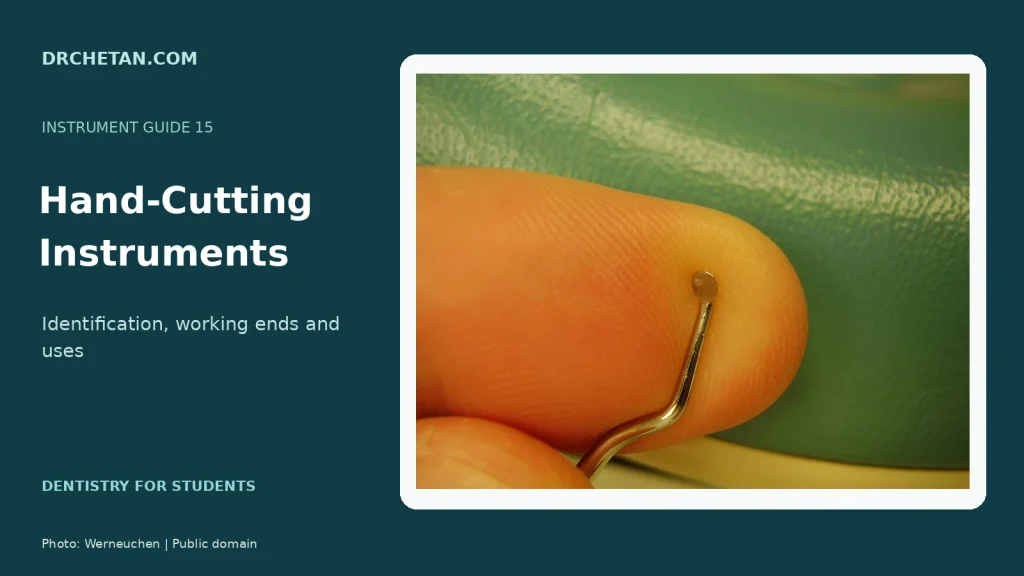
Dental hand-cutting instruments remove or refine tooth tissue through a sharp working edge. A spoon excavator, enamel hatchet, chisel and gingival margin trimmer belong to this broad group, but their blade shapes and intended tasks differ.
A learning guide for dental students. Clinical use requires practical training and supervision.
Photographic reference
Classification: look at the working end
Begin with three parts: handle, shank and working end. The handle provides grip, the shank positions the blade, and the working end performs the cutting task. A change in shank angle helps access; it does not alone change an instrument into a new family.
Hand-cutting instruments are distinguished from rotary cutting instruments, such as burs, and from instruments whose principal role is placing or shaping a restorative material. A mixing spatula, mouth mirror or cotton pliers may be on the same tray, but it is not therefore a tooth-cutting excavator.
A comparison students can revise quickly
| Instrument | Working-end recognition | Broad role |
|---|---|---|
| Spoon excavator | Rounded, spoon-like end with a cutting rim | Selected removal of carious dentine |
| Enamel hatchet | Small blade with an edge arranged in the plane of the instrument; paired designs common | Refines cavity walls and removes selected unsupported enamel |
| Enamel chisel | Chisel-like blade with a terminal cutting edge; straight or angled shanks | Cleaves or planes selected enamel |
| Gingival margin trimmer | Curved blade and an oblique primary cutting edge; often paired | Refines or bevels suitable enamel margins where indicated |
A name should follow the geometry, not replace it. In a viva, point to the cutting edge and describe the feature that separates it from the nearest look-alike.
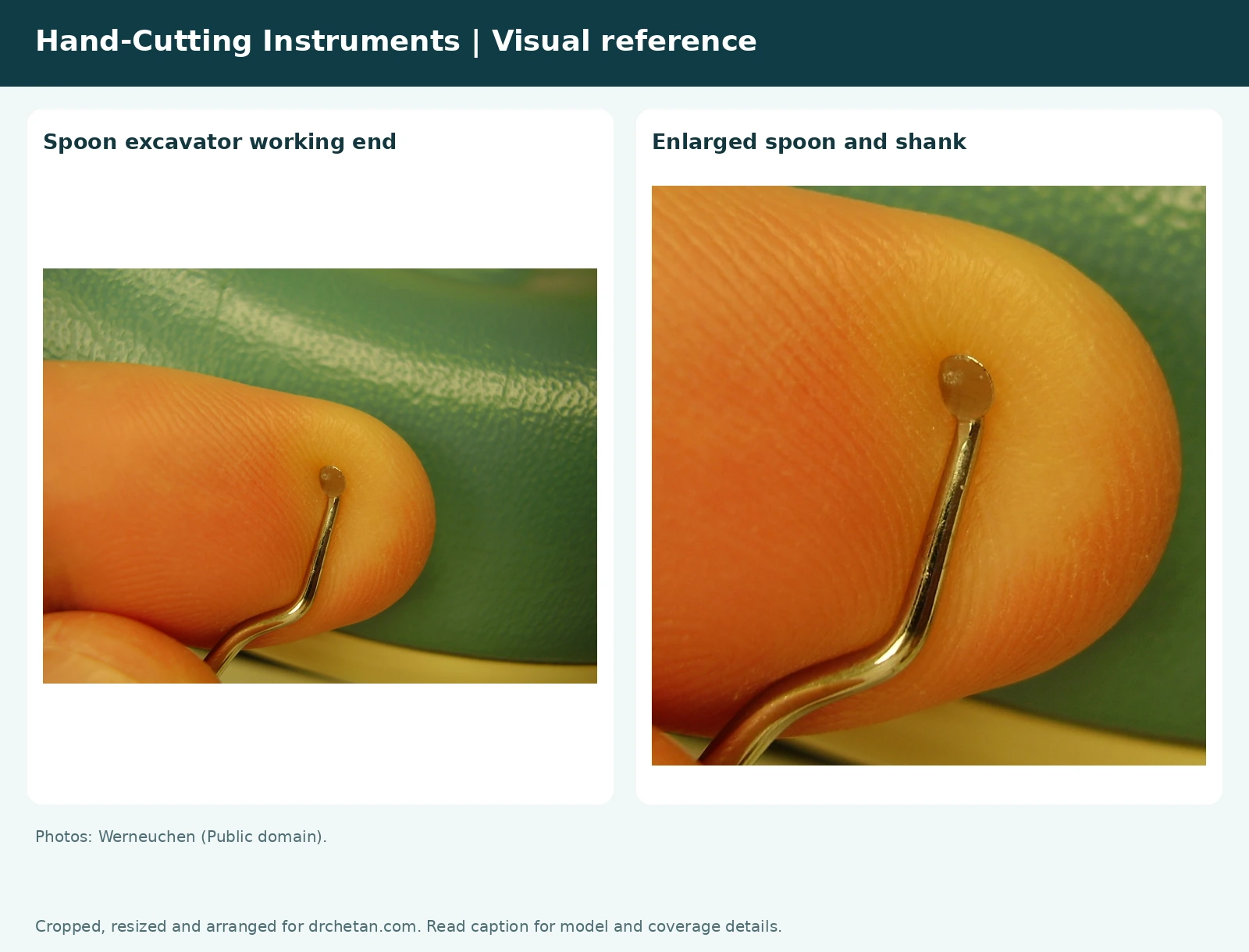
Spoon excavators: shape, sizes and caries removal
The concave end and rounded cutting outline are the useful recognition clues. Instruments differ in spoon diameter, shank angulation and working-end design. Terms such as small, medium and large are convenient descriptions, but exact dimensions must come from the manufacturer. They are not universally 1, 1.5 and 2 millimetres.
The excavator can provide tactile information while removing selected carious dentine. Its sharp edge and the applied force still require control: “hand instrument” does not mean it cannot expose the pulp or damage tissue.
Modern caries management does not require every deep cavity to be excavated to hard dentine at the pulpal wall. The ADA’s 2023 restorative guideline supports conservative carious tissue removal approaches in appropriate vital teeth, particularly advanced lesions. Lesion depth, pulpal diagnosis and the planned restoration determine the endpoint. Instrument identification and deciding how much tissue to remove are separate clinical judgments.
Hatchets and chisels
An enamel hatchet has a blade orientation that supports access along selected cavity walls. Paired instruments provide complementary bevels or access. A chisel has a terminal cutting edge and may have a straight, mono-angle or more complex shank. Examine the edge, bevel and relationship to the handle rather than identifying either by the bend alone.
Both may be used to refine selected enamel, including unsupported enamel when removal is indicated. They are not interchangeable in every location. Also distinguish restorative enamel chisels from surgical bone chisels: the word “chisel” alone does not establish the intended tissue or procedure.
The required preparation form depends on the restorative material and current clinical approach. Do not interpret older descriptions of extension or retention as a requirement to enlarge every modern adhesive preparation.
Gingival margin trimmers
A gingival margin trimmer resembles a modified hatchet, but its blade is curved and its primary cutting edge is oblique to the blade’s long axis. This relationship is a stronger recognition clue than handle appearance. Mesial and distal patterns are commonly supplied as complementary pairs.
The name describes work at a gingival cavity margin, not a purpose of trimming gingiva. It may refine or bevel an appropriate enamel margin, but a bevel is not required at every cervical margin or with every restorative material. A margin in dentine or cementum must not be treated as if it were enamel.
Use the manufacturer’s mesial/distal designation and your course’s approved instrument formula. Do not transfer a memorised model number to every brand.
Numbers, sharpness and common errors
Some hand-cutting instruments carry a G.V. Black instrument formula; others carry a manufacturer’s model code. These are not the same thing. In a three-number formula, the values describe blade width in tenths of a millimetre, blade length in millimetres and blade angle in centigrades. A four-number formula inserts the primary cutting-edge angle after blade width. Centigrades here are angular units, with 100 in a complete circle, not degrees Celsius.
- Do not call every spoon-shaped instrument a caries excavator; surgical curettes can have a larger scoop-like end.
- Do not call a gingival margin trimmer a soft-tissue instrument because of its name.
- Do not use instrument numbers as universal dimensions.
- Do not use an excavator as a routine substitute for a placement instrument merely because its rounded back can move material.
- Keep cutting edges serviceable using the manufacturer’s recommended maintenance; an altered bevel can change function.
Viva practice
Question: How do you distinguish a gingival margin trimmer from an enamel hatchet? Answer: The margin trimmer has a curved blade with an oblique primary cutting edge. Explain its complementary mesial/distal patterns and confirm the actual model rather than relying on the handle.
Question: Must all soft dentine be removed from every deep lesion? Answer: No. Carious tissue removal should follow the diagnosis and selected management approach; conservative removal can be appropriate in vital teeth.
Frequently asked questions
Is a spoon excavator a hand-cutting instrument?
Yes. Its rounded working end has a cutting rim used for selected carious dentine removal.
Are spoon excavator sizes standard between brands?
No. Check the stated working-end diameter and design in the manufacturer’s catalogue.
Does a gingival margin trimmer cut gingiva?
That is not its intended restorative role. It is designed to refine suitable tooth margins, including enamel where indicated.
Are hatchets and chisels the same instrument?
They belong to the broader hand-cutting group but differ in blade geometry and access. Examine the edge and bevel to distinguish them.
What is the difference between a model number and a Black formula?
A model number identifies a manufacturer’s product. A Black formula describes specified blade dimensions and angles; not every engraved number is such a formula.
References and further reading
- HuFriedyGroup: enamel hatchets
- HuFriedyGroup: margin trimmers
- HuFriedyGroup: No. 26 margin trimmer
- Semmelweis University: tooth-preparation instruments
- ADA: restorative treatments for caries guideline
Featured-image photograph: Werneuchen — source photograph (Public domain). Resized and arranged with title. Adapted visual: CC BY-SA 4.0.
Explore more dental instrument guides and articles for dental students.

Leave a Reply