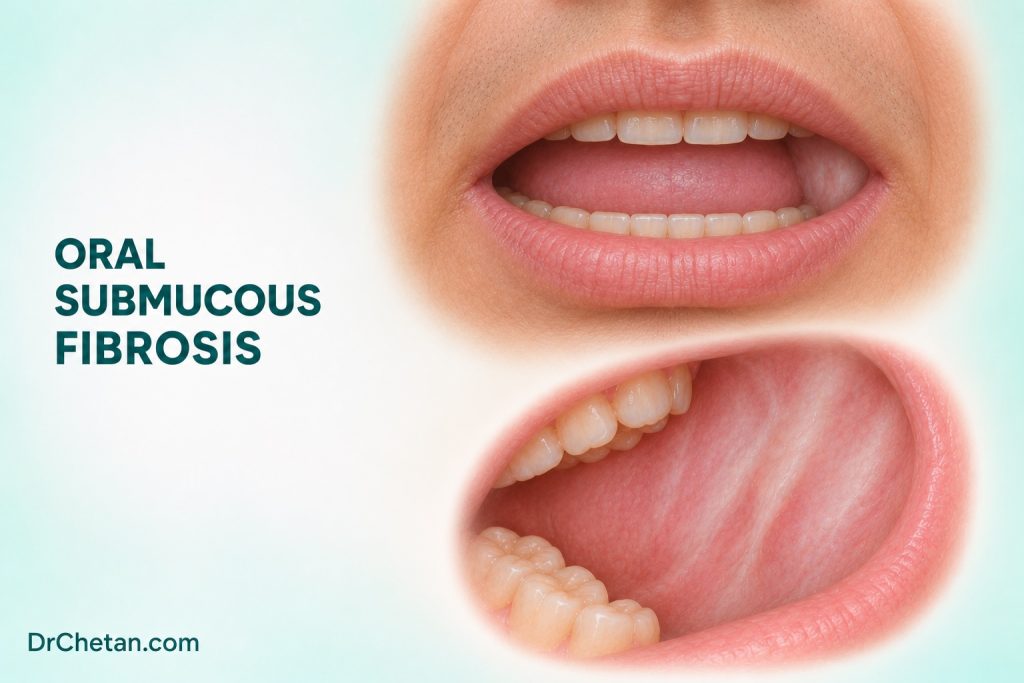
A patient with oral submucous fibrosis (OSF) can open slightly wider after treatment but still has a new sore along the buccal mucosa. The improved measurement is useful for rehabilitation. The sore requires a separate assessment. Management has several concurrent goals: stop areca exposure, reduce symptoms, improve usable function where possible, and monitor the mucosa for suspicious change. A plan is more useful when it names the goal of each intervention and records who will follow it up.
Start with a baseline the next clinician can reproduce
Record current and previous areca preparations, how often they are used, whether tobacco is included and what has changed since diagnosis. Ask about burning, food tolerance, eating, speech, oral hygiene and access for dental care. Measure maximum interincisal opening in millimetres with reproducible landmarks. Record whether pain or another factor limited the effort. If the incisors are missing or altered, document the method used so later measurements can be interpreted.
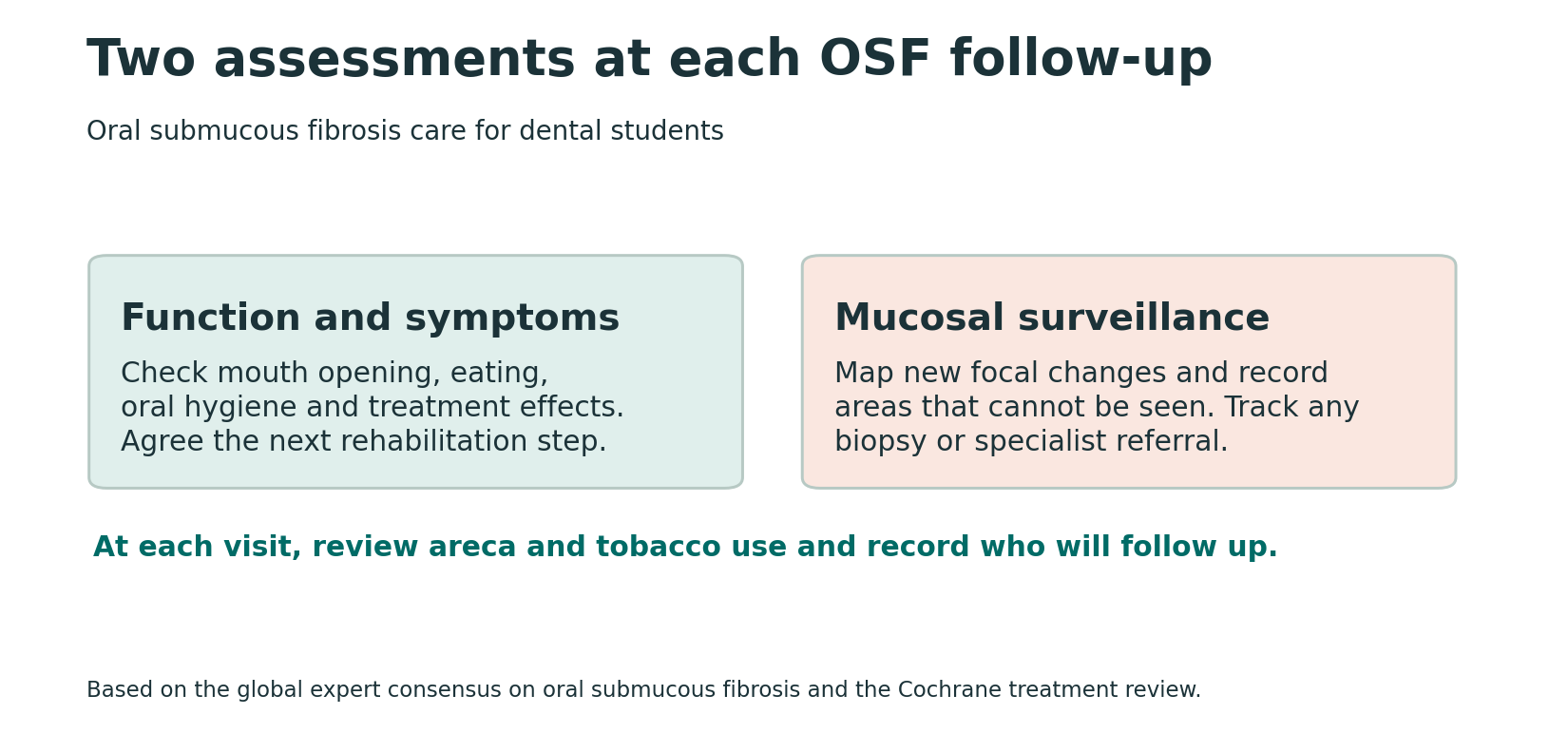
Examine the accessible mucosa for blanching, bands and focal abnormalities. Describe any red or white change, ulceration, mass or firmness separately from the background fibrosis. Record the surfaces that cannot be seen. A restricted examination is useful information for the receiving clinician and can change how assessment is arranged. Compare measurements and photographs only when their methods and sites are sufficiently clear.
| Care goal | What to document | What to compare at follow-up |
|---|---|---|
| Stop exposure | Areca and tobacco products, use patterns and cessation support | Which products stopped, whether substitution occurred and barriers to quitting. |
| Relieve symptoms | Burning, food triggers and effects on daily activities | Patient-reported change and adverse effects of treatment. |
| Improve function | Opening in millimetres, landmarks, mobility and practical limitations | The same measure plus what the patient can now do more easily. |
| Assess cancer risk | Mucosal findings, examination limits, prior pathology and outstanding referrals | New or evolving focal changes and the status of diagnostic assessment. |
Address areca use and nicotine dependence separately
Areca nut is the principal established exposure associated with OSF. A patient may use tobacco-free supari or pan masala and still need help to stop areca. Ask when the product is used and what purpose it serves, such as a social routine or habit after meals. Agree a practical next step and ask about substitution at follow-up. For people using mixed tobacco and areca products, address both exposures. A cessation clinician can assess nicotine dependence and appropriate evidence-based tobacco treatment.
Cessation reduces ongoing exposure. It can be valuable even when longstanding stiffness remains. Explain that symptoms and mouth opening can change at different rates and that the patient needs a plan for reassessment. Where food intake or oral hygiene is affected, coordinate practical support and appropriate referral. A recommendation should account for what the patient can do given their current opening and symptoms.
Explain what treatment evidence can support

The Cochrane review evaluated interventions including systemic agents, injections, physiotherapy and surgery. It found moderate-certainty evidence that systemic antioxidants probably improve opening slightly at three to six months and improve burning scores in the settings studied. Longer-term improvement in opening was uncertain. Many other comparisons had low or very low certainty, and reporting of adverse effects was limited. The review’s findings do not identify one product or regimen that fits every patient.
Intralesional corticosteroids, hyaluronidase and other medicines appear in clinical practice and in studies. Choice depends on diagnosis, symptoms, severity, medical context and specialist judgement. Comparative evidence is uncertain for several regimens. Discuss what outcome is being targeted and how benefit and harms will be monitored. Symptom relief, opening and cancer outcomes are different endpoints. An intervention studied for burning or opening has not thereby been shown to reduce malignant transformation.
Fit rehabilitation to what the patient can use
A supervised exercise programme may be included in a functional plan. The clinician establishes a safe starting point, explains the technique and checks whether the patient can repeat it. Track discomfort and adherence as well as measurements. Evidence on the comparative effect of physiotherapy in the available trials is uncertain. Its role can differ in conservative care and after surgical release, where rehabilitation is planned by the treating team. Avoid forcing movement in the presence of new pain or an unexplained acute change.
Selected patients with severe functional restriction may be assessed for surgery. The operation, reconstruction and rehabilitation depend on the pattern of restriction, patient fitness and the team’s experience. Potential benefit must be weighed against procedure morbidity, recurrence or loss of opening and the ability to participate in follow-up. An opening measurement is one factor. Eating, oral hygiene, ability to receive dental care and the patient’s own priorities matter too.
Set measurable goals and review them together
A plan might record comfortable eating as the patient’s main goal and use interincisal opening as one outcome. Ask which foods or activities are restricted, whether soreness affects home care and whether the patient can attend the proposed appointments. A change of a few millimetres may matter differently depending on the starting point and the activity. Record the measurement conditions and the patient’s description of what has changed.
At review, ask which part of the plan the patient was able to follow. Exercises, cessation support, nutrition advice and a biopsy referral can all be due at once. Clarify the next action for each rather than leaving a general instruction to return if needed. If treatment has caused discomfort or new symptoms, record it and coordinate assessment with the treating service before changing the plan. This separates adverse effects from progression and keeps the patient’s priorities visible.
Keep mucosal surveillance active
OSF is an oral potentially malignant disorder. The follow-up plan should include examination of the accessible mucosa, comparison with earlier records and a route for earlier assessment if a focal finding changes. A persistent ulcer, new red or white patch, mass, induration or concerning cervical lump needs its own evaluation. If the patient’s opening prevents adequate inspection, describe the unseen region and coordinate specialist assessment rather than assuming the entire mouth has been cleared.
Give the patient a definite follow-up plan. Interval decisions depend on the clinical and histological findings, prior changes and access to care. Record who will examine the patient and who will check biopsy results or referral attendance. A previous sample confirming fibrosis does not establish the diagnosis of a new focus elsewhere. Likewise, a successful rehabilitation session does not determine whether a red or indurated area has become less concerning.
If the patient has difficulty reaching a specialist or physiotherapist, agree who will check access and when. A dental visit can still record exposure, symptoms, function and suspicious changes while the longer-term rehabilitation plan is being coordinated. Keep the diagnostic referral prominent if a focal finding is the reason for urgency.
Apply the plan to two follow-up visits
Opening improves, but a new ulcer appears. The patient reports easier eating and the measured opening increases. A focal ulcer has appeared posteriorly and cannot be fully seen. Document the functional gain and the examination limit separately. Arrange prompt specialist assessment when the ulcer is suspicious. Give the receiving clinician the site and any prior reports. Continue to record rehabilitation progress alongside the diagnostic plan.
The patient stops gutka and continues supari. Ask what led to the substitution and how often the patient now uses areca. Explain why both the tobacco exposure and areca habit matter. Agree a feasible step for the remaining product, and arrange tobacco support if the person is still using nicotine. At the next visit, compare the exposure record, opening, symptoms and any mucosal change.
A useful review note records progress in each domain rather than summarising the whole visit as “better” or “stable.” That lets the next clinician identify what is improving, what requires more support and which diagnostic action is due.

Leave a Reply