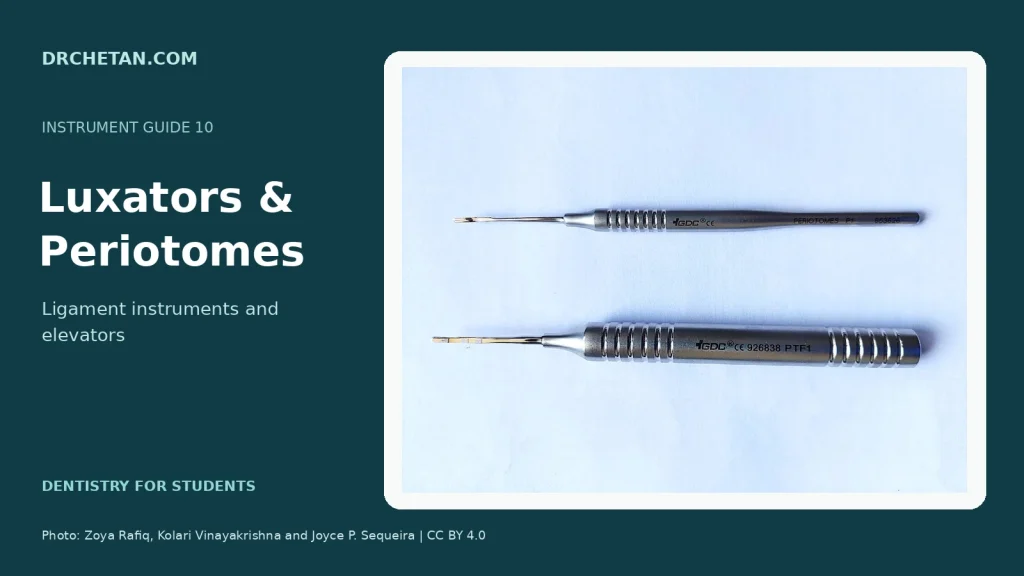
Luxators, periotomes and extraction elevators are often grouped together, but their blades and intended actions differ. Learning those differences is essential: a fine periodontal-ligament instrument should not automatically be treated like a heavy elevator.
A learning guide for dental students. Clinical instrument use requires practical training and supervision.
Start with the periodontal ligament
The periodontal ligament connects the root surface to the surrounding alveolar bone. Instruments designed to sever its fibres can assist tooth removal while aiming to limit unnecessary tissue damage. This explains why some extraction instruments have very thin, sharp blades.
The word luxation describes movement or loosening; it is not a guarantee that every instrument sold with a similar name has the same design. Identify the exact product and its instructions before assigning a technique to it.
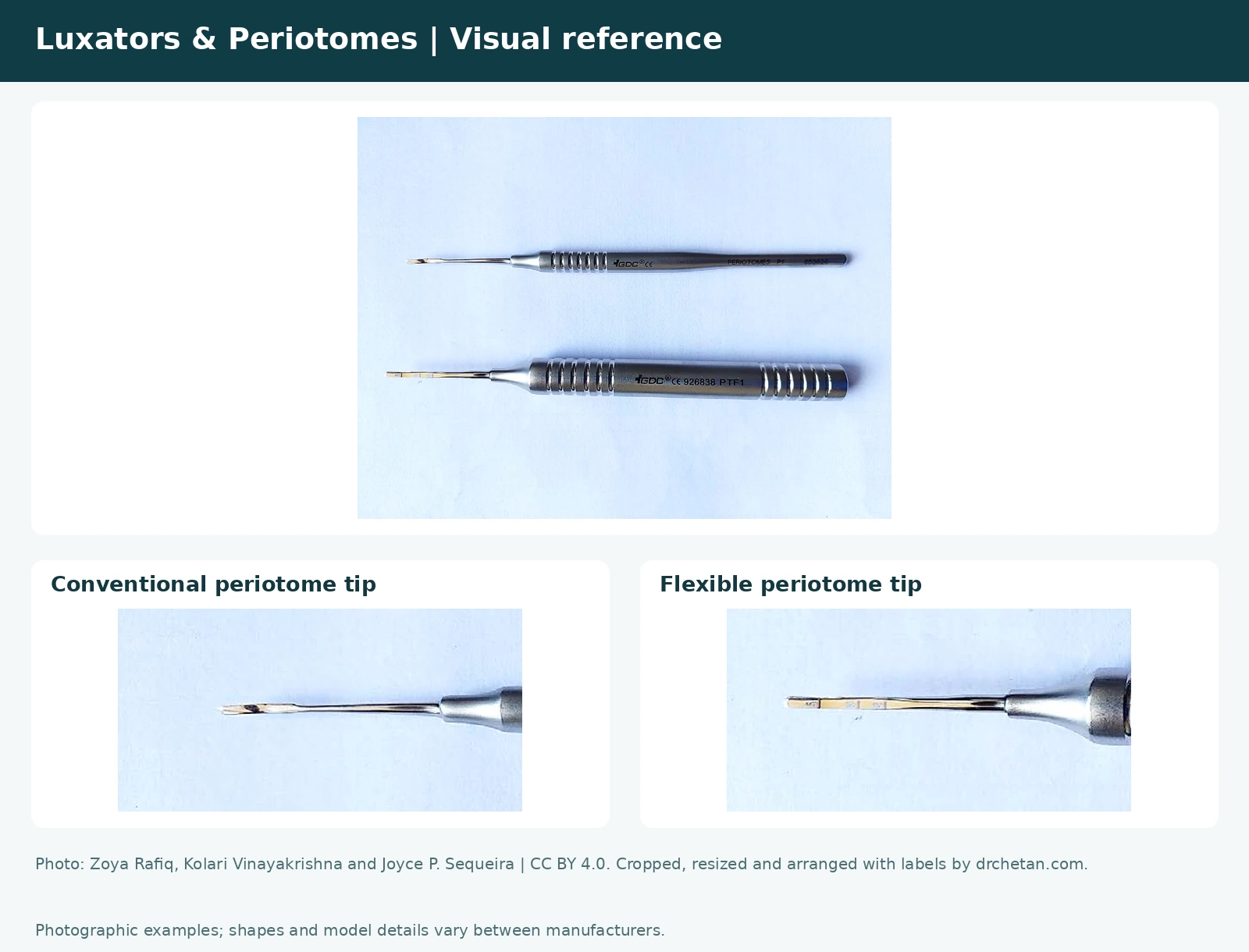
Photographic reference
Compare the instrument families
| Instrument | Principal design emphasis | Key limit |
|---|---|---|
| Periotome | Fine blade for severing periodontal ligament fibres | Do not assume it tolerates the leverage intended for an extraction elevator. |
| Luxating instrument | Often a thin blade intended to assist ligament separation and controlled luxation | The term covers different designs; follow the exact model’s instructions. |
| Conventional root elevator | A blade and shank designed for the specified tooth or root elevation task | Not interchangeable with every thin-bladed instrument. |
| Periosteal elevator | Working ends for reflecting and retracting mucoperiosteal tissue | Different tissue plane and principal purpose. |
Thickness alone is not a complete classification system. Blade geometry, material, shank design and manufacturer instructions all matter. A large handle may improve grip but does not prove that a fine tip can withstand strong leverage.
Luxator Periotome and Luxator Forte are different
Luxator® is a Directa product name. Its Luxator Periotome is a periodontal-ligament instrument; Directa explicitly states that it is not intended to be used as an elevator. Levering with that thin blade can damage it.
Luxator Forte Elevator is a separate instrument designed for elevation. Therefore, “all Luxators must never elevate” is also an inaccurate rule. State the full product name and intended function.
Other manufacturers use terms such as luxating elevator for their own designs. Their indications cannot be inferred solely from Directa’s naming system.
Straight, curved and narrow blades
Blade shape and width influence access around a root. A curved or angled end may reach a surface that is difficult to approach with a straight instrument. A narrower blade may suit a restricted space, but narrow does not automatically mean safer.
For a student identification exercise, inspect the blade from more than one view: is it straight or curved, how does it taper, and is it a thin ligament-cutting design or a specified elevator pattern? Then connect those findings to the manufacturer’s description.
Bone preservation is an aim, not a promise
Appropriate instrument selection is one part of extraction planning. Root anatomy, tooth condition, access, bone characteristics and operator skill also affect the outcome. No instrument can guarantee an “atraumatic” extraction or eliminate the need for surgical access when indicated.
Inspect tips for bending, chips or other damage and remove damaged instruments from use. Reprocess and maintain them according to their specific instructions. Do not improvise sharpening on an unfamiliar blade or assume a technique demonstrated for one model applies to another.
Viva answer: identify the exact instrument, explain whether its principal role is ligament severance or elevation, and state one limitation. That is more reliable than calling every extraction instrument a luxator.
Frequently asked questions
Is a periotome an elevator?
Its principal role is severing periodontal ligament fibres. Some extraction designs overlap in function, so the exact product instructions determine its permitted use.
Can a Luxator Periotome be used for leverage?
Directa states that this model is not intended for use as an elevator. It should not be used as though it were a Forte Elevator.
Is Luxator Forte the same instrument?
No. Luxator Forte is a separate elevator design in the same brand range.
Are curved blades always better?
No. Blade selection depends on the intended access and the particular instrument’s indications.
Does using a periotome guarantee bone preservation?
No. The instrument may assist a tissue-preserving approach, but anatomy, planning and technique still determine the result.
References and further reading
- Directa: Luxator Periotome and its limitations
- Directa: Luxator Forte Elevator
- HuFriedyGroup: periotome information
- HuFriedyGroup: extraction instrument selection
Explore more dental instrument guides and articles for dental students.
Featured-image photograph: Zoya Rafiq, Kolari Vinayakrishna and Joyce P. Sequeira — source photograph (CC BY 4.0). Resized and arranged with title; adapted visual: CC BY-SA 4.0.

Leave a Reply