“My teeth were fine before cleaning. Now they feel different. Did scaling damage them?” This is a common worry, particularly after a first cleaning or treatment for gum disease.
Professionally performed scaling is intended to remove plaque and hardened deposits, rather than grind away healthy teeth. However, the type of cleaning, your gum health and what you feel afterwards all matter. New symptoms deserve an explanation rather than an automatic reassurance that everything is normal.
What does scaling actually remove?
Plaque is the soft bacterial film that repeatedly collects on teeth. When deposits harden into calculus, also called tartar, brushing at home cannot reliably remove them. A dental professional uses suitable instruments to remove these deposits.
Think of cleaning as removing material sitting on a surface. It does not replace a filling in a cavity or rebuild the bone already lost through advanced gum disease. Ask the dentist to show you where deposits are present and explain what they recommend.
Polishing may follow when appropriate to remove some surface staining and smooth the cleaned surfaces. A cleaner appearance does not mean that the underlying natural tooth colour has been chemically whitened.
A routine cleaning and deep gum treatment are different
A routine scale and polish addresses deposits on the teeth. When gum disease has created deeper pockets around teeth, cleaning below the gumline may be needed. This is often called deep cleaning, scaling and root planing, or periodontal treatment.
Deeper treatment may involve local anaesthetic and more than one appointment. The dentist assesses the gums and supporting tissues, explains the treatment and reviews the response. Someone with established periodontitis may need ongoing periodontal maintenance.
Before comparing your experience with a friend’s painless ten-minute visit, check whether you had the same procedure. The label “cleaning” can conceal quite different appointments.
Does scaling remove enamel or make teeth thinner?
The purpose of scaling is to remove deposits, not to reshape the teeth. Professional cleaning uses instruments selected for the surfaces being treated. It is reasonable to ask what will be cleaned, especially if you have exposed roots, implants, veneers or other restorations.
This does not mean that every technique or every procedure is completely without risk. If you notice a sharp edge, a damaged restoration, persistent pain or another new problem, return for assessment. Symptoms cannot be checked through a general article.
Do not try to reproduce scaling with a metal pick or a home device bought online. Good home care and professional deposit removal are different tasks; let the dental team show you the cleaning aids appropriate for your mouth.
Why can gaps appear or teeth feel different afterwards?
With advanced gum disease, teeth may already have lost supporting bone and the gums may be swollen. After treatment, reduced inflammation can leave more root surface visible and the spaces between teeth more noticeable. The extent varies with the original disease.
Removing deposits and allowing inflamed tissues to settle does not regenerate missing bone. A newly visible space therefore needs an explanation based on the examination, rather than an assumption that the cleaning cut a gap between teeth.
If a tooth is loose, ask the dentist to assess its support and prognosis. Gum disease can make teeth mobile; leaving deposits in place is not a treatment for that loss of support. Equally, do not dismiss a new change in mobility without having it checked.
Is sensitivity after scaling normal?
Temporary sensitivity and gum tenderness can occur, particularly after deeper gum cleaning. Exposed root surfaces may react to cold or brushing. Symptoms should be manageable and should improve; the expected recovery depends on the procedure and your starting condition.
Use a soft brush and gentle technique. The dental team may suggest a toothpaste for sensitivity or another treatment. Follow the product directions consistently rather than repeatedly testing the tooth with iced water.
Get advice for severe pain, sensitivity concentrated in one tooth, symptoms that worsen or symptoms that do not settle as expected. Decay, cracks or another problem may need investigation. Sensitivity toothpaste should not be used to postpone that assessment.
Does bleeding mean cleaning injured healthy gums?
Inflamed gums commonly bleed, and tenderness or some bleeding can occur after deeper periodontal treatment. Ask for individual instructions about gentle cleaning during recovery. Avoid forceful scrubbing, but do not abandon plaque control simply because the gums bled once.
Continuing bleeding should be discussed with the dental team. Tell them about your medicines and medical history; do not independently stop prescribed medication before a cleaning.
Describe what is happening plainly: a small spot when brushing is different from bleeding that continues without stopping. Heavy or persistent bleeding needs prompt professional advice.
How often do you need scaling?
There is no cleaning schedule that suits every mouth. The decision depends on your gum condition, deposits, ability to clean and response to previous treatment. Ask when you should return and what the next appointment is intended to achieve.
A routine dental check-up interval is also not the same as a periodontal treatment or maintenance schedule. NICE recommends choosing routine review intervals according to disease risk, rather than automatically using one interval for everyone.
If someone tells you that all adults must have exactly the same cleaning twice a year, ask for the recommendation for your own teeth and gums.
What to do after the appointment
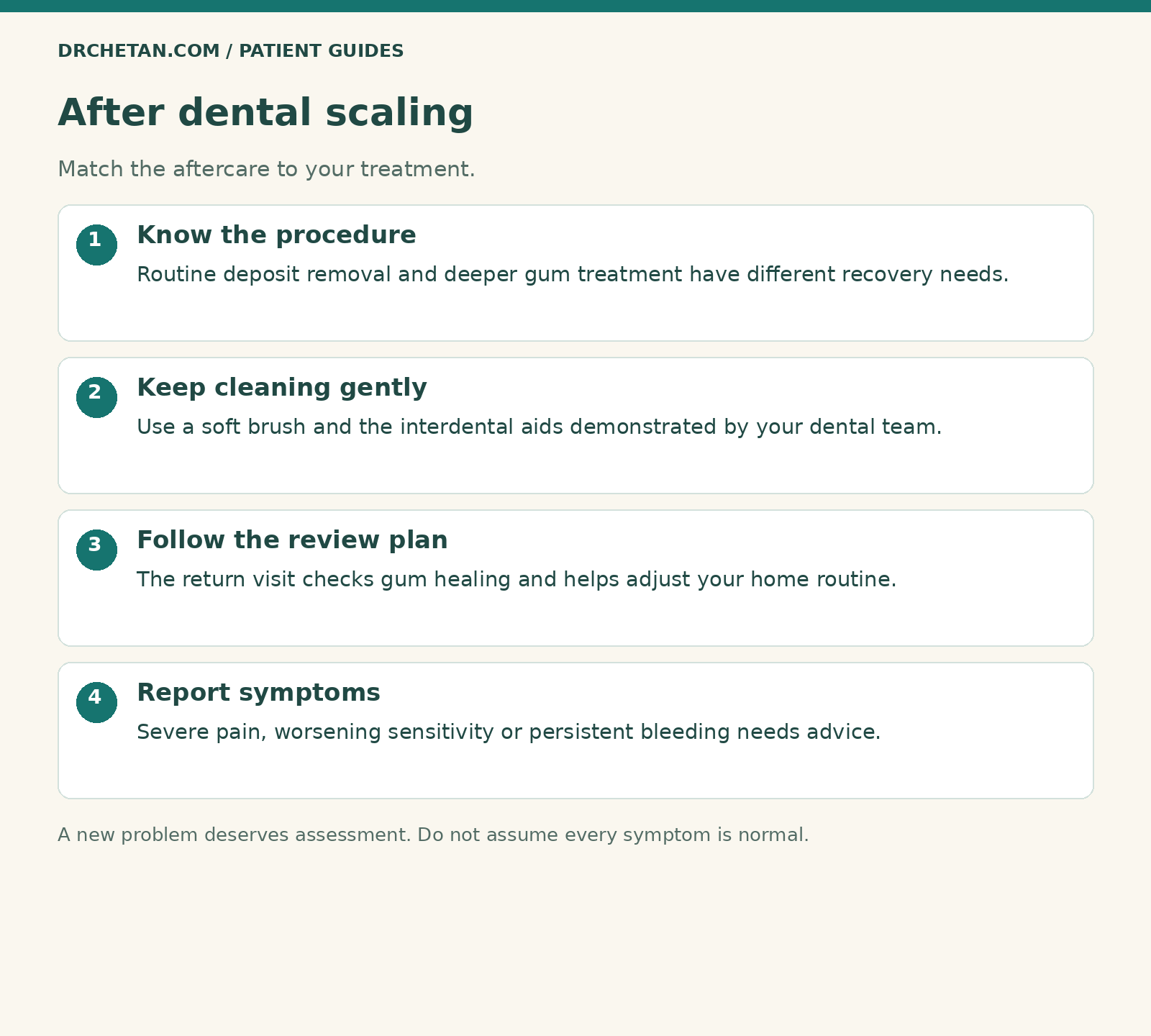
- Follow the instructions for the treatment you actually received.
- Keep brushing gently twice daily with fluoride toothpaste and clean between teeth with suitable aids.
- Ask which interdental brush sizes fit; do not force a large brush through a tight space.
- Attend the planned review so gum healing and cleaning technique can be checked.
- Call if pain worsens, a tooth feels unusually loose or something sharp or broken is bothering you.
A useful question before leaving is: “What changes should settle, and what changes mean I should call you?” Write down the answer if you are unsure you will remember it.
Questions patients often ask
Can I remove tartar by brushing harder?
Harder scrubbing is not a substitute for professional removal of hardened deposits. Ask the team to demonstrate effective plaque control without excessive pressure.
Will scaling permanently stop deposits returning?
No. Daily cleaning and follow-up still matter because plaque continues to form. The appointment and your home routine work together.
Should I tolerate pain because the dentist said cleaning is safe?
Tell the clinician if you are uncomfortable during treatment. Afterwards, report severe or persistent symptoms rather than assuming you must endure them.
References and further reading
- NHS: Dental treatments
- NHS: Gum disease
- Oral Health Foundation: Caring for my teeth and gums
- ADA MouthHealthy: Scaling and root planing
- Guy’s and St Thomas’ NHS: Managing advanced gum disease
- Oral Health Foundation: Sensitive teeth
- NICE: Dental checks and recall recommendations
Sources checked 30 October 2026. This is general patient information. An examination and individual advice may be needed.

Leave a Reply