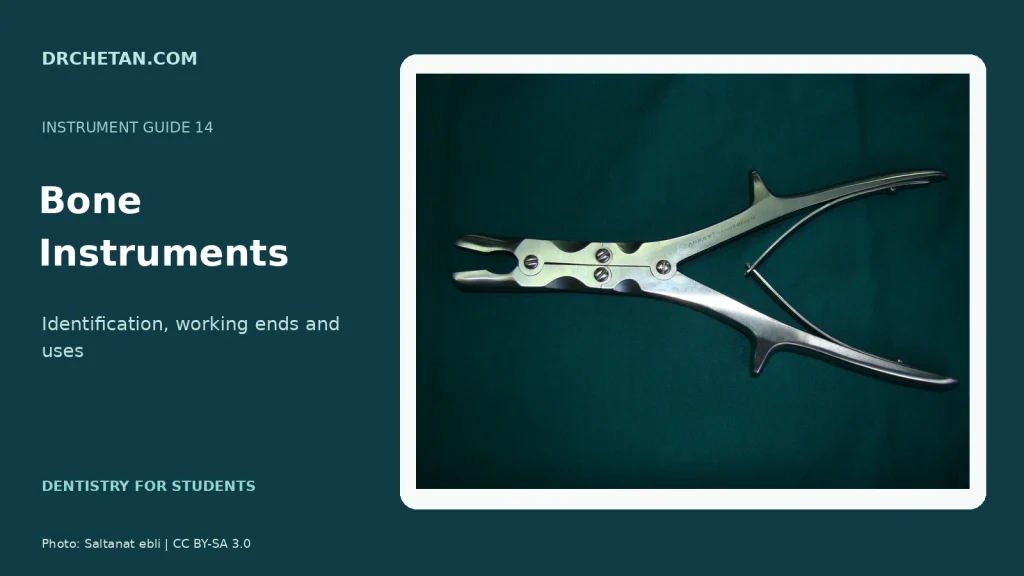
A rongeur cuts small portions of bone, a bone file refines a bony surface, and a surgical curette has a scoop-like working end for indicated debridement. Recognising how the working end acts helps separate these easily confused surgical instruments.
A learning guide for dental students. Clinical use requires practical training and supervision.
Photographic reference
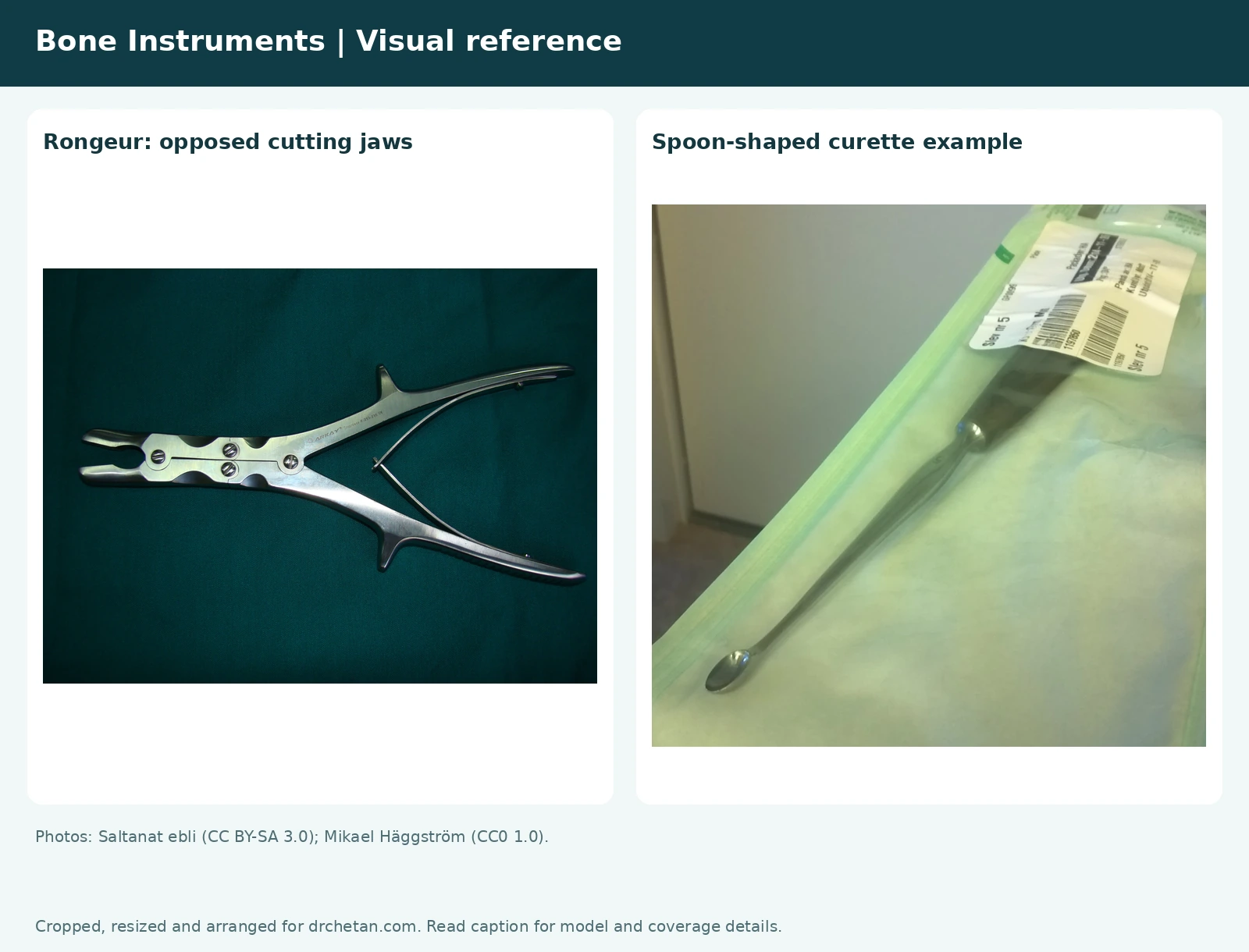
Three instruments, three different actions
| Instrument | Working-end clue | Broad action |
|---|---|---|
| Bone rongeur | Opposed cutting jaws operated by handles | Bites or nibbles small portions of bone |
| Bone file | Abrasive or toothed working surface on a hand instrument | Refines and smooths an accessible bony surface |
| Surgical curette | Concave spoon or scoop with a cutting rim | Removes selected tissue or debris when debridement is indicated |
“Used in a socket” is not a sufficient description to identify an instrument. Explain whether it cuts bone, files a surface or scoops selected material. These actions are not interchangeable.
Bone rongeurs: recognition and patterns
Rongeurs resemble heavy forceps or nippers. Look for the cutting edges at the jaws and, in many designs, a spring between the handles. Patterns differ in jaw size, angle and whether they cut at the end, the sides or both. Single- and double-action mechanisms also exist.
Friedman is one pattern commonly encountered in dental instrument catalogues. Do not call every small rongeur a Friedman: compare the jaw profile with the manufacturer’s illustration. The photograph here demonstrates the rongeur family without assigning an unverified dental pattern.
A rongeur is not an extraction forceps. Its purpose is to cut suitable small portions of bone, not grip a tooth for extraction. Excessive bites or an unsuitable instrument can remove more bone than intended or damage the instrument. The need for bone removal is a clinical decision.
Bone files: recognition and surface refinement
A bone file is commonly a double-ended hand instrument with a textured cutting surface. The working ends may differ in width, curvature and tooth arrangement. Miller and Miller–Colburn names occur in dental catalogues; straight-cut and cross-cut versions are available.
The important distinction is between surface refinement and removal of a larger bulk of bone. A file is intended to refine an accessible surface; it is not simply a substitute for every task performed by a rongeur or rotary surgical instrument.
File tooth direction and design influence the effective stroke. Avoid a universal rule that every file must always cut on the same push or pull motion. Follow the instructions for the exact instrument and the technique taught under supervision.
Surgical curettes and Lucas patterns
A surgical curette has a concave working end with a cutting rim. Lucas curettes are common double-ended examples supplied in different working-end sizes. The number identifies a pattern in a manufacturer’s range; it should not be treated as a universal measurement across brands.
Manufacturer descriptions include selected socket debridement, curettage and cyst-removal tasks. These are indications for a trained clinician, not instructions to scrape every extraction socket. Whether debridement is needed depends on diagnosis, what is present, access and nearby anatomy.
Routine aggressive scraping of a socket is not justified merely because a curette is on the tray. Tissue preservation and protection of adjacent structures remain central. This article does not describe how to perform cyst surgery or socket curettage.
Do not confuse these working ends
- Surgical curette versus spoon excavator: both can look spoon-like, but the excavator is a restorative instrument used for selected carious dentine removal. Confirm the instrument’s intended use and scale.
- Surgical curette versus periodontal curette: a periodontal curette has a blade adapted to root-surface instrumentation, rather than the obvious surgical scoop profile.
- Bone file versus periodontal file: both have multiple cutting features, but they have different intended sites and designs.
- Rongeur versus forceps: cutting jaws support rongeur identification; a general resemblance to pliers is not enough.
Inspection, care and practical-exam answer
Check working ends for defects and ensure the mechanism or handle is sound according to the manufacturer’s inspection instructions. Worn cutting edges, damaged springs and corrosion can impair control. Reusable surgical instruments require validated cleaning and sterilisation; visible cleanliness alone does not mean sterility.
Practical answer: “This is a surgical curette. It has a concave scoop-like working end with a cutting rim. It is intended for selected surgical debridement; it differs from a bone file, which has a textured filing surface.”
For bone files and specific Lucas sizes that are not photographed in this guide, use the linked manufacturer pages to compare the named designs. Do not assign those names to an unrelated instrument photograph.
Frequently asked questions
What is the difference between a rongeur and a bone file?
A rongeur cuts small portions of bone with opposing jaws. A file refines a surface with its textured working end.
Is a surgical curette a type of periodontal scaler?
No. Surgical curettes and periodontal scaling instruments have different working-end designs and intended uses.
Should every socket be curetted after extraction?
The presence of a curette does not establish an indication. Debridement depends on the clinical findings and the clinician’s judgment.
Are Lucas curette numbers universal sizes?
No. Check the manufacturer’s stated working-end dimensions rather than transferring numbers between brands.
Do all bone files cut in the same direction?
Do not assume that. Tooth arrangement varies; use the specified technique for the actual instrument.
References and further reading
- HuFriedyGroup: 64 Miller bone file
- HuFriedyGroup: Miller–Colburn bone file
- HuFriedyGroup: Lucas 85 surgical curette
- HuFriedyGroup: Lucas 86 surgical curette
Featured-image photograph: Saltanat ebli — source photograph (CC BY-SA 3.0). Resized and arranged with title. Adapted visual: CC BY-SA 4.0.
Explore more dental instrument guides and articles for dental students.

Leave a Reply