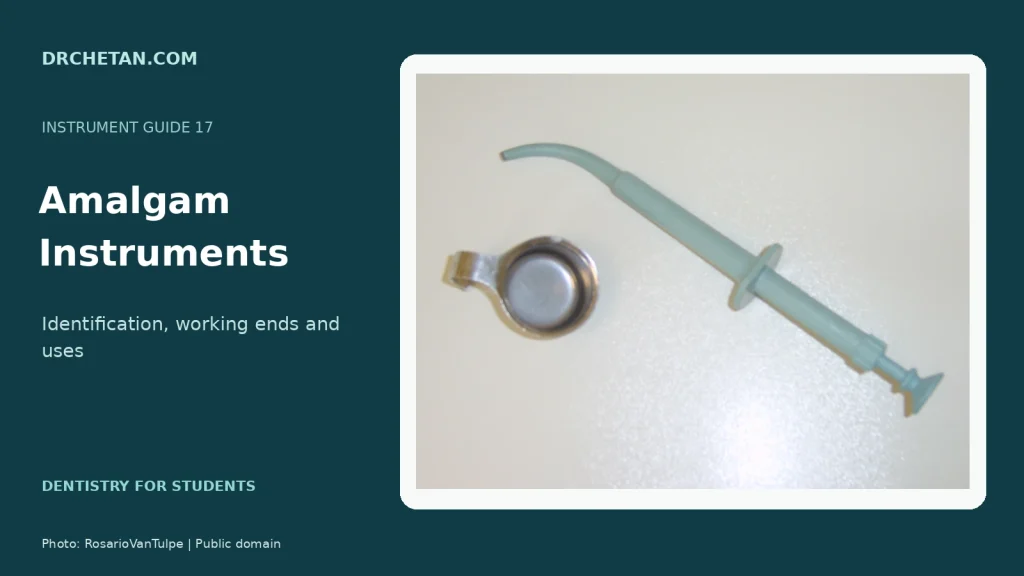
An amalgam carrier transports material, a condenser packs it, and a carver removes excess to develop the restoration’s form. Linking each instrument to that action makes this group much easier to recognise.
A learning guide for dental students. Clinical instrument use requires practical training and supervision.
Photographic reference
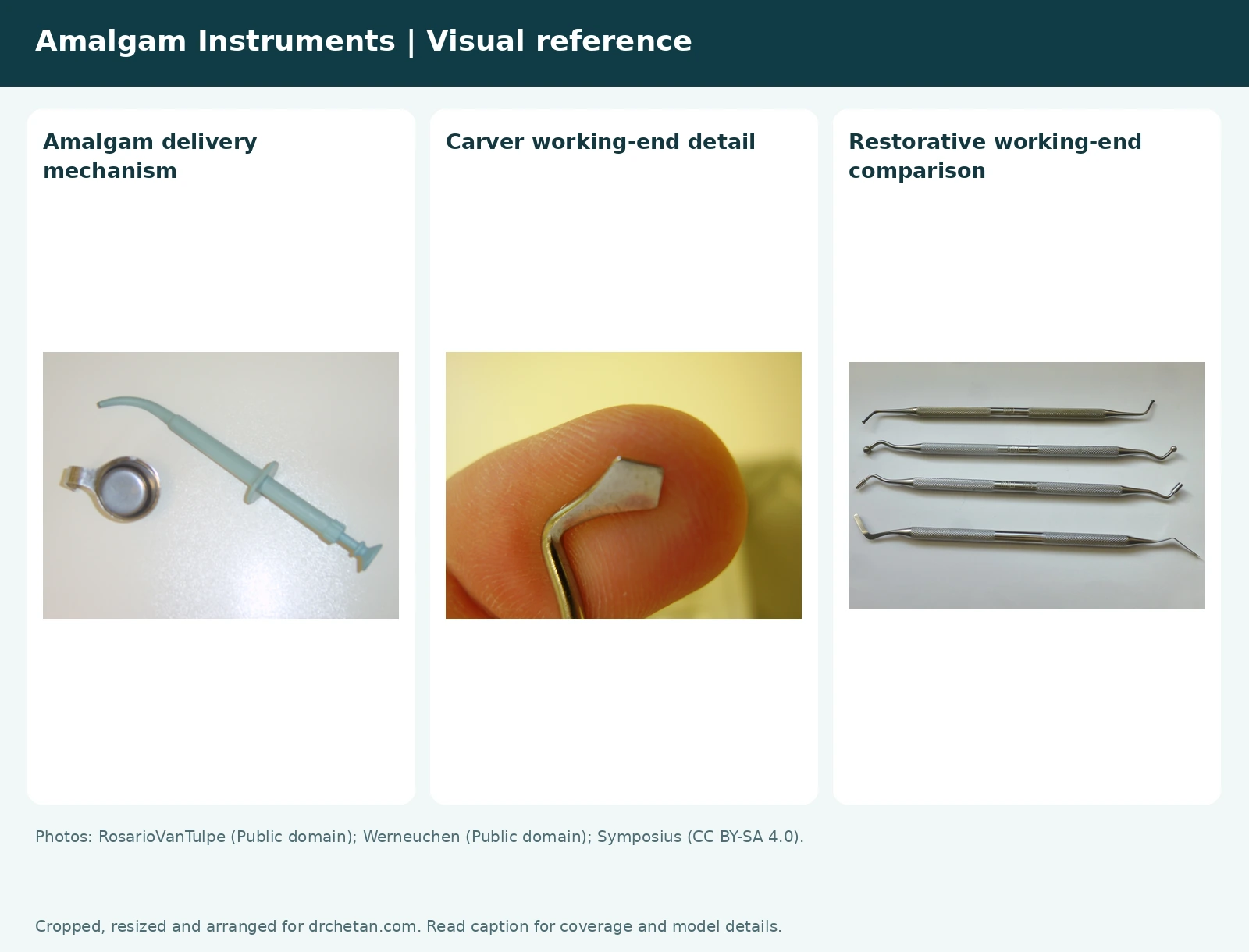
The core distinction: transport, pack and shape
| Instrument | Working-end clue | Primary task |
|---|---|---|
| Amalgam carrier | Hollow delivery barrel and a plunger or lever mechanism | Transfers and dispenses amalgam |
| Condenser / plugger | Terminal packing face, which may be smooth or serrated | Packs and adapts suitable material |
| Carver | A shaped blade with a cutting edge | Removes excess and develops contours |
| Burnisher | Smooth rounded working surface | Adapts or smooths selected contours |
Think of these as different tasks, not an instruction to pick up every instrument in a rigid order. Actual use depends on the material, stage of treatment and supervised clinical technique.
Amalgam carriers: recognise the delivery mechanism
A carrier has a delivery end that contains a small quantity of mixed amalgam. Activating its mechanism expels the material. Designs include single-ended and double-ended carriers, with delivery barrels of different capacities or angles. The hollow dispensing end separates it from a solid plugger.
A carrier is not a condenser. Dispensing material into a preparation does not, by itself, achieve the adaptation and compaction required by the restorative technique. It is also not an anaesthetic syringe: similar-looking plungers do not establish the same purpose.
After use, remaining material must be dealt with promptly according to the instrument and waste-handling instructions. Allowing amalgam to set within a delivery barrel can obstruct the mechanism. Do not force an obstructed plunger or improvise a cleaning method that could damage the instrument.
Condensers and pluggers
In restorative teaching, “condenser” and “plugger” are often used for instruments that press or pack material with a terminal face. Faces may be round, oval or otherwise shaped, and smooth or serrated. Different ends allow access and contact areas suited to different locations.
Named patterns include Black, Hollenback and other manufacturer-specific designs. A name alone is not sufficient: a Hollenback plugger and a Hollenback carver are different instruments. Inspect the working end and its surface before answering.
Do not assume that greater force is always better or that one tip is appropriate for every material. The applied pressure depends on the force and the area of contact, while clinical selection also depends on access and the material’s properties. This guide deliberately does not prescribe a universal condensation pressure.
Common carver patterns
| Pattern | Recognition point | Broad role |
|---|---|---|
| Hollenback | A slender, pointed blade-like working end; versions and sizes vary | Carves and refines suitable restorative contours |
| Discoid–cleoid | A disc-like end paired with a claw-like or pointed end | Develops occlusal contours and anatomy |
| Ward and other knife-like patterns | Flatter or broader cutting blade profiles | Removes or refines selected excess material |
| Interproximal carver | Thin working end designed for access near proximal surfaces | Refines selected proximal contours |
The cutting edge matters more than the handle. A narrow blade that looks rounded in one photograph may still be a carver. Conversely, a smooth rounded burnisher should not be identified as a carver solely because it can help shape anatomy.
Understanding the anatomy being shaped
Carving aims to reproduce appropriate contours, including marginal ridges, fossae and grooves, while avoiding excess or deficient material. A deeply scratched groove is not automatically good anatomy. The final surface must be assessed in relation to adjacent teeth, contacts and occlusion by the treating clinician.
A matrix helps control proximal form, but the presence of a band does not guarantee a correct contact or cervical seal. Likewise, a carver cannot correct every defect caused by an unstable matrix or poor material handling.
Why students still learn these instruments
These instruments remain relevant to practical examinations, preclinical training and recognising existing restorations. Studying them does not mean amalgam is the appropriate material for every patient. Material selection, mercury handling and waste management must follow the applicable guidance and clinical setting.
Learning about amalgam is also not a reason to remove an existing sound restoration. The FDA advises against removal of intact amalgam fillings solely to prevent disease when there is no clinical need. That advice is distinct from deciding which material to use for a new restoration.
Viva checklist and care
- Identify the hollow barrel, terminal face, cutting edge or smooth tip.
- Name the family before giving a specific pattern.
- Explain the intended action in one sentence.
- Check for worn edges, blocked mechanisms, corrosion or damage.
- Follow the validated reprocessing instructions; never assume every component has the same reuse status.
Viva example: “This is a discoid–cleoid carver. Its complementary disc-like and pointed working ends help develop suitable restorative anatomy. It removes or refines material rather than transporting it like an amalgam carrier.”
Frequently asked questions
Are a plugger and a carver the same?
No. A plugger has a packing face, whereas a carver has a cutting edge for shaping and removing excess.
Are all condensers serrated?
No. Smooth and serrated designs are available. Check the actual working face.
What does discoid–cleoid describe?
The complementary disc-like and claw-like or pointed working ends of a carver.
Does a carrier condense amalgam?
Its main role is transport and dispensing. Condensation is a separate task.
Should old amalgam fillings be removed because newer materials exist?
A sound filling does not automatically need replacement. Assessment depends on its condition and the patient’s clinical needs.
References and further reading
- HuFriedyGroup: amalgam carriers
- HuFriedyGroup: pluggers and condensers
- HuFriedyGroup: carvers
- HuFriedyGroup: Hollenback carver example
- FDA: dental amalgam fillings
Featured-image photograph: RosarioVanTulpe — source photograph (Public domain). Resized and arranged with title. Adapted visual: CC BY-SA 4.0.
Explore more dental instrument guides and articles for dental students.

Leave a Reply