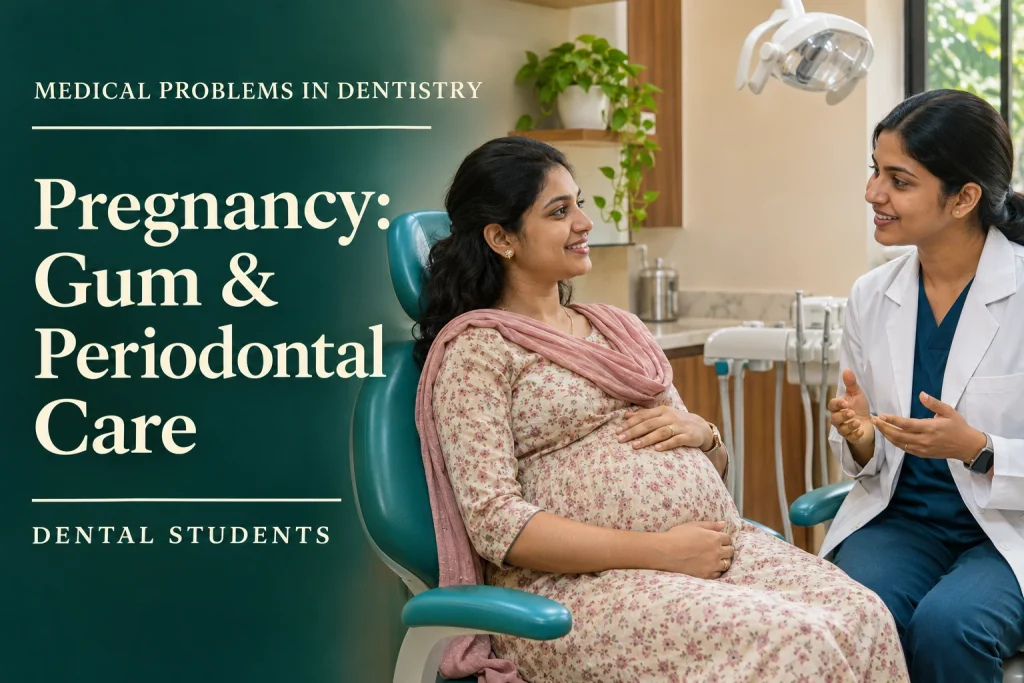
Medical Problems in Dentistry: Article 176 of 215 · Women's health · Complete student guide
Medical Problems in Dentistry · Student guide
Pregnancy can modify the gingival response to plaque, but it does not make every swollen or bleeding gingiva the same disease. Students should examine the periodontal tissues, describe any local lesion and offer appropriate care without automatically postponing treatment until after delivery.
In this guide: Learning objectives · Start with this clinical case · Explain the plaque–hormone relationship accurately · Distinguish gingivitis from attachment loss · A gingival mass needs a differential · Translate findings into separate decisions · Provide appropriate care during pregnancy · Discuss obstetric associations honestly · Review rather than assume resolution · Viva and self-check
Learning objectives
- Explain the relationship between plaque and pregnancy-associated gingival inflammation.
- Assess a local gingival mass without assuming it is harmless.
- Counsel about periodontal care without promising obstetric benefits.
Start with this clinical case
Fictional teaching case. A pregnant patient reports bleeding on brushing and a red gingival swelling that bleeds easily. She has stopped cleaning the area because she fears harming the pregnancy. A student calls everything “pregnancy gums” and advises waiting until delivery. What needs examination and what can be addressed now?
Explain the plaque–hormone relationship accurately
Pregnancy-associated hormonal changes can accentuate the inflammatory response to plaque bacteria. This does not mean that bleeding is unavoidable, that hygiene is useless or that pregnancy itself establishes periodontitis. Assess plaque, local irritants, gingival inflammation and the patient’s cleaning difficulties.
The ADA pregnancy guidance recognises gingival and periodontal concerns and supports appropriate oral care. Use the explanation to make prevention understandable, not to blame the patient for symptoms or to dismiss them as an expected part of pregnancy.[PREG]
Distinguish gingivitis from attachment loss
Take a periodontal history and perform an appropriate examination. Ask about previous periodontal disease, mobility, pain, bleeding, oral hygiene, smoking or other exposures and relevant medical conditions. Record findings needed to distinguish gingival inflammation from destructive periodontal disease.
The terms gingivitis and periodontitis should not be used interchangeably. A change in bleeding during pregnancy does not by itself demonstrate new attachment loss. Conversely, a pregnant patient can have pre-existing or current periodontitis that deserves assessment and treatment.
A gingival mass needs a differential
A pregnancy-associated pyogenic granuloma is a reactive vascular lesion. The traditional phrase “pregnancy tumour” can alarm patients and should be explained carefully. A clinical impression still requires assessment of the site, appearance, onset, growth, bleeding and local factors.
Do not assign that diagnosis to every gingival lump. Atypical, persistent or concerning findings require appropriate referral and possible tissue diagnosis. Spontaneous bleeding, rapid change or interference with eating and cleaning affects management; pregnancy is not a reason to ignore the lesion.
Translate findings into separate decisions
| Finding or question | Clinical implication | Student action |
|---|---|---|
| General gingival bleeding with plaque | An exaggerated inflammatory response may be relevant | Assess and improve tolerable plaque control |
| Evidence suggesting attachment loss | Periodontitis needs its own assessment | Chart and plan appropriate periodontal care |
| Local red mass that bleeds | A reactive lesion is one possible diagnosis | Assess the differential and need for referral |
| Cleaning avoided because of fear | The cycle of inflammation may worsen | Explain and demonstrate gentle practical hygiene |
| Concern about an adverse pregnancy outcome | Association does not establish individual causation | Counsel without promising prevention through scaling |
Provide appropriate care during pregnancy
Explain achievable brushing and interdental cleaning, adapting methods to nausea, soreness and practical barriers. Professional periodontal assessment and indicated care should not automatically be deferred. The ADA notes that periodontal treatment can be provided during pregnancy.[PREG]
Consider comfort, medical history and any pregnancy complications when arranging care. A necessary intervention should be planned according to its indication and the patient’s circumstances, with obstetric liaison where relevant. Do not turn a preferred appointment window into a prohibition on essential treatment at other times.
Discuss obstetric associations honestly
Periodontal disease has been studied in relation to adverse pregnancy outcomes. An association does not establish that periodontal disease caused a particular outcome or that treating it guarantees prevention. Avoid frightening the patient or using an unproven obstetric promise to sell treatment.
The reason to provide periodontal care is to diagnose and manage oral disease, improve comfort and support oral health. The ADA guidance distinguishes the evidence on associations from evidence that periodontal treatment changes obstetric outcomes. Keep that distinction in a viva answer and patient explanation.[PREG]
Review rather than assume resolution
Arrange follow-up for the gingival inflammation and any local lesion. Record changes in size, bleeding, symptoms and cleaning. Some reactive lesions may change after pregnancy, but an expectation of regression does not replace assessment or justify leaving a concerning lesion unreviewed.
Give a clear return route if bleeding becomes difficult to control, a mass grows or other symptoms develop. Continue periodontal care after delivery where needed. A good student plan connects the current diagnosis, practical treatment, uncertainty and reassessment.
Viva and self-check
Does pregnancy-associated bleeding establish periodontitis? No. Assess periodontal findings and attachment loss separately.
Is every gingival mass in pregnancy a pyogenic granuloma? No. Consider the differential and refer concerning or atypical lesions.
Can periodontal treatment be promised to prevent preterm birth? No. Provide oral care for its indications and explain the limits of obstetric-outcome evidence.
Continue through the series
- Previous: Breastfeeding and Dental Medicines: Using Lactation Evidence Correctly
- Next: Menopause, Oral Dryness and Bone Health: Assessment Without Overattribution
- Browse all 215 student guides by subject
More in Women's health: Dental Treatment During Pregnancy: Risk Assessment, Imaging and Urgent Care · Breastfeeding and Dental Medicines: Using Lactation Evidence Correctly · Menopause, Oral Dryness and Bone Health: Assessment Without Overattribution
Continue learning
- Explaining dental care during pregnancy to a patient
- Structured medical history and examination
- Oral cancer warning signs: when to biopsy or refer
References and scope
Sources checked on 26 November 2026. This is an original student teaching guide. International clinical recommendations are identified by their issuing organisation. Use current local protocols, appropriate supervision and an individual clinical assessment.
Images are AI-generated educational illustrations of fictional people or equipment, not clinical records or diagnostic photographs.

Leave a Reply