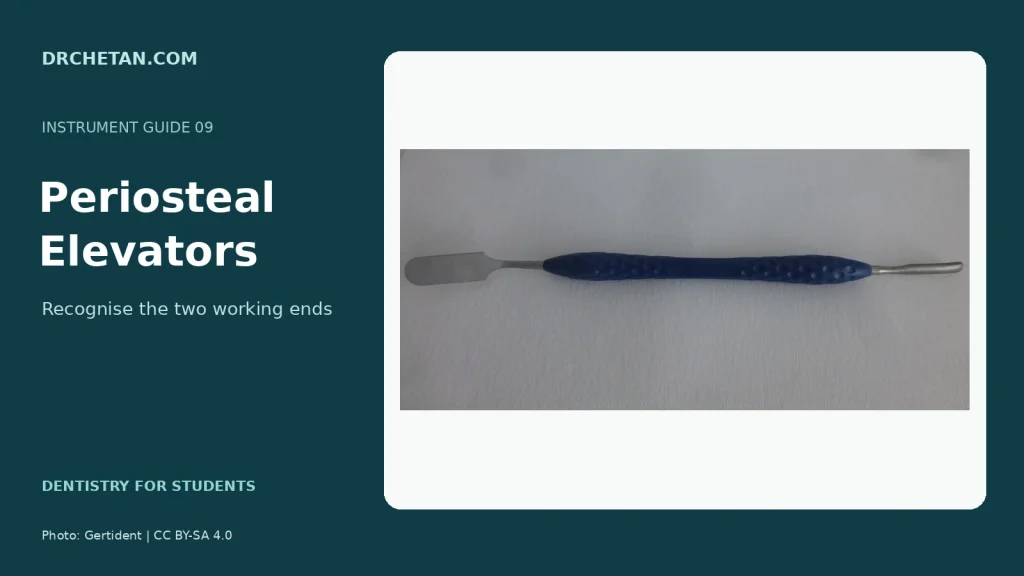
A periosteal elevator is used to reflect and retract mucoperiosteal tissue in appropriate surgical procedures. For students, the essential distinction is the tissue plane it works in: it is a flap instrument, not an extraction elevator.
A learning guide for dental students. Clinical instrument use requires practical training and supervision.
What does mucoperiosteal reflection mean?
A full-thickness mucoperiosteal flap includes the overlying soft tissue and periosteum. After the planned incision, the surgeon separates this flap from the underlying bone in the appropriate plane. The objective is controlled exposure while protecting the flap.
That anatomy explains the instrument’s name. “Elevator” describes a broad family of instruments, and does not mean every elevator is designed to loosen a tooth. Always state periosteal or root/extraction when the distinction matters.
Photographic reference
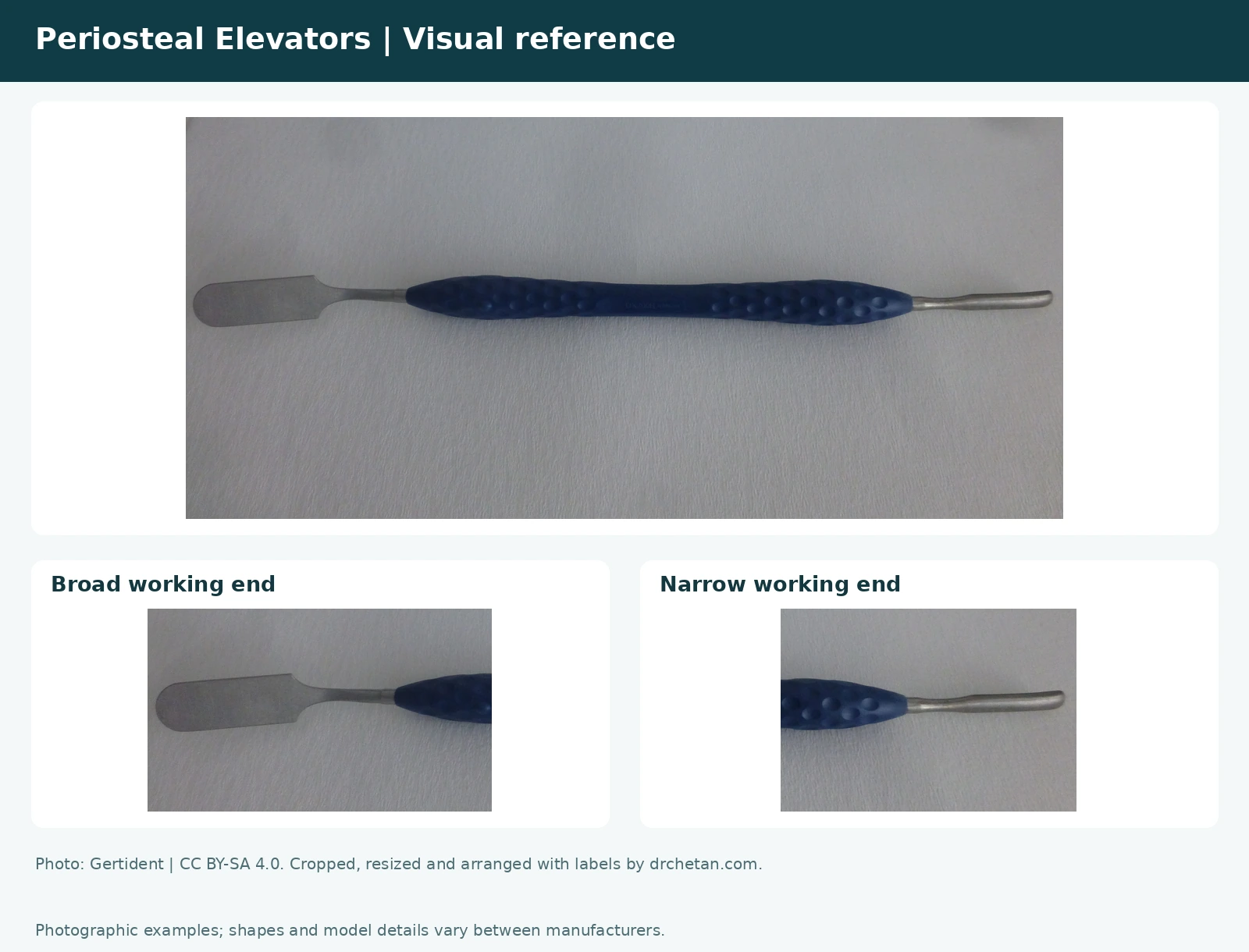
Parts and working-end features
Look for a central handle, connecting shanks and one or two working ends. Assess the end’s width, curvature and edge profile. A narrow end and a broad end offer different access and contact areas.
Do not assume a narrow or pointed-looking end is a scalpel. Edge profiles differ between products, and names such as sharp and blunt must be interpreted against the actual manufacturer’s design. Handle colour or overall length alone is insufficient for identification.
Molt, Howarth and Freer designs
| Pattern | Recognition focus | Learning point |
|---|---|---|
| Molt No. 9 | Double-ended pattern with a relatively narrow end and a broader, rounded end | The contrasting ends provide different access and contact areas during tissue reflection. |
| Howarth | A long double-ended periosteal pattern; inspect each end’s contour | Sharp/blunt versions are supplied by manufacturers; exact dimensions and contours vary. |
| Freer | A relatively slender double-ended pattern in common catalogues | Freer variants differ, so match the end profile to the specified model. |
Molt No. 9 is a useful starting point for a student tray. Rather than reciting a fixed blade width for every manufacturer, describe the narrow and broad ends you can see. Selective measurements are product specifications, not universal definitions.
How it differs from other “elevators”
A root elevator assists tooth or root luxation during extraction. A periotome has a thin blade intended to sever periodontal ligament fibres. A periosteal elevator addresses soft-tissue reflection at the bone surface. These are related surgical instruments with different principal jobs.
A frequent examination error is to identify a Molt as a straight extraction elevator because both have metal blades. Check whether the working end is shaped for reflecting a flap or for the specified extraction task, then confirm the pattern marking.
Understanding safe use without memorising force
The incision, flap design, access and tissue plane determine how the instrument is used. If exposure is inadequate or resistance is unexpected, that is a reason to reassess under supervision, not simply apply more force. Poor adaptation can tear the flap or damage adjacent tissues.
Inspect edges and tips for damage before use. Follow the product’s cleaning and sterilization instructions and the surgical instrument protocol. Any sharpening or repair must follow manufacturer guidance; changing a tip’s shape changes its behaviour.
Viva structure: name the instrument, describe its two ends, state mucoperiosteal reflection and retraction as the principal function, and distinguish it from a root elevator.
Frequently asked questions
What is a Molt No. 9 used for?
Reflection and retraction of mucoperiosteal tissue during appropriate surgical procedures.
Why does a Molt have two different ends?
The narrower and broader ends provide different access and contact areas. Their use depends on the operative site and training.
Is a periosteal elevator used to loosen a tooth?
That is not its principal role. Tooth or root luxation requires an appropriate extraction instrument.
Is a Howarth always identical between manufacturers?
No. Confirm the model, end contours and dimensions in the relevant catalogue.
Is a periotome the same as a periosteal elevator?
No. A periotome addresses the periodontal ligament; a periosteal elevator reflects mucoperiosteal tissue.
References and further reading
- HuFriedyGroup: Molt No. 9 periosteal
- HuFriedyGroup: Freer No. 15 periosteal
- HEBUmedical: Howarth sharp/blunt periosteal design
- HuFriedyGroup: periotome information
Explore more dental instrument guides and articles for dental students.
Featured-image photograph: Gertident — source photograph (CC BY-SA 4.0). Resized and arranged with title; adapted visual: CC BY-SA 4.0.

Leave a Reply