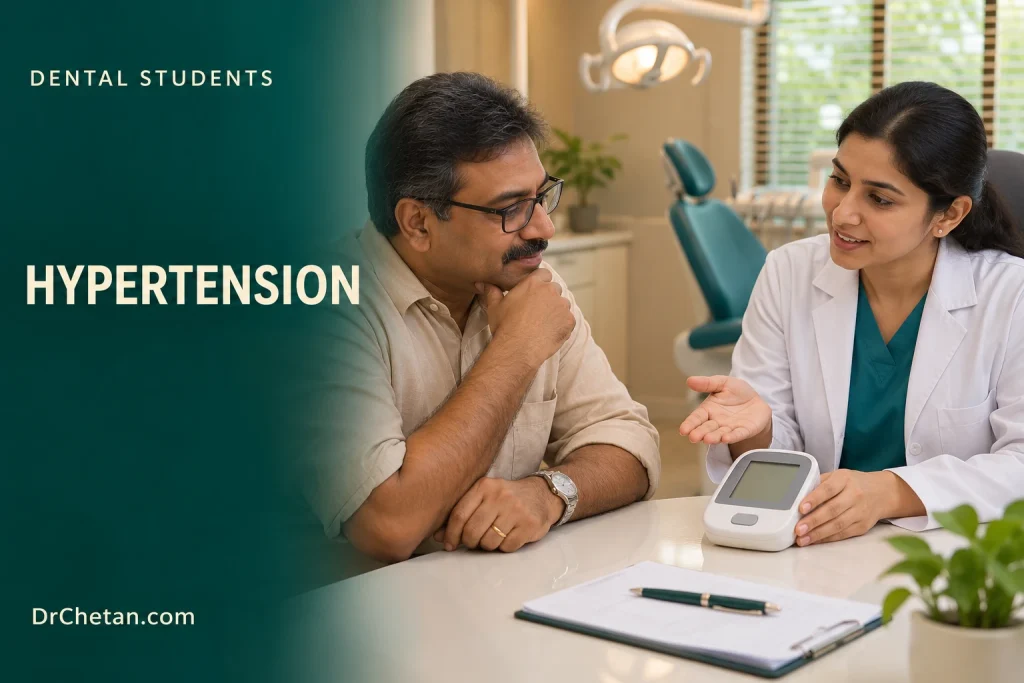
Medical Problems in Dentistry: Article 8 of 215 · Ischaemic heart disease and hypertension · Complete student guide
Medical Problems in Dentistry · Student guide
An elevated blood pressure in the dental chair requires interpretation, a documented response and appropriate follow-up. The number matters, but so do measurement technique, symptoms, usual readings and the urgency of the dental problem.
In this guide: Learning objectives · Why chronic hypertension matters · First check symptoms, then measurement · Three different thresholds · How to use the ADA dental framework · A practical chairside decision table · Medicines and oral findings · Local anaesthesia and anxiety · Two original cases · Write a useful medical handover · Viva and MCQ
Learning objectives
- Separate diagnosis of hypertension from a dental treatment decision.
- Repeat an unexpected reading using a reliable method.
- Recognise symptoms that require emergency assessment and communicate a focused referral.
Why chronic hypertension matters
Long-standing high arterial pressure is associated with cardiovascular, cerebrovascular and kidney harm. Many patients have no symptoms, so the absence of headache is not reassurance about long-term control. Pain, anxiety, recent exertion and medicines can also affect a particular reading.
The dental encounter can identify a need for medical review. It should not become a place to diagnose chronic disease from one hurried observation or rapidly lower an asymptomatic patient’s BP with an improvised medicine regimen.
First check symptoms, then measurement
Ask about chest discomfort, breathlessness, new neurological symptoms, visual change and acute severe illness. If symptoms suggest an emergency, begin assessment and arrange urgent help without waiting through a prolonged “rest and repeat” exercise.
For a stable person, use an appropriate validated upper-arm device, bare arm and suitable cuff. Support back and arm, keep feet flat and legs uncrossed, allow quiet rest and repeat readings at suitable intervals. Record the values and circumstances. Talking, an unsupported arm or an unsuitable cuff can undermine the result.[1]
Three different thresholds
A diagnostic threshold is used by a medical framework to identify hypertension, usually supported by repeated or out-of-office measurements. A treatment target is an individual goal set with the medical team. A dental decision threshold guides whether to proceed, modify, defer or obtain advice for a particular intervention. Do not use one in place of another.
Guidelines can differ in definitions and targets. Name the framework you are using, follow the institution’s current pathway and communicate the actual readings rather than only a category label.
How to use the ADA dental framework
The ADA presents a proposed adult outpatient dental approach: below 160/100 mmHg usually needs no BP-related modification; readings above that level should be repeated. Confirmed elevation leads to medical advice before elective care. For urgent dental problems in the 160–180 systolic and/or 100–109 diastolic range, it describes selected care with monitoring when pain contributes. Above 180 systolic and/or 109 diastolic, obtain medical advice before proceeding. Symptoms suggesting an emergency override the routine pathway.[2]
These figures are a named clinical framework, not a universally validated guarantee of safety, an Indian legal rule or a substitute for assessment. At a boundary, or when systolic and diastolic fall into different bands, use the more concerning finding and the responsible clinician’s protocol. Severe illness can require emergency care below any memorised cut-off.
A practical chairside decision table
| Situation | Immediate student action | What to document |
|---|---|---|
| New emergency symptoms | Stop elective care, alert the supervisor and activate emergency assessment | Symptoms, onset, observations, help requested and handover |
| Unexpected elevation, patient stable | Correct technique, allow rest and repeat | All readings, cuff, posture and relevant circumstances |
| Persistent elevation without acute symptoms | Discuss the dental urgency and obtain appropriate medical advice | Reason to proceed or defer and follow-up arrangement |
| Usual BP apparently controlled | Proceed with the planned assessment and individual precautions | Relevant history, medicines and baseline observations |
Medicines and oral findings
Reconcile every medicine, including combination tablets, non-prescribed analgesics and supplements. Dry mouth, gingival enlargement and postural dizziness may be relevant to treatment, depending on the medicine and patient. Do not stop an antihypertensive because of an oral finding; document it and coordinate a review.
Ask about dizziness before moving an older or symptomatic patient rapidly from a reclined position. Raise the chair gradually when appropriate and assist the patient. Review analgesic choices and interactions rather than automatically prescribing an NSAID to every patient with pain.
Local anaesthesia and anxiety
Adequate pain control and calm communication help avoid unnecessary sympathetic stress. Vasoconstrictor decisions depend on cardiovascular status, the medicine list and the planned dose. Use careful technique and an individual plan; neither “epinephrine is always forbidden” nor “any cartridge count is safe” is a useful rule.
Keep the procedure within the clinician’s competence and the facility’s support. If instability is suspected, changing the local anaesthetic alone does not resolve the assessment problem.
Two original cases
Case A: A patient arrives late, anxious and in pain, with a first reading of 172/102. He has no emergency symptoms. A supervised repeat after proper rest remains elevated. The record should explain the findings, urgency of the dental condition and medical advice sought. “Anxiety” is a possible contributor, not proof that the finding is harmless.
Case B: Another patient reports chest pressure and new weakness despite a lower reading. Symptoms determine the emergency response. Do not wait for the display to exceed a preferred crisis number.
Write a useful medical handover
Include symptoms and onset, each reading and time, usual readings if known, relevant medicines, the dental diagnosis, urgency and proposed intervention. Ask the question that affects care: evaluation of persistent elevation, clarification of new symptoms or advice on a specific procedural plan. Explain the follow-up to the patient and check that it has a clear owner.
Viva and MCQ
Can one dental reading diagnose chronic hypertension? Usually no; diagnosis requires the appropriate medical measurement pathway.
Does a reading below a dental threshold override chest pain? No. Symptoms can indicate an emergency independently.
MCQ: Which action is most useful after a stable patient’s unexpected high reading: A, record only “anxious”; B, correct technique, repeat and document a plan; C, prescribe rapid BP reduction independently? Answer: B.
Continue through the series
- Previous: Postoperative Monitoring in Medically Complex Dental Patients: Pain, Bleeding, Infection and Intake
- Next: Angina and Previous Myocardial Infarction: Dental Planning and Cardiology Questions
- Browse all 215 student guides by subject
More in Ischaemic heart disease and hypertension: Angina and Previous Myocardial Infarction: Dental Planning and Cardiology Questions · Coronary Stents and Antiplatelet Therapy: Dental Treatment Without Unsafe Drug Interruption · Chest Pain in the Dental Chair: Recognising Possible Acute Coronary Syndrome
Continue learning
- taking a structured medical history
- assessment and medical liaison for complex patients
- medical emergency readiness in a dental clinic
References and scope
Sources checked on 25 November 2026. This is an original student teaching guide. International clinical guidance is identified by its issuing organisation; it is not presented as an Indian statutory rule. Apply the treating team’s current protocol and supervision to individual patients.
Images are AI-generated educational illustrations of fictional people or equipment, not clinical records or diagnostic photographs.

Leave a Reply