You brush in the morning and before bed. Your mouth feels fresh, and there is no obvious food stuck anywhere. Do you still need to clean between your teeth?
Yes. Daily cleaning between teeth helps remove plaque and food from areas your toothbrush does not clean effectively. This is part of a regular oral-care routine, rather than something to do only when a piece of food becomes annoying.
The next question is which tool to use. Floss, interdental brushes and water flossers have different practical advantages. Choosing something that fits your teeth—and learning how to use it gently—is more useful than buying a product simply because it looks advanced.
Why brushing alone leaves work to do
Two neighbouring teeth have surfaces facing each other. Access to these surfaces can be limited, particularly where the teeth touch closely.
Plaque contains bacteria and can collect between teeth and along the gumline. If it hardens into calculus, or tartar, professional removal is needed. Interdental cleaners help control soft plaque.
You are therefore trying to clean the sides of the teeth, not just pull food out of the gap.
Floss or an interdental brush: which should you choose?
There is no single tool that suits every space in every mouth.
| Your situation | A useful option to discuss with your dental team |
|---|---|
| Teeth touch tightly, with little space underneath | Dental floss or dental tape |
| There is enough room for a small brush between teeth | An appropriately sized interdental brush |
| Some spaces are tight and others are larger | A combination of floss and interdental brushes |
| Holding or guiding string floss is difficult | A floss holder or another suitable cleaning aid |
| Braces or a fixed bridge make access awkward | A tailored combination of aids, which may include a threader or water flosser |
Floss is useful for tight spaces, while interdental brushes come in different sizes for spaces that can accommodate them. Your dentist or hygienist can help you choose.
Do not force a brush into a space just because you have been told interdental cleaning is important. The tool must fit the space.
How to use dental floss
Begin somewhere you can see and reach comfortably. A mirror helps while you are learning.
1. Prepare a manageable length
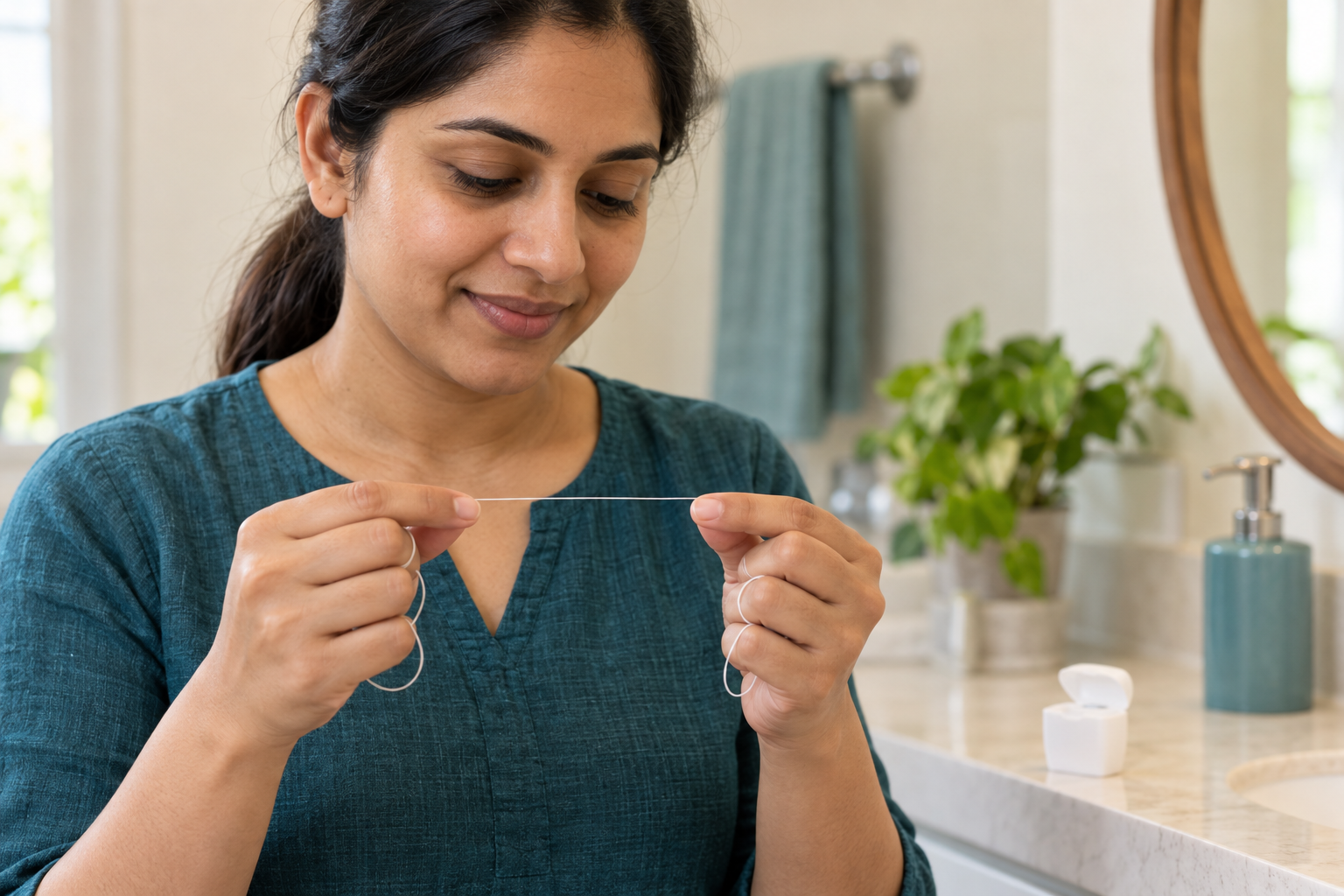
Take approximately 30–45 cm of floss or dental tape. Wind it around your fingers so you can hold a short working section firmly between your thumbs and forefingers. You need enough control to guide it, rather than a long, loose strand.
2. Ease it between two teeth
Use a gentle rubbing movement to pass the contact point. Avoid snapping the floss suddenly into the gum underneath. If you find yourself repeatedly pulling hard, stop and ask your dental team to check your technique.
3. Curve it against one tooth
When you reach the gumline, curve the floss into a C-shape around the side of one tooth. Keep it in contact with that tooth and gently slide it up and down. Allow it to pass just under the gum edge without pushing it forcefully into the tissue.
4. Clean the neighbouring tooth too
Within the same gap, curve the floss around the tooth on the other side and repeat. Each gap has two tooth surfaces to clean. Move to a clean section of floss as you work around your mouth.
5. Follow the same route each day
Continue through both jaws and remember the back surface of the last tooth on each side. A familiar route makes it easier to notice whether you have missed somewhere.
The movement should feel controlled. If you are repeatedly hurting yourself or cannot get comfortable access, ask for a demonstration rather than trying to solve it by applying more force.
How to use an interdental brush
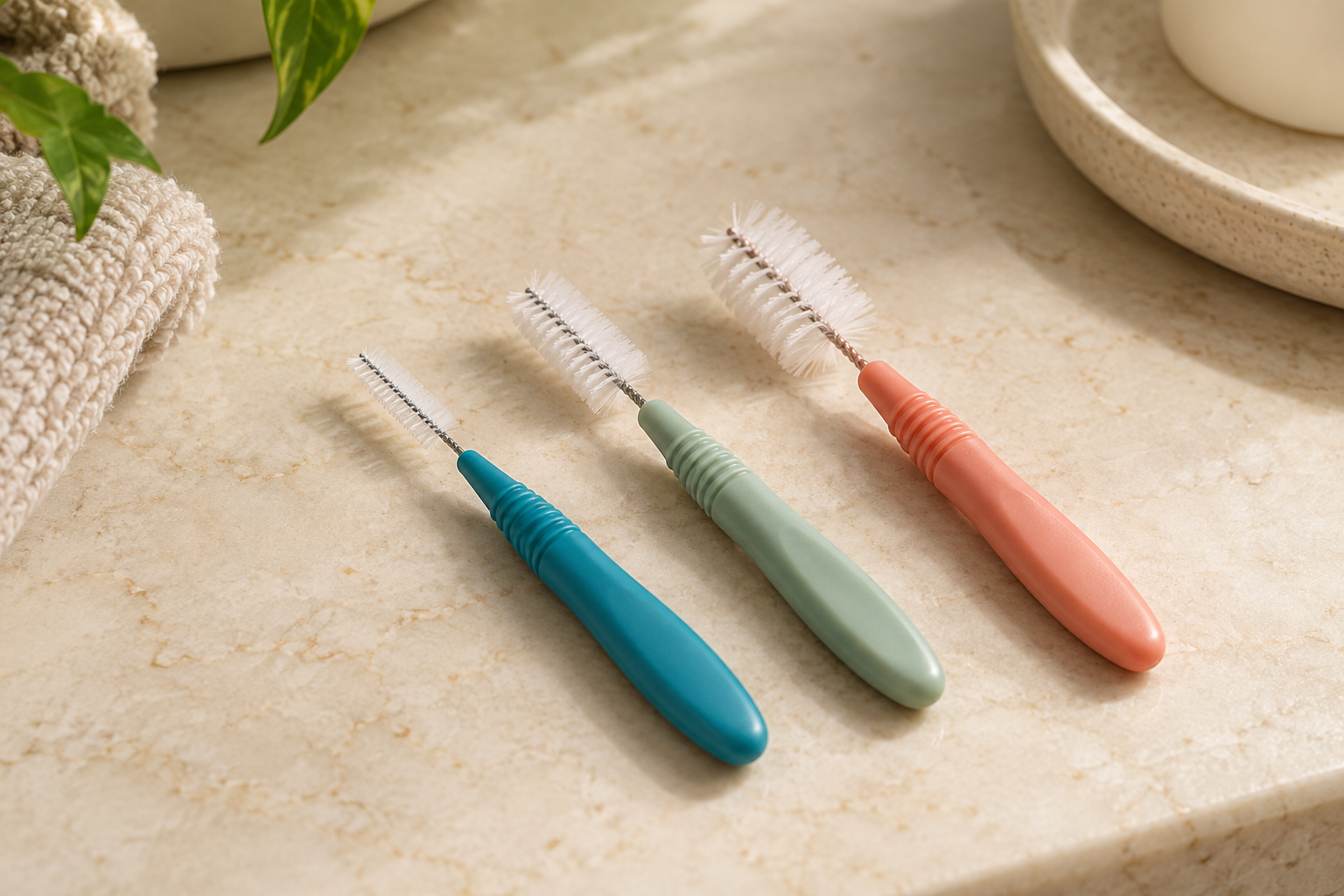
An interdental brush has a small bristled head designed to pass through a suitable space between teeth.
Start with the correct size
Ask your dentist or hygienist to show you which sizes fit your mouth. You may need more than one size, and some spaces may still need floss. The bristles should make contact with the surfaces being cleaned without needing to force the brush through.
Instead of trying to remember a whole demonstration afterwards, ask your dental team to write down which brush goes where. For example, a simple note identifying the front and back spaces can make the routine easier to repeat at home.
Guide the brush through gently
Hold the handle securely and guide the brush into the space close to the gumline. Once it fits comfortably, move it back and forth gently to clean the space. Work around your mouth systematically.
If it feels too tight, do not push harder. A smaller brush or a different aid may be needed. If you cannot find a comfortable fit, let your dentist or hygienist check it.
Look after the cleaning aid
Follow the manufacturer’s instructions for cleaning and replacement. A reusable brush and a strand of string floss are different products; do not assume the same after-use instructions apply to both. Discard used string floss rather than keeping it for the next day.
Do I clean between my teeth before or after brushing?
A practical routine is to clean between your teeth first, then brush with fluoride toothpaste. NHS guidance recommends flossing before brushing.
The ADA also explains that either order can be acceptable when cleaning is thorough. Daily consistency matters more than abandoning the habit because you cannot follow your preferred sequence.
Pick a time when you can pay attention. If bedtime always feels rushed, a different time of day may make daily cleaning easier to maintain.
What if my gums bleed?
Bleeding can be a sign of inflamed gums, and using the wrong size or technique can also make cleaning uncomfortable. It should not become a reason to stop all oral hygiene—or a reason to scrub more aggressively. [5, 9]
Keep cleaning gently and arrange a dental assessment if your gums bleed, particularly if it recurs or is accompanied by swelling, soreness or persistent bad breath. A dentist can assess the gums and check your technique. [9]
If a particular area hurts each time you clean it, ask for advice. Cleaning between your teeth should not be a daily exercise in tolerating pain.
Can a water flosser help?
A water flosser directs a stream of water around and between teeth. It can be an option if string floss is difficult to manage, including for some people with braces or fixed bridges. Certain devices have evidence supporting plaque removal and improvement in gingivitis.
It is not a replacement for toothbrushing. If you already use interdental brushes, ask your dental team whether a water flosser should supplement or change that routine. Follow the device instructions rather than assuming the highest pressure setting is best.
Getting started with a water flosser
- Read the instructions for your particular model, including suitable water, attachments and cleaning.
- Ask your dental team to demonstrate where the tip should be guided, especially around a bridge, implant or fixed brace.
- Use the recommended starting setting. Increase only as the instructions and your comfort allow; more pressure is not a goal in itself.
- Work systematically so that convenience does not become a reason to miss the back teeth or difficult areas.
- Clean and dry the device as directed. Do not share a personal nozzle.
These are general preparation points, not a substitute for the device instructions. A water flosser can make interdental cleaning easier for some people with limited dexterity or dental work, but it is not automatically the best option for every space.
Does a water flosser replace string floss?
It can be a suitable interdental option for some people. The decision depends on what needs cleaning, the device and whether you can use it well. Ask your dentist whether to use it instead of, or alongside, floss or interdental brushes. Keep the twice-daily toothbrushing routine whichever option you choose.
For example, someone with close contacts at the front and an accessible gap farther back might use floss in one place and a correctly sized brush in another. A person who struggles to guide floss around a fixed bridge might benefit from a demonstration of a water flosser or threader. The useful question is which method reaches the surfaces reliably in your mouth.
Common mistakes to avoid
Only cleaning when food is trapped. Make it a daily habit even when the spaces look clear.
Snapping floss into the gums. Guide it gently through the contact, then clean against each tooth surface.
Using one brush size everywhere without checking the fit. Different spaces may need different sizes or a combination of aids.
Using improvised sharp objects. Pins, fingernails and similar objects are not substitutes for cleaning aids designed for the mouth.
Buying something you cannot comfortably use. Bring it to an appointment and ask someone to show you. A useful demonstration should leave you able to repeat the movement yourself.
Questions patients often ask
Can I use floss and interdental brushes in the same mouth?
Yes. A mixed routine may suit a mouth with different-sized spaces. Use each aid where it fits appropriately.
Is waxed floss better than unwaxed floss?
Both can be used to clean between teeth. Choose a type you can handle comfortably; technique and regular use matter more than flavour or the presence of wax.
Will this cure bad breath?
Cleaning between teeth is part of caring for your mouth and may help with breath-related concerns, but it is not a guaranteed cure for every cause of bad breath. Persistent bad breath deserves a dental assessment.
What if food keeps getting stuck in the same place?
Tell your dentist which space is troubling you. Keep the area gently clean, but do not treat repeated difficulty as a reason to push harder or use a sharp object. An examination can help determine whether your cleaning method needs adjusting or something else needs attention.
Do children need help with flossing?
Children need help when they cannot clean effectively themselves. The ADA recommends beginning cleaning between teeth when two teeth touch, with an adult handling the task initially. Ask your child’s dentist for a suitable method.
At your next appointment, ask one specific question: “Could you show me which tool fits each space, and watch me try it?” That can turn a confusing shelf of products into a routine you understand.
References
- NHS: Take care of your teeth and gums.
- American Dental Association: Dental Floss/Interdental Cleaners.
- US Health Resources and Services Administration: Oral Health for Adults.
- Oral Health Foundation: How to Clean Between Your Teeth Effectively.
- Collingwood Health Group, NHS patient information: Why should I use interdental brushes?.
- NHS: How to keep your teeth clean.
- Dorset County Hospital: Keeping your Teeth and Gums Healthy.
- American Dental Association, MouthHealthy: Flossing.
- NHS: Gum disease.
- American Dental Association, MouthHealthy: Water Flossers and Water Flossing.
- NHS: Bad breath.

Leave a Reply