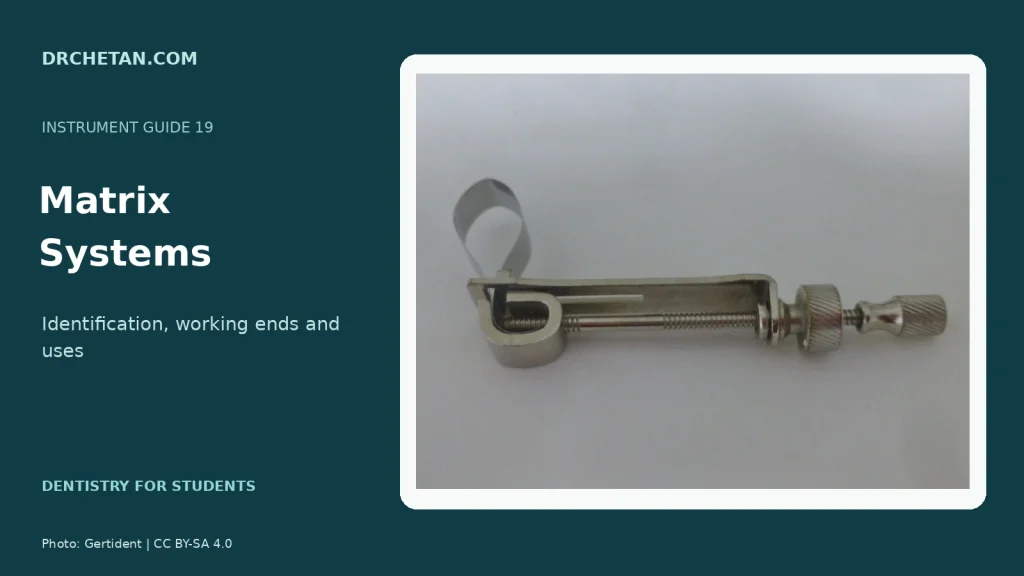
A matrix temporarily replaces a missing tooth wall while a restoration is formed. The band creates the boundary; other components hold, adapt or stabilise it. Understanding those separate roles makes matrix systems easier to identify.
A learning guide for dental students. Clinical instrument use requires practical training and supervision.
Photographic reference
The components and their jobs
| Component | What it looks like | Main role |
|---|---|---|
| Matrix band or strip | Thin metal or transparent sheet, flat or pre-contoured | Provides a temporary boundary for restorative material |
| Retainer | A mechanical holder or integrated tightening assembly | Holds and adjusts a compatible band |
| Wedge | Small tapered wood or plastic component | Supports cervical adaptation and may provide some separation |
| Sectional separating ring | Spring ring with tines positioned near the proximal area | Provides separation and supports band stability in its system |
| Placement instrument | Forceps or another device designed for the component | Places or removes that specified component |
A band is not the same thing as a retainer. A wedge is not a separating ring. Some systems combine functions, but the individual purpose remains useful to understand.
Circumferential systems and the Tofflemire retainer
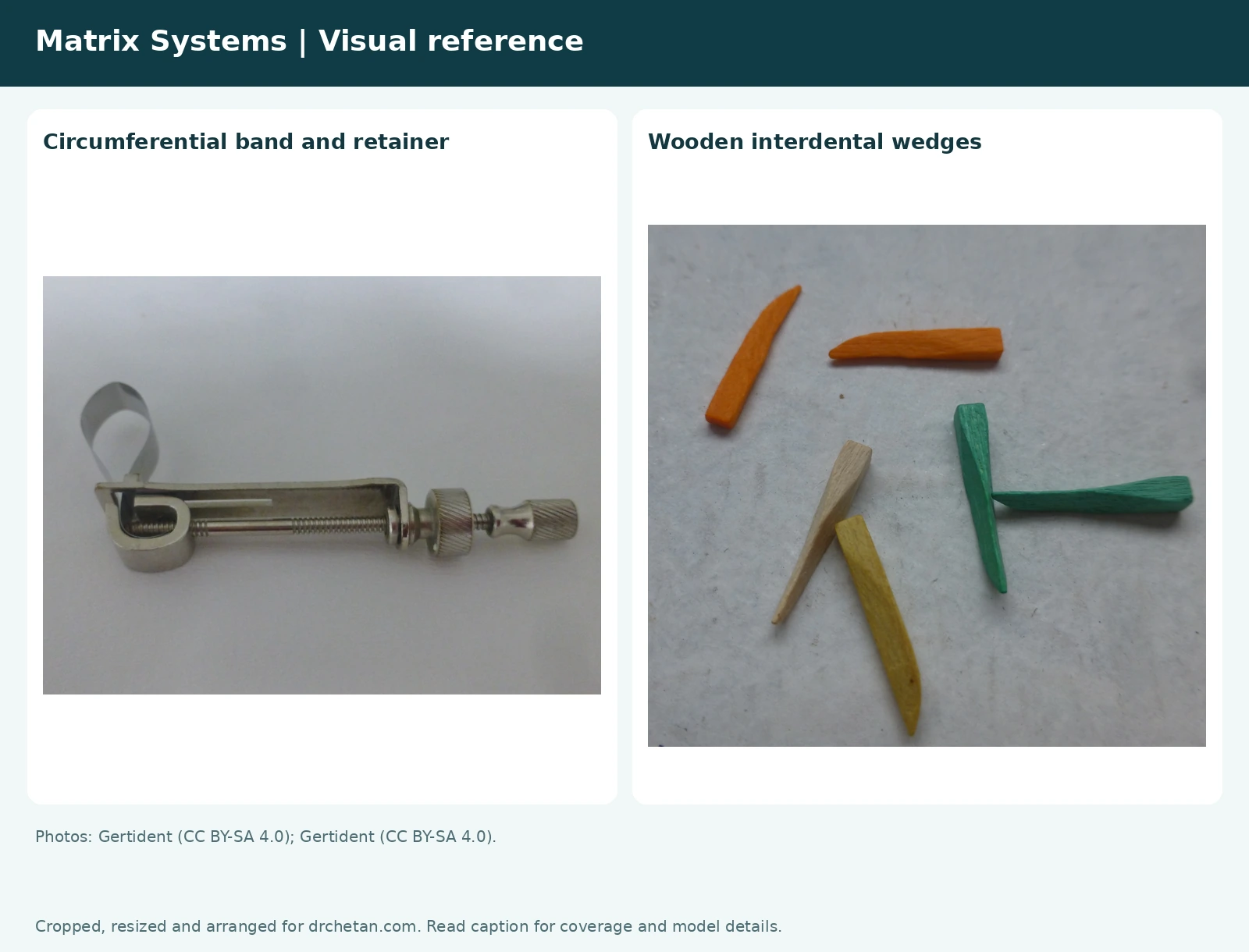
A circumferential band surrounds the tooth. A Tofflemire retainer is a familiar reusable mechanical holder with a slotted head, a mechanism that secures the band ends, a threaded assembly and adjusting knobs. The band forms the loop; the retainer controls and holds it.
Identify the actual locking and loop-adjusting mechanisms on the model in your department. Names such as inner or outer knob can be confusing when diagrams are viewed from opposite ends. Explain which mechanism secures the band ends and which adjusts the loop, rather than memorising a picture without understanding it.
Junior, senior and universal variants exist in manufacturer ranges. The word “universal” does not mean that every band size, tooth or clinical situation can be managed equally well with one configuration.
Other conventional retainers, such as Siqveland or Ivory patterns, have different mechanisms. Retainerless circumferential systems use an integrated tightening arrangement instead of a separate conventional Tofflemire-style holder. Do not confuse “retainerless” with a loose, unsupported band.
Sectional matrix systems
A sectional band covers the relevant proximal part of the tooth rather than forming a complete loop. Many systems combine a pre-contoured band, wedge and separating ring. The contour helps reproduce proximal form, while separation helps accommodate band thickness when the band is removed.
This arrangement is commonly used for direct Class II composite restorations. Its components must suit the preparation and the manufacturer’s system. Ring height, tine shape and band height vary; a ring that is suitable for one site may not be stable at another.
A separating ring is not a rubber dam clamp. Both may look spring-like and both have placement instruments, but their design and purpose differ. Use the specified ring-placement forceps rather than assuming that any forceps can safely engage it.
Circumferential versus sectional: avoid absolute rules
| Feature | Circumferential system | Sectional system |
|---|---|---|
| Band coverage | Encircles the tooth | Covers a selected proximal area |
| Holding mechanism | Separate retainer or integrated tightening arrangement | Often a ring-supported system with a wedge |
| Common learning context | Conventional posterior matrix techniques and selected complex situations | Direct Class II composite techniques |
| Main selection questions | Can the band be stabilised and contoured appropriately? | Will the band, wedge and ring fit and remain stable? |
Neither system guarantees a correct contact. Selection depends on the remaining walls, access, isolation and restorative technique. A sectional system should not be called universally superior for every extensive defect merely because it is useful for many routine Class II composites.
Wedges: adaptation, not just separation
A wedge helps press the band against the cervical region and reduce an unwanted gap. It can also stabilise the band and contribute to separation. Shape, size and flexibility affect adaptation; choose by fit rather than by a memorised colour alone.
Colours are not a universal size code between manufacturers. A larger wedge is not automatically better: it can distort a band or injure tissue if unsuitable. Some systems include protective wedges or shields for specific tasks; these do not all replace a matrix band.
A ring cannot compensate for an open cervical gap, and a wedge alone does not guarantee the intended contact. Assess the complete assembly under the supervised technique before placing material.
Transparent strips and curing
Transparent strips are often used to help form suitable anterior composite contours. Preformed transparent matrices are also available for particular tasks. The term “Mylar strip” is often used in teaching, but the material and design should be confirmed from the product.
Transparency does not prove that a restoration has been adequately cured. Access of the curing light, material thickness, shade and the prescribed exposure remain important. Metal and transparent matrices may require different clinical handling; follow the material and system instructions.
Viva checklist and care
Example: “This is a Tofflemire matrix retainer holding a circumferential metal band. The band replaces the missing wall, the retainer holds and adjusts it, and a suitable wedge helps cervical adaptation.”
Check a reusable retainer for a functioning thread and secure band-holding mechanism. Inspect separating rings and their tines according to the manufacturer’s instructions. Bands, wedges, rings and forceps can have different reuse and reprocessing requirements. Do not transfer the reusable status of a metal retainer to a component labelled single use.
Frequently asked questions
What is the difference between a matrix band and retainer?
The band forms the temporary wall. The retainer holds and adjusts a compatible band.
Does every matrix need a Tofflemire retainer?
No. Sectional and retainerless systems use other holding arrangements.
What does a sectional ring do?
It provides separation and supports band stability within the specified system. It does not replace the band or wedge.
Are wedge colours standard across brands?
No. Use the size and fit information supplied for the actual system.
Does a clear matrix guarantee adequate curing?
No. Follow the composite and curing-light instructions; visibility through a strip does not establish the degree of cure.
References and further reading
- PD: Tofflemire retainers and bands
- Garrison: sectional matrix components
- Garrison: separating ring designs
- FDA AccessGUDID: single-use dental wedge example
Featured-image photograph: Gertident — source photograph (CC BY-SA 4.0). Resized and arranged with title. Adapted visual: CC BY-SA 4.0.
Explore more dental instrument guides and articles for dental students.

Leave a Reply