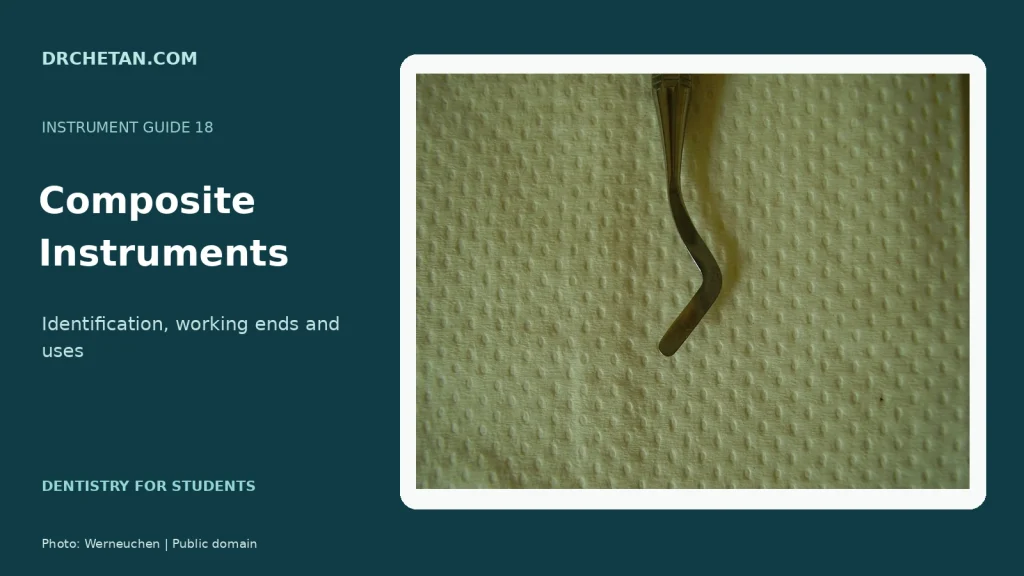
Composite placement instruments carry, adapt and shape uncured restorative material. Their working ends may look simple, but a broad spatula, a rounded plugger and a fine sculpting tip each contact the material differently.
A learning guide for dental students. Clinical instrument use requires practical training and supervision.
Photographic reference
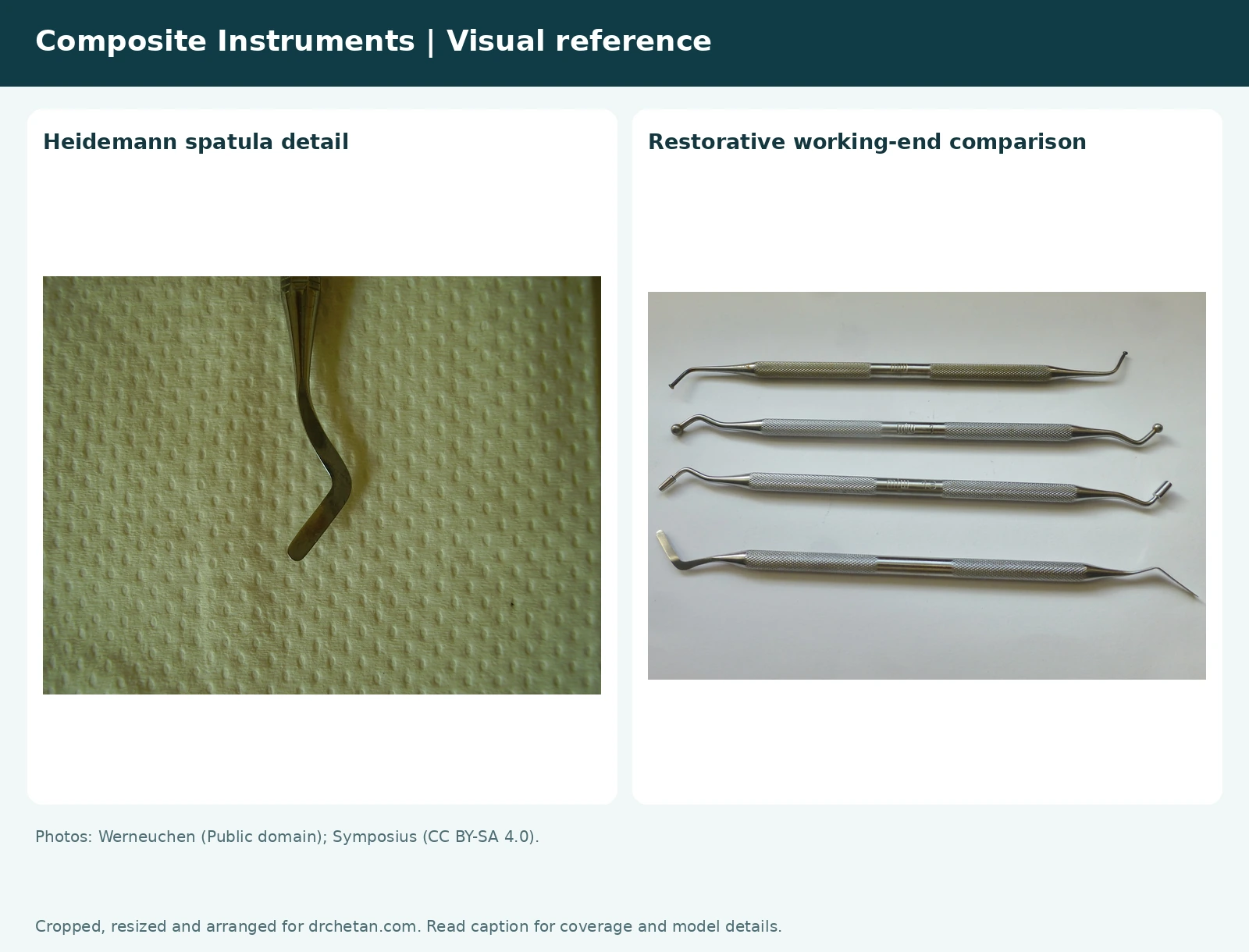
What does “flat plastic instrument” mean?
In traditional dental terminology, a flat plastic instrument is used to manipulate material in a plastic or mouldable state. The name does not mean that the instrument itself must be made of plastic. Many familiar flat plastic instruments are metal.
A typical example has a flattened blade or paddle, usually with an angled shank. Heidemann is one commonly encountered spatula pattern. Blade width, thickness, stiffness and angulation vary; the exact model should be confirmed from the marking and catalogue.
Common working ends and what they help you do
| Working end | Recognition feature | Broad role before curing |
|---|---|---|
| Flat plastic / spatula | Flattened blade or paddle | Transfers, spreads and contours suitable material |
| Rounded plugger | Rounded or flat-ended solid tip | Helps adapt material to accessible preparation surfaces |
| Ball / ovoid contouring tip | Smooth convex end | Blends or contours selected surfaces |
| Fine sculpting tip | Narrow pointed or conical working end | Develops finer occlusal details |
| Thin interproximal blade | Slender, sometimes flexible blade | Accesses selected proximal contours or excess |
| Specialised brush or silicone tip | Non-metallic working end designed for a specified system | Blends or models material within its stated indication |
These categories overlap. A double-ended instrument can combine placement and sculpting functions. Its name, surface finish and intended material matter as well as the silhouette.
Spatulas: broad surfaces versus fine access
A broader spatula contacts more material at once and can help form a relatively broad contour. A finer, thinner blade may reach a narrower space or refine a detail. Flexibility changes how the end behaves under pressure, but a flexible blade is not automatically better for every task.
For a manufacturer example, LM describes its Modella as a fine, wide spatula for modelling larger surfaces, while its Fissura has fine tips intended for sculpting detail. These names describe specific products; they should not be assigned to an unrelated generic photograph.
Do not bend a fine instrument to create a new angle unless its instructions expressly permit this. Altering the working end can damage it or change its control and surface condition.
Composite adaptation is not amalgam condensation
Some placement tips resemble amalgam pluggers, but the material and technique differ. Applying greater packing force does not by itself improve a composite restoration, create a proximal contact or eliminate polymerisation shrinkage. Good adaptation depends on the preparation, material consistency, access and the restorative technique.
The matrix system establishes and supports the missing contour. A placement instrument helps adapt the material within that boundary. Treating the instrument as a substitute for a well-adapted matrix can leave an unsatisfactory contact or contour.
The permitted increment thickness and curing exposure come from the composite and curing-light instructions. Do not apply one fixed increment size or exposure time to every material simply because the same placement instrument is used.
Polished and coated surfaces
Manufacturers offer polished stainless steel and coated instruments intended to reduce sticking and improve handling. For example, HuFriedyGroup supplies highly polished placement instruments, and LM offers diamond-like carbon coated composite instruments. These are product-specific features rather than a universal property of all gold or dark tips.
A non-stick description does not mean that material can never adhere. Residual composite, scratches and inappropriate cleaning can affect the surface. Do not scrape coated tips against other instruments or use an abrasive cleaner unless approved.
If a modelling liquid or wetting resin is used, it must be compatible with the composite and follow the product instructions. Do not improvise by dipping the instrument into alcohol or an arbitrary bonding agent to make material less sticky. A cleaning instruction for a used instrument is not permission to introduce that liquid into a restoration.
Do not confuse these instruments
- Enamel hatchet or chisel: a hand-cutting instrument for tooth tissue, rather than a routine composite placement paddle.
- Periodontal probe: calibrated for assessment, not automatically a substitute for a fine composite sculptor.
- Excavator: has a spoon-like cutting rim for selected carious dentine removal.
- Amalgam carrier: has a delivery barrel; it is not a universal composite dispenser.
- Dispenser and capsule: delivery components must be compatible with the restorative material and the specified device.
Practical-exam answer and care
Example: “This is a double-ended composite placement instrument with a flattened spatula end. It is used to transfer and contour suitable uncured restorative material. Its thin blade differs from the rounded face of a plugger.”
Inspect the surface and working-end integrity. Remove residual material and clean and sterilise reusable instruments according to their instructions. Check the reuse status of tips, brushes and delivery components separately; a reusable handle does not establish that every attachment can be reused.
Frequently asked questions
Is a flat plastic instrument made of plastic?
Not necessarily. The term commonly refers to manipulating material while it is mouldable; many such instruments are metal.
Do I need a different instrument for every composite?
No universal instrument count applies. Select compatible working ends for the material, access and task.
Does a non-stick coating guarantee no composite will adhere?
No. Surface condition, material properties and handling still matter.
Can alcohol be used to stop composite sticking during placement?
Do not introduce alcohol into the restoration as an improvised modelling liquid. Follow the composite and instrument instructions.
Does stronger pressure eliminate composite shrinkage?
No. Instrument pressure does not remove polymerisation shrinkage or replace the prescribed restorative and curing technique.
References and further reading
- HuFriedyGroup: composite placement instrument
- HuFriedyGroup: composite instrument kit
- LM-Dental: Modella spatula
- LM-Dental: Fissura sculpting instrument
- LM-Dental: composite instrument coatings
Featured-image photograph: Werneuchen — source photograph (Public domain). Resized and arranged with title. Adapted visual: CC BY-SA 4.0.
Explore more dental instrument guides and articles for dental students.

Leave a Reply