
Medical Problems in Dentistry: Article 24 of 215 · Diabetes and pancreatic disorders · Complete student guide
Medical Problems in Dentistry · Student guide
The practical risks of a dental appointment often arise from a mismatch: usual glucose-lowering treatment continues while food intake, stress or recovery changes. Planning must cover the hours before and after treatment as well as the time in the chair.
In this guide: Learning objectives · Start with this clinical case · Define the procedure before discussing medicines · Coordinate food and medication around the patient · Newer medicines and fasting require specific advice · Infection and healing: identify the actual problem · Prepare the visit and resolve the case · Viva and self-check
Learning objectives
- Identify when the appointment may disrupt eating or usual treatment.
- Separate routine local-anaesthetic care from fasting or sedation pathways.
- Plan infection care and follow-up without blanket antibiotic rules.
Start with this clinical case
Fictional teaching case. A woman using insulin needs treatment for a painful tooth. She has been told by a friend to fast for any dental injection and to skip all diabetes medicines. The proposed visit is an examination and possible treatment under local anaesthesia. Explain what needs clarification before giving her appointment instructions.
Define the procedure before discussing medicines
Record diagnosis, urgency, anticipated duration, tissue trauma, anaesthesia and expected postoperative intake. A routine local-anaesthetic appointment does not automatically require fasting. Sedation or general anaesthesia can introduce a different preparation and recovery plan. Give only instructions that match the actual procedure and responsible care team.
Reconcile the diabetes type, exact medicines, monitoring method, usual meals, recent hypoglycaemia and relevant complications. Ask what the patient normally does when ill or unable to eat. “Diabetic tablets” is insufficient for deciding how reduced intake might affect the visit.
Coordinate food and medication around the patient
The ADA advises dental planning that considers usual eating and medicine schedules and the risk of hypoglycaemia. Avoid a generic instruction to fast or omit all treatment. The diabetes team should direct necessary medication changes when food intake or the procedure makes the usual regimen unsuitable.[ADADM]
Agree what happens if the appointment is delayed, a meal is missed or the procedure becomes more extensive than expected. A convenient early appointment may help some patients, but clock time cannot replace an individual plan. Ask the patient to explain the instructions back in their own words.
| Finding or question | Clinical implication | Student action |
|---|---|---|
| Before the visit | Usual meals, medicines and monitoring | Confirm the agreed instructions and contact for uncertainty |
| During treatment | Duration, symptoms and unexpected delay | Build in reassessment and access to the hypoglycaemia protocol |
| After treatment | Chewing, pain and hydration | Plan feasible intake and drug-specific advice |
| When circumstances change | Vomiting, spreading infection or inability to eat | Seek prompt medical or emergency assessment as appropriate |
Newer medicines and fasting require specific advice
The American Diabetes Association’s 2026 hospital standards distinguish SGLT2-inhibitor perioperative precautions and individualised planning for GLP-1-based medicines. Anaesthesia, fasting, gastrointestinal symptoms and procedure urgency matter. These hospital recommendations should not be converted into a blanket instruction for every short dental visit under local anaesthesia.[DM2026]
If surgery, fasting, deep sedation or general anaesthesia is planned, obtain a written medicine and monitoring plan from the appropriate medical or anaesthetic team. Do not independently disconnect an insulin pump or advise complete insulin withdrawal. Document who manages the device and medicines during preparation, treatment and recovery.
Infection and healing: identify the actual problem
Assess dental infection, spreading swelling, systemic illness, oral intake and airway concerns. Definitive source control and medical optimisation may need to proceed together. Repeated antibiotics without a dental diagnosis do not solve a diseased tooth. A diabetes label alone does not establish a prophylactic antibiotic indication; prescribing should follow the actual diagnosis and patient-specific risks.
Explain wound care, a practical eating plan and the expected review. Arrange earlier reassessment when pain, swelling or intake worsens. Do not promise that a particular glucose result guarantees normal healing, and do not assume every patient with diabetes will heal poorly.
Prepare the visit and resolve the case
For the case, confirm that the planned care is under local anaesthesia and correct the unsupported fasting instruction. Obtain the insulin and meal details and ask the diabetes team for advice if reduced intake or more extensive treatment is anticipated. Give a clear route to call if the patient is unwell or cannot follow the agreed preparation.
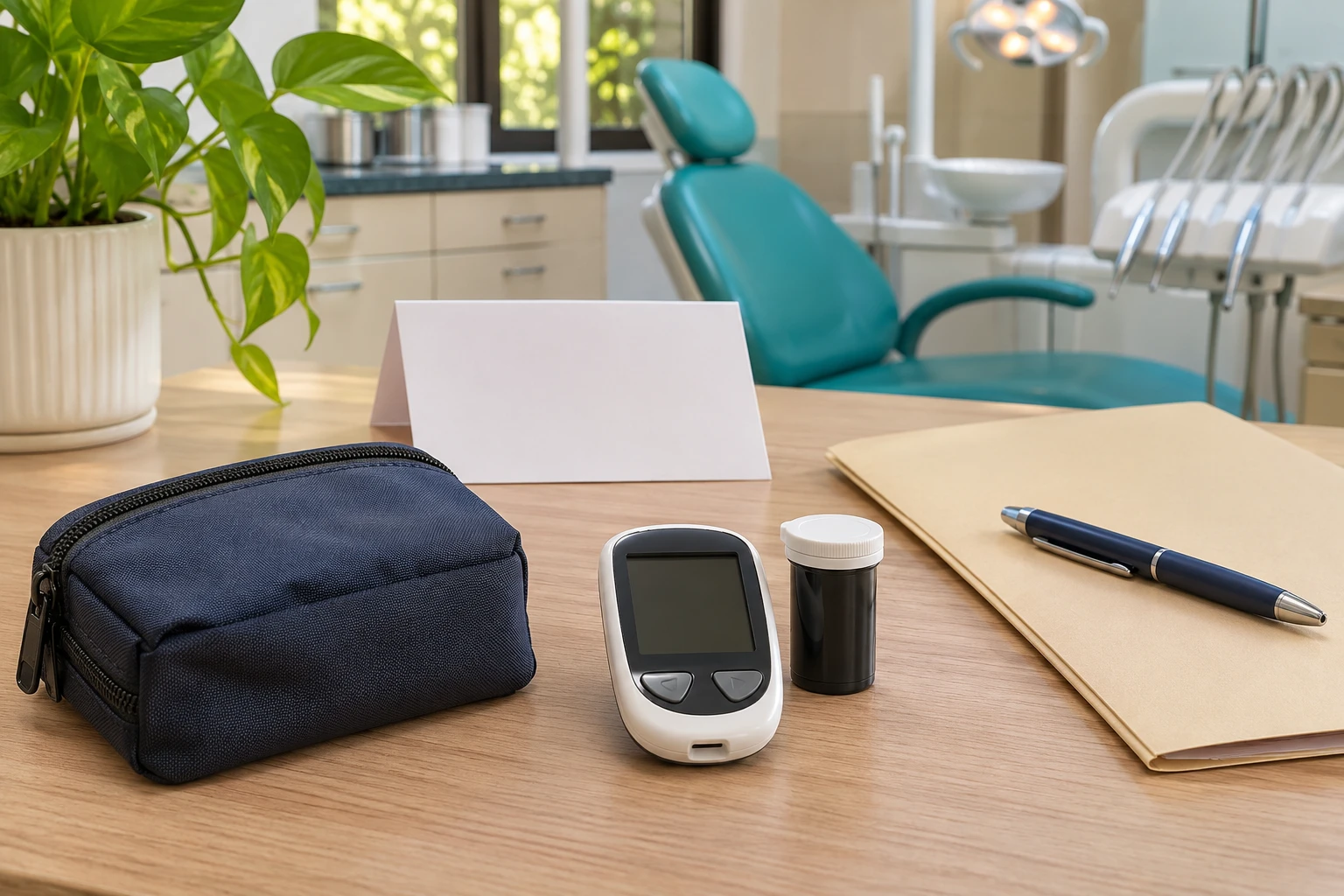
The illustration is an organisational prompt, not a prescription list. The actual visit kit depends on the patient’s treatment and monitoring needs. Confirm what the clinic supplies and what the patient should bring.
A useful handover names the dental procedure, expected eating disruption, current regimen and specific question. At follow-up, document symptoms, intake, wound findings and whether the medical plan needs updating. Continuity is more useful than a form saying only “diabetes clearance obtained”.
Viva and self-check
Must every patient fast before local anaesthesia? No. Preparation depends on the actual procedure and anaesthetic plan.
MCQ: All diabetes medicines should be omitted for every extraction. False. Obtain an individual drug- and procedure-specific plan when adjustment is needed.
What must postoperative advice cover besides wound cleaning? Feasible intake, medicines, monitoring, warning signs and access to follow-up.
Continue through the series
- Previous: Assessing Glycaemic Control Before Dental Treatment: HbA1c, Current Glucose and Clinical Context
- Next: Diabetes and Periodontitis: Mechanisms, Evidence and Shared Medical Care
- Browse all 215 student guides by subject
More in Diabetes and pancreatic disorders: Diabetes Mellitus for Dental Students: Types, Complications and Oral Findings · Assessing Glycaemic Control Before Dental Treatment: HbA1c, Current Glucose and Clinical Context · Diabetes and Periodontitis: Mechanisms, Evidence and Shared Medical Care
Continue learning
- Structured medical history and examination
- Medical liaison and referral for complex dental patients
- Explaining extraction assessment to a patient with diabetes
References and scope
Sources checked on 25 November 2026. This is an original student teaching guide. International clinical recommendations are identified by their issuing organisation. Emergency contact information is specific to India. Use current local protocols, appropriate supervision and an individual clinical assessment.
- American Dental Association: Diabetes, Oral Health Topics
- American Diabetes Association: Diabetes Care in the Hospital, Standards of Care in Diabetes 2026; official indexed recommendations
Images are AI-generated educational illustrations of fictional people or equipment, not clinical records or diagnostic photographs.

Leave a Reply